
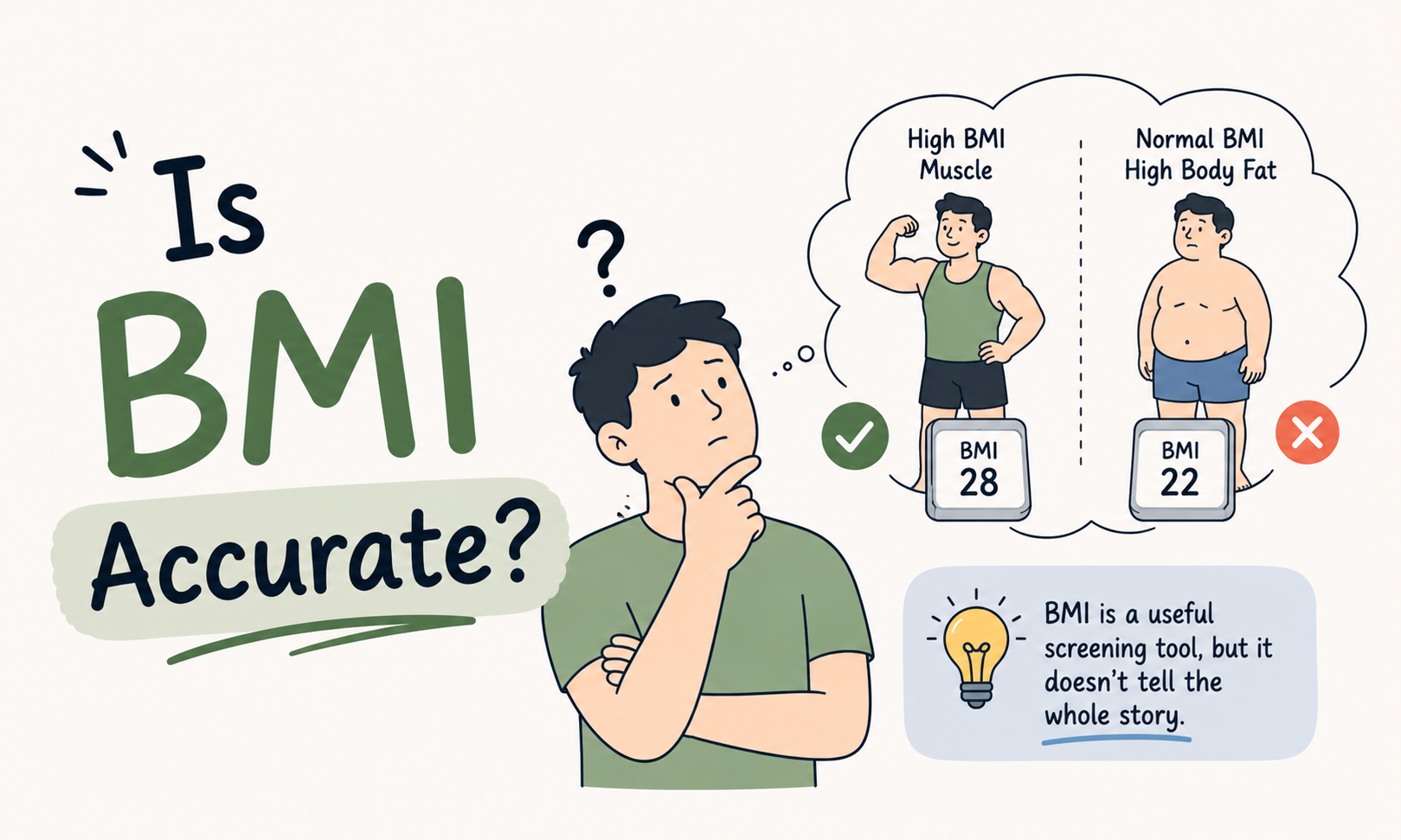
Body Mass Index (BMI) is one of the most widely used tools for estimating whether a person's weight is appropriate for their height. It is simple, inexpensive, and recommended by healthcare organizations worldwide as a screening tool for weight-related health risks.
However, many people wonder whether BMI is accurate for everyone. The answer is both yes and no. BMI works well for most adults at the population level, but it has limitations because it does not distinguish between muscle, fat, bone, or body composition.
In this guide, we'll explore how accurate BMI is for different groups of people and compare it with other methods of assessing health.
Is BMI Accurate for Everyone?
For most healthy adults, BMI provides a useful estimate of whether body weight falls within a healthy range.
Healthcare professionals use BMI because it is:
- Quick to calculate
- Easy to understand
- Supported by decades of research
- Effective for identifying potential health risks
However, BMI has limitations because it only considers:
- Height
- Weight
It does not measure:
- Body fat percentage
- Muscle mass
- Bone density
- Fat distribution
- Overall fitness
Because of these limitations, two people with the same BMI may have very different body compositions and health profiles.
BMI should therefore be viewed as an initial screening tool, not a complete assessment of health.
BMI Accuracy for Athletes
BMI is often less accurate for athletes and highly active individuals.
Athletes usually have:
- Greater muscle mass
- Lower body fat
- Higher bone density
Since muscle weighs more than fat, an athlete may have a BMI that falls into the overweight category despite having very little body fat.
For example:
- A professional rugby player
- A competitive swimmer
- A bodybuilder
may all have a BMI above 25 while maintaining excellent cardiovascular health and low body fat percentages.
For athletes, healthcare professionals may recommend additional measurements such as:
- Body fat percentage
- Waist circumference
- Skinfold thickness
- DEXA scan
- Bioelectrical impedance analysis (BIA)
These provide a more complete picture of body composition.
Check Your BMI in Seconds
BMI is an excellent starting point for understanding your health.
Calculate your result instantly using the free Howtigo BMI Calculator and learn which BMI category you fall into.
BMI Accuracy for Older Adults
BMI can also become less accurate as people age.
Older adults naturally lose muscle mass through a process known as age-related muscle loss.
As muscle decreases and body fat increases, BMI may remain unchanged even though body composition has changed significantly.
For this reason, an older adult with a "healthy" BMI may still have:
- Higher body fat
- Lower muscle strength
- Increased risk of falls
- Reduced mobility
Healthcare providers often consider additional factors such as:
- Muscle strength
- Waist circumference
- Physical activity
- Nutritional status
- Medical history
These assessments help provide a more complete evaluation of health in older adults.
BMI Accuracy for Women
BMI works reasonably well for women but has some important limitations.
Women naturally carry a higher percentage of body fat than men because of biological and hormonal differences.
Life stages such as:
- Pregnancy
- Breastfeeding
- Menopause
can also affect body composition without significantly changing BMI.
For example:
- Pregnant women should not use BMI as a measure of current health.
- Women going through menopause may experience increased abdominal fat even if their BMI remains stable.
Healthcare professionals may combine BMI with other measurements, including waist circumference and body fat percentage, to better assess overall health.
Despite these limitations, BMI remains a useful screening tool for most adult women when interpreted alongside other health information.
BMI Accuracy Compared to Other Measurements
BMI is only one method of assessing health.
Other measurements often provide additional insights into body composition and disease risk.
| Measurement | What It Measures | Advantages | Limitations |
|---|---|---|---|
| BMI | Weight relative to height | Quick, simple, inexpensive | Doesn't measure body fat |
| Waist Circumference | Abdominal fat | Indicates central obesity | Doesn't assess total body composition |
| Waist-to-Height Ratio | Fat distribution | Good predictor of health risk | Less widely used |
| Body Fat Percentage | Percentage of body fat | More accurate body composition | Requires specialized equipment |
| DEXA Scan | Fat, muscle, and bone mass | Highly accurate | Expensive and less accessible |
Rather than replacing BMI, healthcare professionals often use several measurements together.
Combining BMI with:
- Waist circumference
- Blood pressure
- Cholesterol levels
- Blood sugar
- Physical activity
- Family medical history
provides a much clearer picture of overall health.
Summary
BMI is an effective and scientifically supported screening tool for most adults, but it is not perfect. Because it only considers height and weight, BMI cannot distinguish between muscle and fat or account for differences in body composition, age, or life stage.
For athletes, older adults, pregnant women, and individuals with unusually high muscle mass, additional health measurements may provide a more accurate assessment. Even so, BMI remains one of the easiest and most reliable ways to identify potential weight-related health risks and serves as an excellent starting point for understanding your overall health.
The best approach is to use BMI alongside other health indicators and consult a healthcare professional if you have concerns about your weight or body composition.
Find Out Your BMI Today
Want to see where your BMI falls?
Use the free Howtigo BMI Calculator to calculate your BMI instantly and take the first step toward understanding your overall health.