
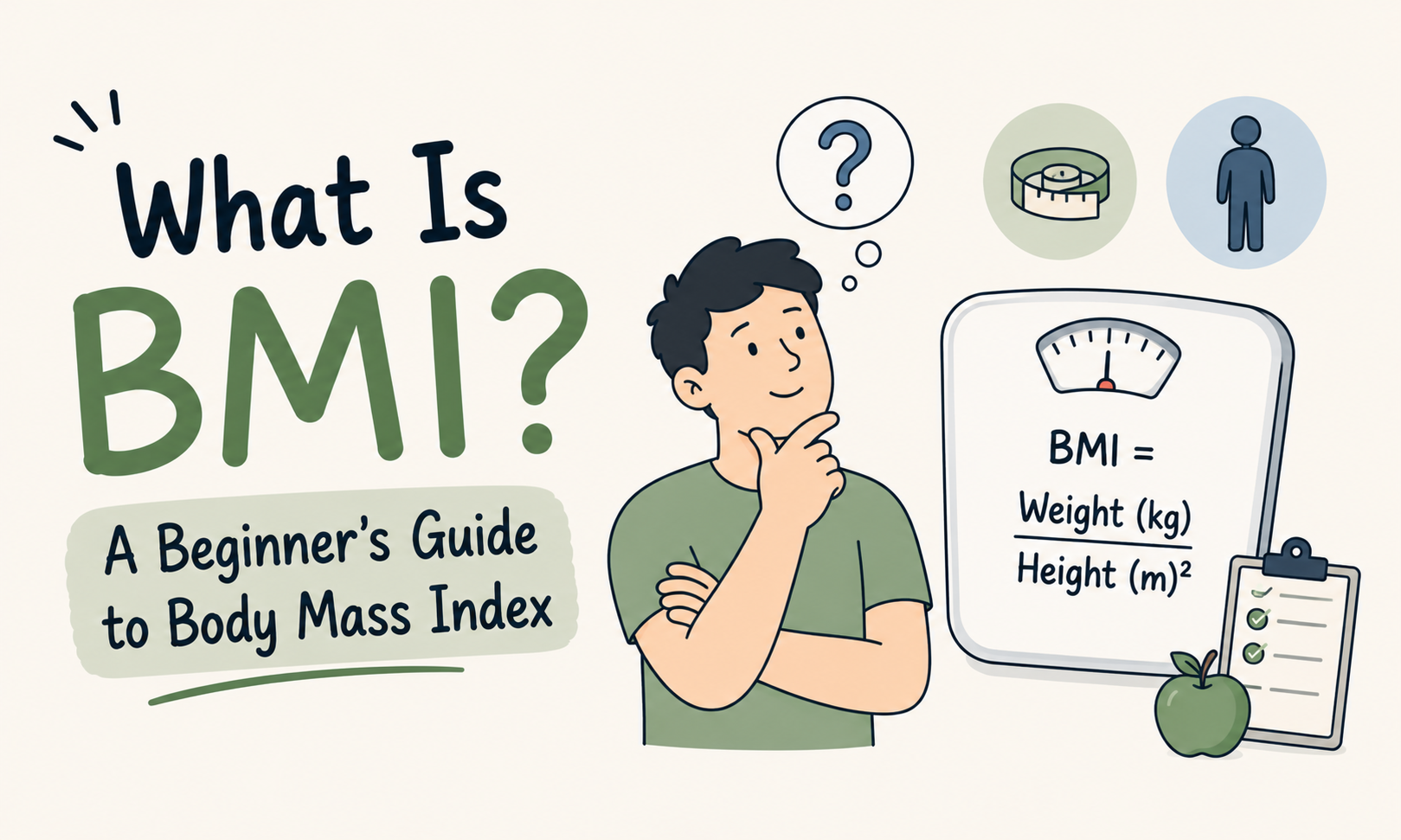
Body Mass Index (BMI) is one of the most widely used health measurements worldwide. Whether you're starting a weight-loss journey, trying to maintain a healthy lifestyle, or simply curious about your health, understanding BMI is an excellent first step.
BMI provides a quick estimate of whether your weight is appropriate for your height. Although it doesn't directly measure body fat, it is a valuable screening tool used by healthcare professionals to identify potential weight-related health risks.
In this guide, you'll learn what BMI is, where it came from, how it is calculated, why it remains popular around the world, and the misconceptions you should know before interpreting your results.
What Is BMI? A Beginner's Guide
BMI stands for Body Mass Index, a numerical value calculated from your weight and height. It helps estimate whether your body weight falls within a healthy range.
The BMI formula is simple:
BMI = Weight (kg) ÷ Height² (m²)
For example:
- Weight: 70 kg
- Height: 1.75 m
BMI = 70 ÷ (1.75 × 1.75)
BMI = 22.9
This result falls within the healthy weight category.
The standard BMI classifications for adults are:
| BMI | Weight Category |
|---|---|
| Below 18.5 | Underweight |
| 18.5 – 24.9 | Healthy Weight |
| 25.0 – 29.9 | Overweight |
| 30.0 and above | Obesity |
It's important to understand that BMI is a screening tool, not a medical diagnosis. Your doctor may consider additional factors such as age, muscle mass, body fat distribution, and medical history before assessing your overall health.
Who Invented BMI and Why?
BMI has been around for nearly 200 years.
It was developed in the early 1830s by Belgian mathematician and statistician Adolphe Quetelet. His goal wasn't to evaluate individual health but to study the physical characteristics of large populations.
The original name for BMI was the Quetelet Index.
Decades later, researchers found that the formula was useful for identifying obesity trends and estimating health risks across populations. As a result, it became known as Body Mass Index (BMI) and was adopted by healthcare organizations worldwide.
Today, BMI is widely used because it is:
- Simple to calculate
- Easy to understand
- Inexpensive
- Consistent across different populations
- Useful for public health research
Although BMI has limitations, it remains one of the most practical tools for initial health assessments.
Calculate Your BMI in Seconds
Curious about your BMI?
Instead of calculating it manually, use the free Howtigo BMI Calculator to instantly discover your BMI score, weight category, and what your results mean.
How BMI Is Measured
BMI only requires two measurements:
- Your body weight
- Your height
Using the metric system, the formula is:
BMI = Weight (kg) ÷ Height² (m²)
For countries using pounds and inches, the formula becomes:
BMI = (Weight (lb) × 703) ÷ Height² (in²)
Online BMI calculators automatically perform these calculations, making it easy to receive accurate results in seconds.
To improve accuracy:
- Measure your height without shoes.
- Use a reliable weighing scale.
- Wear light clothing.
- Measure under similar conditions each time if tracking progress.
Remember that BMI estimates weight relative to height. It does not directly measure body fat percentage or muscle mass.
Why BMI Is Used Around the World
BMI has become the global standard for weight assessment because of its simplicity and practicality.
Easy to Use
Only height and weight are needed, making BMI accessible to almost everyone.
Cost-Effective
Unlike body composition scans or laboratory tests, BMI requires no expensive equipment.
Useful for Healthcare Professionals
Doctors use BMI as an initial screening tool to determine whether additional health evaluations may be needed.
Valuable for Public Health
Governments and researchers use BMI to monitor obesity rates, evaluate health trends, and design public health initiatives.
Helps Identify Potential Health Risks
People with BMI values outside the recommended range may have an increased risk of developing:
- Type 2 diabetes
- High blood pressure
- Heart disease
- Stroke
- Sleep apnea
- Joint problems
- Certain cancers
Although BMI isn't perfect, it provides a useful starting point for assessing overall health.
Common Misconceptions About BMI
BMI is often misunderstood. Here are some of the most common myths.
Myth 1: BMI Measures Body Fat
BMI does not measure body fat directly.
Instead, it estimates whether your weight is appropriate for your height.
Myth 2: BMI Is Accurate for Everyone
BMI may not accurately reflect health in:
- Athletes
- Bodybuilders
- Pregnant women
- Older adults
- Children and teenagers
These groups often require additional health assessments beyond BMI.
Myth 3: A Healthy BMI Means You're Completely Healthy
A healthy BMI is encouraging, but it doesn't guarantee perfect health.
Other important health indicators include:
- Blood pressure
- Cholesterol levels
- Blood sugar
- Physical activity
- Diet quality
- Sleep
- Mental well-being
Maintaining healthy lifestyle habits remains essential.
Myth 4: BMI Is Outdated
Although BMI has limitations, it continues to be recommended by healthcare organizations because it is supported by decades of research and remains an effective screening tool when combined with other health assessments.
Summary
Body Mass Index (BMI) is a simple calculation that estimates whether your weight is appropriate for your height. Developed nearly two centuries ago, it remains one of the most widely used health screening tools because it is easy to calculate, inexpensive, and backed by extensive research.
While BMI cannot measure body fat directly or account for every individual difference, it provides a valuable starting point for understanding your health. For the most accurate assessment, BMI should be considered alongside other health indicators such as waist circumference, physical activity, diet, and regular medical checkups.
Knowing your BMI is a small step that can help you make informed decisions about your long-term health and well-being.
Check Your BMI Today
Want to know where you stand?
Use the free Howtigo BMI Calculator to calculate your BMI instantly and better understand your current weight category.