
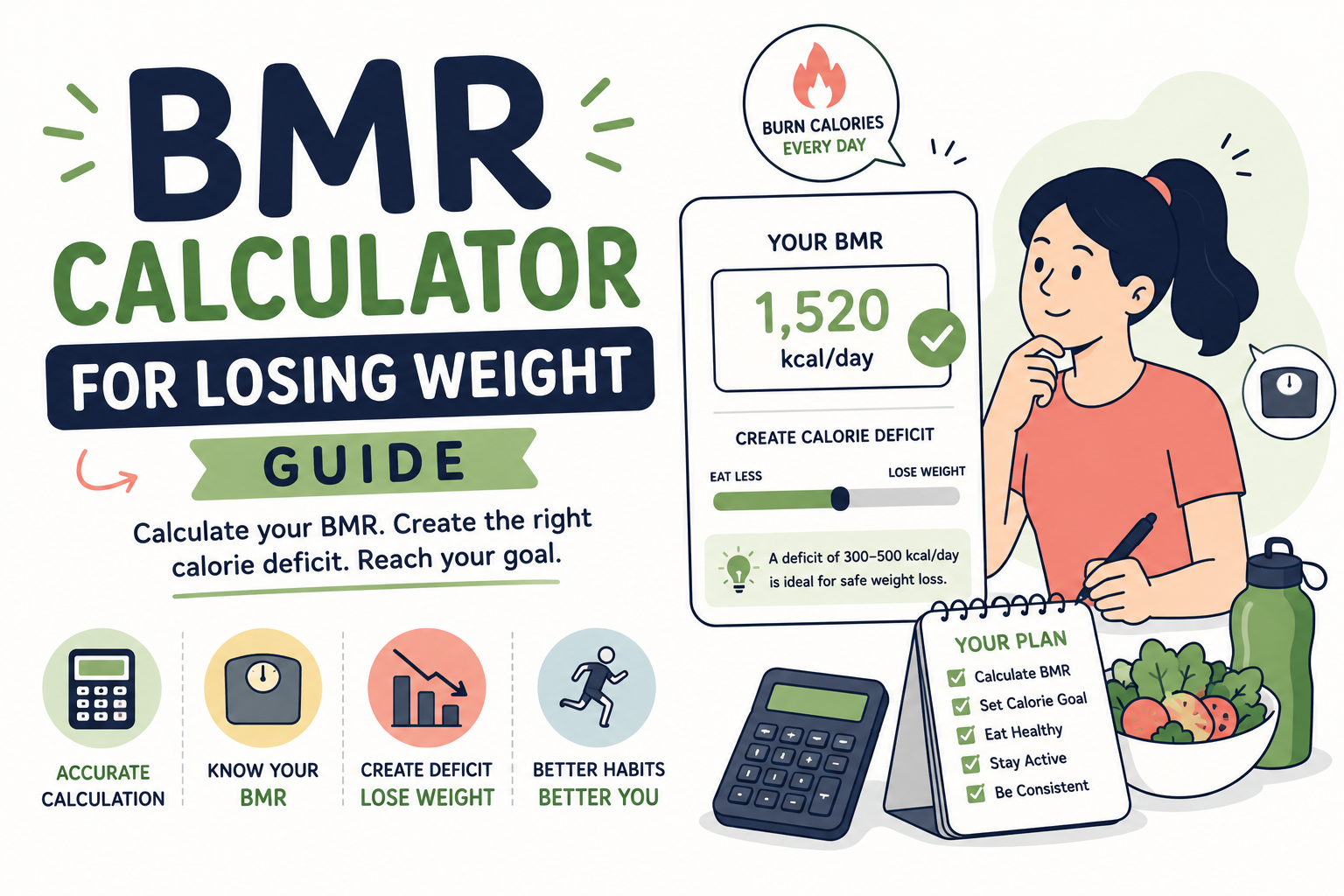
Bmr Calculator For Losing Weight Guide
A BMR calculator for losing weight helps estimate how many calories your body burns at complete rest. Knowing this number makes it easier to build a calorie deficit safely instead of relying on guesswork or restrictive diets.
Whether you want to calculate my BMR to lose weight, understand the accurate BMR formula, or estimate your AMR/BMR calorie needs, this guide explains everything you need to know.
Try the free tool: Howtigo BMR Calculator
What is BMR calculator for losing weight?
Basal Metabolic Rate (BMR) is the minimum amount of energy your body requires to maintain essential functions such as breathing, circulation, hormone production, and body temperature while resting.
A BMR calculator estimates this value using your age, sex, height, and weight. Modern calculators commonly use the Mifflin–St Jeor equation because it is considered one of the most reliable methods for healthy adults.
Many people confuse BMR with AMR or TDEE. BMR measures calories burned at rest, while activity level increases your daily calorie expenditure. This is why many people compare AMR BMR calorie estimates before deciding on a weight-loss calorie target.
Women often search for the average BMR for females in kcal, but there is no single average because BMR varies by age, height, weight, and muscle mass.
Benefits of BMR calculator for losing weight
Using a BMR calculator offers several advantages:
- Helps create a realistic calorie deficit.
- Makes it easier to calculate your daily calorie needs.
- Supports gradual fat loss while preserving muscle.
- Reduces the risk of eating too few calories.
- Tracks progress as your weight changes.
Using your BMR together with activity level gives a much better estimate of your daily calorie requirements than guessing.
Calculate your BMR now: Howtigo BMR Calculator
How to use BMR calculator for losing weight
- Enter your age.
- Select your sex.
- Input your height and weight.
- Calculate your BMR.
- Estimate your activity level to determine maintenance calories.
- Create a moderate calorie deficit of about 300–500 calories per day if appropriate.
If your goal is to calculate your BMR to lose weight, remember that BMR is only the starting point. Daily calorie needs depend on both metabolism and activity level.
Common mistakes
Common mistakes include:
- Confusing BMR with maintenance calories.
- Eating below BMR for long periods without professional guidance.
- Ignoring protein intake and strength training.
- Never recalculating BMR after significant weight changes.
- Assuming everyone has the same metabolism.
FAQs
Is a BMR calculator accurate?
It provides an estimate using validated equations. Individual metabolism can vary slightly.
Can I calculate my BMR to lose weight?
Yes. Your BMR helps determine an appropriate calorie target for sustainable weight loss.
What is the accurate BMR formula?
Most calculators use the Mifflin–St Jeor equation because research shows it performs well for healthy adults.
What is the average BMR for females in kcal?
There is no universal average. Many adult women have a BMR between roughly 1,200 and 1,600 kcal/day, but individual values differ.
Should I calculate BMI too?
Yes. Many people calculate both BMI and BMR because BMI estimates weight status while BMR estimates resting calorie needs.
Summary
A BMR calculator for losing weight is a practical tool for planning a healthy calorie deficit. By estimating your resting calorie needs and combining that information with your activity level, you can build a sustainable weight-loss strategy based on data rather than guesswork.
Start today with the Howtigo BMR Calculator and use your results alongside balanced nutrition, regular exercise, and consistent healthy habits.
References
Academy of Nutrition and Dietetics. (2024). Weight Management.
Centers for Disease Control and Prevention. (2024). Healthy Weight, Nutrition, and Physical Activity.
Mifflin, M. D., St Jeor, S. T., Hill, L. A., Scott, B. J., Daugherty, S. A., & Koh, Y. O. (1990). A new predictive equation for resting energy expenditure in healthy individuals. American Journal of Clinical Nutrition, 51(2), 241–247.
National Institute of Diabetes and Digestive and Kidney Diseases. (2024). Healthy Eating and Weight Management.