
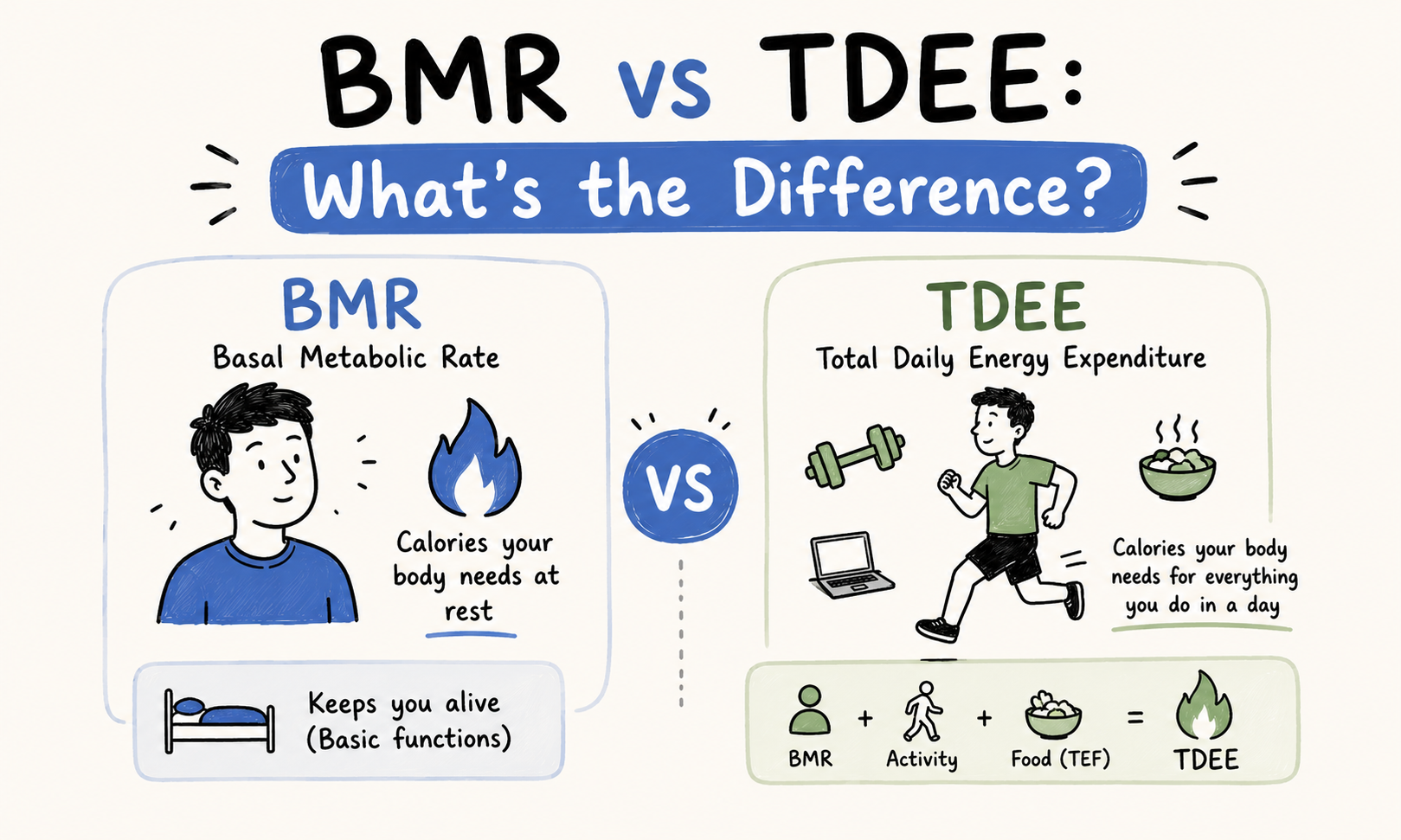
BMR vs TDEE: What's the Difference?
When planning a healthy diet or fitness routine, you will often come across two important terms: Basal Metabolic Rate (BMR) and Total Daily Energy Expenditure (TDEE). Although they are closely related, they measure different aspects of your body's energy needs. Understanding the difference helps you set realistic calorie goals for losing weight, maintaining your current weight, or building muscle.
BMR tells you how many calories your body needs just to stay alive, while TDEE estimates how many calories you burn in an entire day after including physical activity and digestion. Together, these measurements provide the foundation for effective nutrition planning.
What Is BMR?
Basal Metabolic Rate (BMR) is the minimum number of calories your body requires to perform essential life-sustaining functions while completely at rest. These functions include breathing, blood circulation, brain activity, hormone production, and maintaining body temperature.
For most adults, BMR accounts for approximately 60–75% of total daily calorie expenditure. Your BMR depends on several factors, including age, sex, height, weight, muscle mass, and genetics.
BMR does not include calories burned from walking, exercising, working, or digesting food.
What Is TDEE?
Total Daily Energy Expenditure (TDEE) is the total number of calories your body burns during an average day. It begins with your BMR and adds energy used for daily movement, structured exercise, and the thermic effect of food.
Common activity multipliers include:
| Activity Level | Multiplier |
|---|---|
| Sedentary | 1.20 |
| Lightly Active | 1.375 |
| Moderately Active | 1.55 |
| Very Active | 1.725 |
| Extra Active | 1.90 |
Because TDEE reflects your lifestyle, it is generally the number used to determine calorie intake for weight management.
Use the Howtigo BMR Calculator to estimate your BMR before calculating your TDEE.
Key Differences
Although BMR and TDEE are related, they serve different purposes.
- BMR measures calories needed while completely at rest.
- TDEE measures calories burned throughout an entire day.
- BMR remains relatively stable unless body composition changes significantly.
- TDEE changes according to activity level and exercise habits.
- BMR is the starting point used to estimate TDEE.
For example, if your BMR is 1,600 calories and you are moderately active, your TDEE may be approximately 2,480 calories after applying the appropriate activity multiplier.
Knowing both numbers allows you to create an appropriate calorie surplus for muscle gain or a moderate calorie deficit for sustainable weight loss.
When to Use Each Measurement
Use BMR when you want to understand your body's minimum calorie requirements at rest or compare metabolic changes over time.
Use TDEE when planning:
- Daily calorie intake
- Weight-loss programs
- Muscle-building diets
- Weight-maintenance plans
- Fitness and nutrition goals
For most people, TDEE is the practical number used when deciding how much to eat each day, while BMR provides the scientific foundation behind that estimate.
Calculate your resting calorie needs today using the Howtigo BMR Calculator before estimating your daily energy expenditure.
Frequently Asked Questions About BMR vs TDEE
Which is more important, BMR or TDEE?
Both are important. BMR explains your resting calorie needs, while TDEE estimates your total daily calorie requirements.
Should I eat based on my BMR or TDEE?
Most nutrition plans use TDEE because it includes daily activity. BMR alone is usually too low for determining everyday calorie intake.
Can my TDEE change?
Yes. Changes in exercise habits, occupation, body weight, and muscle mass can all affect TDEE.
Does losing weight reduce BMR?
Yes. As body weight decreases, BMR generally decreases because your body requires less energy to maintain itself.
Can online calculators estimate both?
Yes. Most BMR calculators estimate resting calories and can be combined with activity multipliers to calculate TDEE.
Summary
BMR and TDEE are closely connected but represent different measurements. BMR estimates the calories your body needs at complete rest, while TDEE estimates the calories you burn throughout an average day. Understanding both numbers helps you create realistic nutrition plans and make informed decisions about weight loss, muscle gain, and long-term health.
If you are unsure where to start, estimate your resting calorie needs first with the Howtigo BMR Calculator. Once you know your BMR, calculating your TDEE becomes much easier.
References
American College of Sports Medicine. (2022). ACSM's guidelines for exercise testing and prescription (11th ed.). Wolters Kluwer.
Mifflin, M. D., St Jeor, S. T., Hill, L. A., Scott, B. J., Daugherty, S. A., & Koh, Y. O. (1990). A new predictive equation for resting energy expenditure in healthy individuals. The American Journal of Clinical Nutrition, 51(2), 241–247. https://doi.org/10.1093/ajcn/51.2.241
National Institute of Diabetes and Digestive and Kidney Diseases. (2024). Body weight and health. https://www.niddk.nih.gov/
World Health Organization. (2024). Healthy diet. https://www.who.int/news-room/fact-sheets/detail/healthy-diet