
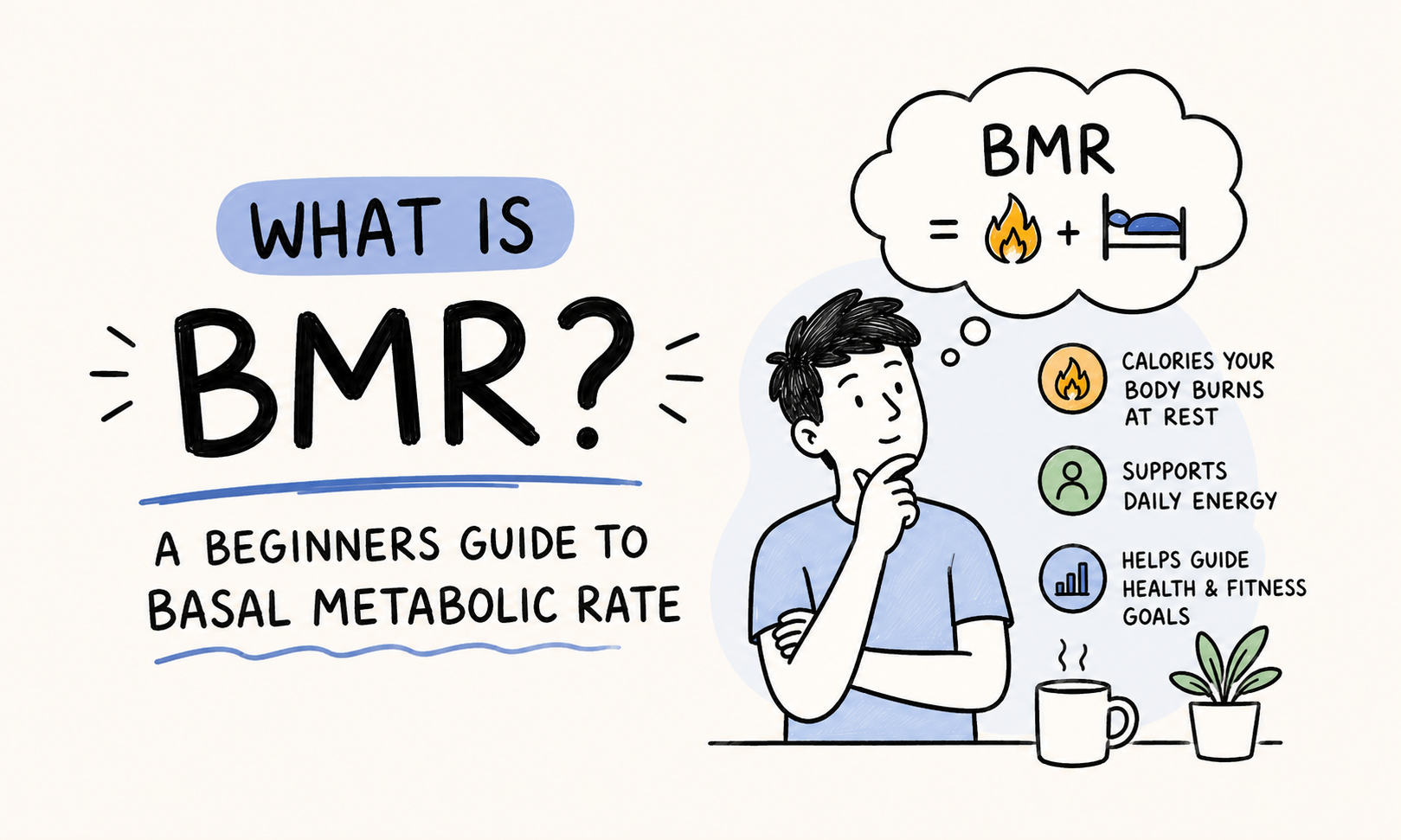
What Is BMR? A Beginner's Guide to Basal Metabolic Rate
Your body burns calories every second—even while you're sleeping. These calories keep your heart beating, lungs breathing, brain functioning, and cells repairing themselves. The number of calories your body needs to perform these basic life-sustaining functions is known as your Basal Metabolic Rate (BMR).
Understanding your BMR is one of the easiest ways to build a healthier lifestyle. Whether your goal is to lose weight, gain muscle, or simply maintain your current weight, knowing your BMR provides a starting point for estimating your daily calorie needs.
What Is Basal Metabolic Rate (BMR)?
Basal Metabolic Rate (BMR) is the minimum amount of energy, measured in calories, that your body requires to stay alive while completely at rest. Imagine lying quietly in a comfortable room after a full night's sleep without eating or exercising. Even then, your body is constantly using energy.
Your BMR supports essential functions such as:
- Breathing
- Blood circulation
- Brain activity
- Body temperature regulation
- Hormone production
- Cell growth and repair
For most adults, BMR accounts for approximately 60–75% of total daily calorie expenditure, making it the largest component of energy use.
It is important to remember that BMR is not the same as the calories you burn throughout the day. Activities like walking, exercising, working, and even digesting food require additional energy beyond your BMR.
Why BMR Matters for Your Health
Knowing your BMR helps you make informed decisions about nutrition and fitness instead of relying on guesswork.
Some practical benefits include:
- Weight loss: Eating fewer calories than your body burns can help create a calorie deficit.
- Weight maintenance: Matching calorie intake with daily energy expenditure helps maintain a stable weight.
- Muscle building: Adequate calorie intake supports muscle growth and recovery.
- Healthy aging: Understanding changing metabolic needs can prevent unwanted weight gain.
- Better meal planning: BMR provides the foundation for estimating Total Daily Energy Expenditure (TDEE).
Remember that BMR is only one piece of the puzzle. Sleep, stress, physical activity, diet quality, and medical conditions also influence overall health.
Try estimating your calorie needs using the Howtigo BMR Calculator together with a BMR calculator to better understand your health profile.
Factors That Affect Your BMR
Several biological and lifestyle factors influence how many calories your body burns at rest.
Age
BMR generally decreases with age because muscle mass naturally declines over time.
Sex
Men often have higher BMR values than women due to greater lean muscle mass on average.
Body Size
Larger individuals require more energy to support bigger organs and tissues.
Muscle Mass
Muscle tissue burns more calories than fat tissue, even while resting. Strength training can therefore slightly increase BMR over time.
Genetics
Some people naturally have faster or slower metabolisms because of inherited traits.
Hormones
Hormonal conditions such as hyperthyroidism or hypothyroidism can significantly affect metabolic rate.
Environment
Extreme temperatures, illness, recovery from surgery, and pregnancy can temporarily increase calorie requirements.
Although you cannot control every factor, maintaining muscle mass through regular exercise and eating a balanced diet can help support a healthy metabolism.
How BMR Is Calculated
Scientists have developed equations to estimate BMR using factors such as age, sex, height, and weight.
The two most common formulas are:
Mifflin-St Jeor Equation
This is considered one of the most accurate formulas for healthy adults.
Men
BMR = (10 × weight in kg) + (6.25 × height in cm) − (5 × age) + 5
Women
BMR = (10 × weight in kg) + (6.25 × height in cm) − (5 × age) − 161
Harris-Benedict Equation
An older but still widely recognized formula that estimates resting calorie needs.
After calculating BMR, an activity multiplier is applied to estimate Total Daily Energy Expenditure (TDEE).
Common activity multipliers include:
| Activity Level | Multiplier |
|---|---|
| Sedentary | 1.2 |
| Lightly Active | 1.375 |
| Moderately Active | 1.55 |
| Very Active | 1.725 |
| Extra Active | 1.9 |
Online calculators simplify this process and reduce calculation errors.
Calculate your estimated BMR today using the Howtigo BMR Calculator and compare it with your overall health indicators.
Frequently Asked Questions About BMR
Is BMR the same as metabolism?
No. BMR measures calories burned at complete rest. Metabolism includes every process that uses energy throughout the day.
Can I increase my BMR?
You cannot dramatically change your BMR, but building muscle, staying physically active, getting enough sleep, and eating sufficient protein may help support a healthy metabolism.
Does drinking water increase BMR?
Water is essential for metabolism. Drinking water may temporarily increase calorie burning slightly, but the effect is relatively small.
Is a higher BMR always better?
Not necessarily. A higher BMR simply means your body requires more calories at rest. Health depends on many factors beyond metabolic rate.
Should I rely only on BMR for weight loss?
No. BMR should be combined with your activity level, nutrition, medical history, and long-term healthy habits.
Summary
Basal Metabolic Rate is the number of calories your body needs to perform essential life functions while resting. Since BMR makes up the majority of daily calorie expenditure, understanding it can help you make smarter decisions about nutrition, exercise, and weight management.
Although age, genetics, and hormones influence BMR, maintaining muscle mass, staying active, and eating a balanced diet all contribute to a healthier metabolism. Instead of focusing solely on calorie restriction, use BMR as a guide for creating realistic and sustainable health goals.
Ready to estimate your calorie needs? Try the Howtigo BMR Calculator and use it alongside your BMR calculation for a better understanding of your overall health.
References
American College of Sports Medicine. (2022). ACSM's Guidelines for Exercise Testing and Prescription (11th ed.). Wolters Kluwer.
Mifflin, M. D., St Jeor, S. T., Hill, L. A., Scott, B. J., Daugherty, S. A., & Koh, Y. O. (1990). A new predictive equation for resting energy expenditure in healthy individuals. The American Journal of Clinical Nutrition, 51(2), 241–247. https://doi.org/10.1093/ajcn/51.2.241
National Institute of Diabetes and Digestive and Kidney Diseases. (2024). Body weight and health. https://www.niddk.nih.gov/
World Health Organization. (2024). Healthy diet. https://www.who.int/news-room/fact-sheets/detail/healthy-diet