
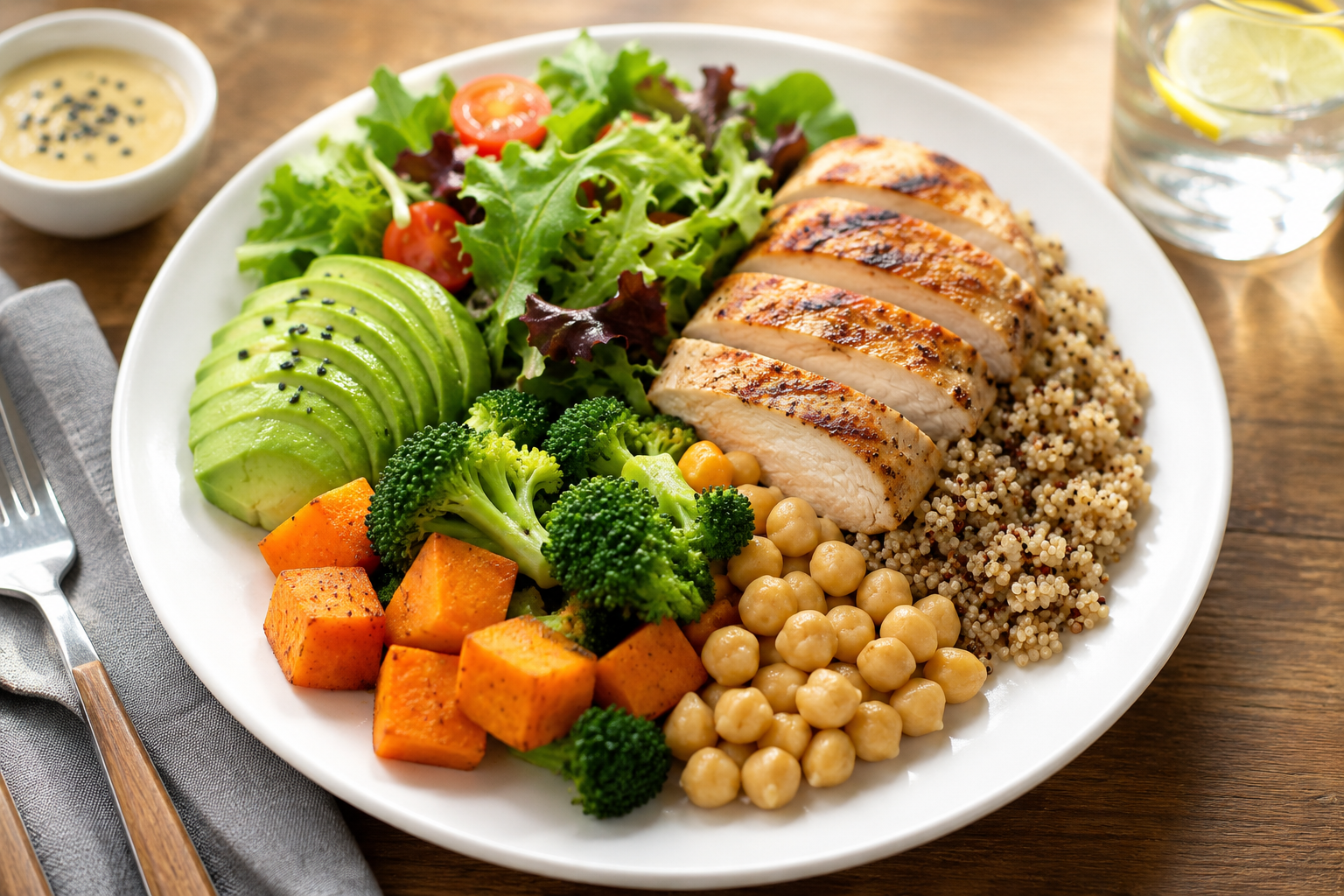
Calories and protein are two useful numbers to track when you are planning your diet. Calories describe the energy you obtain from food, while protein is a nutrient needed for many functions, including maintaining and building body tissues.
A calorie and protein calculator combines these ideas to estimate two daily targets: how much energy you may need and how much protein may be appropriate for your body and goal.
The calculation is only a starting point. Your actual needs can vary with body size, activity, age, goals, body composition, and other individual factors.
What Is a Calorie and Protein Calculator?
A calorie and protein calculator estimates daily calorie needs and a practical protein target using information such as:
- Age
- Sex
- Height
- Body weight
- Activity level
- Weight-management goal
Use the Calorie Calculator
The Calorie Calculator can estimate your daily calorie requirements.
The BMR Calculator can also help estimate the energy your body uses at rest before activity is considered.
Calories and Protein Explained
Calories measure energy. Your body obtains energy from carbohydrates, fat, protein, and alcohol.
How Daily Calorie Needs Are Estimated
A calorie calculator commonly estimates resting energy expenditure using a predictive equation and then accounts for activity.
One commonly used equation is the Mifflin-St Jeor equation.
For men:
BMR = (10 × weight in kg) + (6.25 × height in cm) − (5 × age) + 5
For women:
BMR = (10 × weight in kg) + (6.25 × height in cm) − (5 × age) − 161
An activity factor can then be used to estimate total daily energy expenditure.
For example, a 1,600-calorie BMR multiplied by an activity factor of 1.5 gives an estimated 2,400 calories of daily energy expenditure.
How Protein Needs Are Estimated
Protein needs are often expressed relative to body weight.
For healthy adults, the established Recommended Dietary Allowance is 0.8 grams of protein per kilogram of body weight per day. This is a population reference value, not necessarily the target every active person should use.
For example, a 70 kg adult using 0.8 g/kg would calculate:
70 × 0.8 = 56 grams of protein per day
The appropriate target depends on the individual and the purpose of the calculation.
Protein Intake and Body Weight
Body weight provides a convenient starting point for estimating protein.
For example, using a target of 1.6 g/kg:
70 kg × 1.6 = 112 grams of protein per day
Protein and Calorie Targets for Weight Loss
Weight loss generally requires a sustained calorie deficit, meaning average energy intake is below energy expenditure over time.
Protein can be particularly useful during a calorie-restricted diet because adequate protein helps support maintenance of lean tissue. Research in adults with overweight or obesity has found that increased protein intake during weight loss can help reduce loss of muscle mass.
For example, a person with estimated maintenance needs of 2,400 calories might initially choose a 2,000-calorie intake and a 120-gram protein target.
Protein and Calorie Targets for Weight Gain
Weight gain generally requires a sustained calorie surplus.
For example, someone with estimated maintenance needs of 2,400 calories might initially choose about 2,700 calories for a weight-gain plan and then establish protein based on body weight and training goals.
If the person weighs 70 kg and chooses 1.6 g/kg:
70 × 1.6 = 112 grams of protein
Protein provides:
112 × 4 = 448 calories
Protein and Calorie Targets for Maintenance
Maintenance means attempting to keep body weight relatively stable over time.
If estimated daily energy expenditure is 2,400 calories, an initial maintenance target might be around that level.
Protein can then be set according to body weight and individual needs.
For example, a 75 kg person using 1.2 g/kg would target 90 grams of protein.
Calories From Protein
Protein contains approximately 4 calories per gram.
So:
50 g protein = 200 calories
100 g protein = 400 calories
150 g protein = 600 calories
This is useful when checking whether a protein target fits within your overall calorie target.
If your daily target is 2,000 calories and you consume 120 grams of protein, about 480 calories come from protein, leaving roughly 1,520 calories for other sources.
Protein vs Total Calorie Intake
Protein should not be viewed separately from total energy intake.
A person could consume a high-protein diet but still gain weight if total calorie intake consistently exceeds energy expenditure.
Likewise, a person could consume enough protein but lose weight if their total calorie intake remains below their energy expenditure.
For weight management, both numbers matter:
Total calories influence energy balance.
Protein contributes to nutritional adequacy and helps support body tissues.
How Activity Level Affects Calorie and Protein Needs
Activity has a major influence on calorie requirements.
Someone who is sedentary generally uses less energy than someone who performs physical work and exercises frequently.
Exercise can also influence protein needs. People who regularly perform resistance or endurance training may need more protein than the basic adult RDA.
Why Protein Requirements Vary
There is no single protein target that is ideal for every adult.
Protein needs can vary with:
- Body weight
- Age
- Activity level
- Training type
- Energy intake
- Body-composition goals
- Health status
The standard adult RDA provides a baseline reference, while active individuals may use higher targets.
People with kidney disease or other medical conditions may need individualized dietary advice, so a generic calculator should not replace guidance from a qualified healthcare professional.
Setting Realistic Daily Targets
A useful target should be practical enough to follow consistently.
For calories, avoid assuming that a calculator result is exact. Monitor your weight trend, hunger, activity, and progress over time.
For protein, choose a target that can realistically be reached through your normal diet.
Good protein sources include:
- Fish
- Eggs
- Poultry
- Lean meats
- Milk and yogurt
- Soy foods
- Beans and lentils
- Nuts and seeds
Tracking Calories and Protein Together
Tracking both numbers can make your nutrition records more informative.
For example:
Daily calorie target = 2,200
Daily protein target = 110 g
At the end of the day, you might record:
Calories consumed = 2,050
Protein consumed = 115 g
This tells you that your intake was below the calorie target while your protein intake was slightly above the protein target.
Related Health Calculators
- Calorie Calculator — Estimate daily calorie needs.
- BMR Calculator — Estimate basal metabolic rate.
- Body Fat Calculator — Estimate body fat percentage.
Using a Calculator to Estimate Daily Nutrition Targets
A simple workflow is:
- Enter your age, sex, height, and weight.
- Select your usual activity level.
- Estimate your calorie needs.
- Choose a protein target appropriate for your body weight and activity.
- Adjust the calorie target according to your goal.
- Track your actual intake.
- Review your progress over several weeks.
- Recalculate when your weight or activity changes substantially.
Summary
A calorie and protein calculator estimates two important daily nutrition targets: energy needs and protein intake.
Calories are primarily used to understand energy balance, while protein provides amino acids needed for many functions and helps support body tissues. A common adult protein reference is 0.8 g/kg/day, while people who exercise regularly may require more; sports-nutrition guidance commonly places exercising adults around 1.4–2.0 g/kg/day.
For example, a 70 kg person using a 1.6 g/kg protein target would calculate:
70 × 1.6 = 112 g protein per day
Those 112 grams provide approximately:
112 × 4 = 448 calories
Use the Calorie Calculator to estimate daily energy needs and consider protein as a separate target within your overall calorie plan.
References
Institute of Medicine. (2005). Dietary reference intakes for energy, carbohydrate, fiber, fat, fatty acids, cholesterol, protein, and amino acids. National Academies Press. https://nap.nationalacademies.org/catalog/10490/dietary-reference-intakes-for-energy-carbohydrate-fiber-fat-fatty-acids
Jäger, R., Kerksick, C. M., Campbell, B. I., et al. (2017). International Society of Sports Nutrition position stand: Protein and exercise. Journal of the International Society of Sports Nutrition, 14, 20. https://doi.org/10.1186/s12970-017-0177-8
Morton, R. W., Murphy, K. T., McKellar, S. R., et al. (2018). A systematic review, meta-analysis and meta-regression of the effect of protein supplementation on resistance training-induced gains in muscle mass and strength in healthy adults. British Journal of Sports Medicine, 52(6), 376–384. https://doi.org/10.1136/bjsports-2017-097608
Krause, M. I., et al. (2024). Enhanced protein intake on maintaining muscle mass, strength, and physical function in adults with overweight/obesity: A systematic review and meta-analysis. Clinical Nutrition. https://pubmed.ncbi.nlm.nih.gov/39002131/
National Academies of Sciences, Engineering, and Medicine. (2023). Dietary reference intakes for energy. National Academies Press. https://nap.nationalacademies.org/catalog/26818/dietary-reference-intakes-for-energy