
If you are trying to lose weight, you may have heard that you need a calorie deficit. But how large should that deficit be, and how do you calculate it?
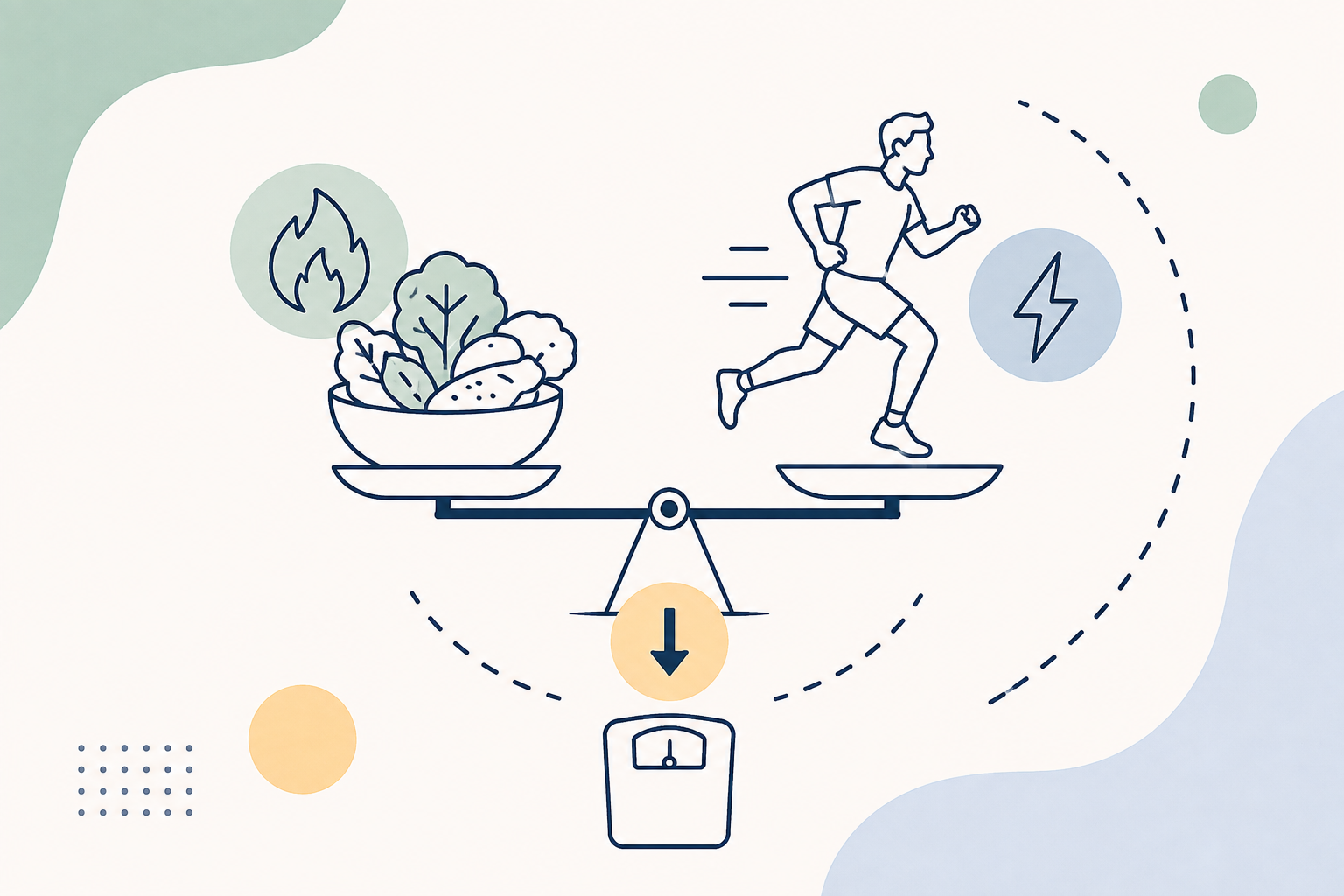
A calorie deficit occurs when your body uses more energy than you consume over time. A calorie deficit calculator can estimate the numbers, but energy needs change with activity and body weight.
What Is a Calorie Deficit?
A calorie deficit means that your calorie intake is lower than your total energy expenditure.
For example, if your body uses an estimated 2,300 calories per day and you consume an average of 1,900 calories, the difference is:
2,300 − 1,900 = 400 calories
That represents an estimated 400-calorie daily deficit.
Over time, a sustained energy deficit can contribute to weight loss. However, weight does not necessarily fall at the same rate every day because body weight is also affected by water, glycogen, food in the digestive system, and other factors.
Calorie Deficit Formula
The basic calorie deficit formula is:
Calorie deficit = Calories burned − Calories consumed
If you know your estimated maintenance calories, you can also write it as:
Calorie deficit = Maintenance calories − Daily calorie intake
For example:
- Estimated maintenance calories: 2,400 kcal
- Planned calorie intake: 1,900 kcal
- Estimated deficit: 500 kcal/day
Use a Calorie Calculator
Use the Calorie Calculator to estimate your daily calorie requirements. Once you have an estimated maintenance level, you can subtract a chosen calorie amount to create a starting deficit.
You can also use the BMR Calculator to understand the resting energy component behind your daily calorie needs.
Calories Consumed vs. Calories Burned
Calories consumed come from food and beverages. Calories burned include resting energy expenditure, physical activity, exercise, and the energy involved in processing food. What matters is the overall energy balance across time, not perfect balance every day.
How to Determine Your Calorie Deficit
A practical method is to calculate your estimated maintenance calories first.
Step 1: Estimate Maintenance Calories
Your maintenance calories are often estimated from resting energy expenditure plus your usual activity.
A calculator may use your age, sex, height, weight, and activity level to estimate this number.
Step 2: Choose a Deficit
Subtract a reasonable amount from your estimated maintenance calories.
For example, if maintenance is estimated at 2,400 kcal:
2,400 − 300 = 2,100 kcal
or:
2,400 − 500 = 1,900 kcal
The appropriate target depends on your calorie needs, health, and weight-management goal.
Step 3: Monitor the Trend
Follow your calorie intake and weight trend for several weeks. If weight changes faster or slower than intended, your maintenance estimate may not match real-world energy expenditure.
Example Calorie Deficit Calculation
Suppose an adult has an estimated maintenance requirement of 2,200 calories per day.
They decide to start with a 400-calorie deficit:
2,200 − 400 = 1,800 calories per day
Their estimated daily intake would therefore be 1,800 calories.
Over seven days, the simple mathematical deficit would be:
400 × 7 = 2,800 calories per week
This does not predict exact body-fat loss because energy expenditure and water balance also change.
Maintenance Calories and Calorie Deficit
Maintenance calories are the reference point for calculating a deficit.
If estimated maintenance is 2,500 calories:
- Eating about 2,500 calories → approximately maintenance
- Eating about 2,200 calories → approximately 300-calorie deficit
- Eating about 2,000 calories → approximately 500-calorie deficit
- Eating about 2,800 calories → approximately 300-calorie surplus
These are estimates. Your actual maintenance level may be higher or lower than the calculator predicts.
As body weight decreases, energy requirements can also decrease. The NHLBI evidence review notes that weight-loss trajectories are not perfectly linear and that energy requirements may fall as weight decreases.
Choosing a Realistic Calorie Deficit
Older clinical guidelines commonly used a 500–1,000 kcal/day deficit as a framework for weight-loss programs, corresponding roughly to 1–2 pounds of weight loss per week. Current guidance also emphasizes gradual, sustainable weight loss rather than rapid results.
This range is not a universal prescription. Calorie needs, health, medications, body size, activity, and nutritional requirements all matter. For many people, a smaller starting deficit may be easier to maintain.
Calorie Deficit and Weight Loss
A sustained calorie deficit can lead to weight loss because the body must draw on stored energy when energy intake does not fully cover expenditure.
Weight loss is not perfectly linear. As weight decreases, the body generally requires less energy, activity can change, and energy expenditure may adapt. A deficit that initially produces weight loss can therefore produce a slower rate later.
The CDC recommends gradual, steady weight loss rather than rapid results.
Why a Calorie Deficit Is an Estimate
A deficit calories calculator cannot directly measure how many calories your body burns each day.
The estimate can be affected by:
- Changes in body weight
- Changes in muscle and fat mass
- Exercise
- Everyday movement
- Work activity
- Food intake
- Sleep and recovery
- Individual differences in metabolism
Food intake is also difficult to measure perfectly. Portion sizes, restaurant meals, cooking methods, and food-label differences can all introduce uncertainty.
This is why your real-world weight trend can provide useful information when evaluating a calculated calorie target.
What Happens When Calorie Intake Changes?
When calorie intake decreases, the energy balance changes. If the new intake is below actual energy expenditure, a deficit may develop.
The size of the deficit can also change over time. If someone loses weight and becomes less active, their energy expenditure may decrease. If they increase physical activity, expenditure may increase.
NIDDK's Body Weight Planner also accounts for both calorie intake and physical activity when estimating progress toward a weight goal.
How Activity Affects Calorie Deficit
You can create a calorie deficit through food intake, physical activity, or a combination of both.
Regular physical activity has benefits beyond calorie expenditure. NIDDK notes that activity can support weight management and provide important health benefits even when weight loss itself is limited.
Common Calorie Deficit Mistakes
Common mistakes include:
- Treating a calculator result as exact.
- Assuming the same deficit will work forever.
- Ignoring activity changes.
- Reacting to short-term scale fluctuations.
- Making an unnecessarily large calorie reduction.
- Focusing only on calories rather than overall diet quality.
Use the calculator as a starting estimate and evaluate the longer-term trend.
When a Calorie Deficit May Be Too Aggressive
A very large calorie reduction can make it difficult to meet nutritional needs and maintain a sustainable eating pattern. Rapid weight loss can also have health consequences; NIDDK notes that very rapid weight loss and very-low-calorie diets can increase the risk of gallstones.
Persistent weakness, dizziness, difficulty concentrating, excessive hunger, or difficulty maintaining normal activities are reasons to reassess the approach.
People who are pregnant or breastfeeding, adolescents, people with certain medical conditions, and anyone considering a very-low-calorie diet should seek individualized medical or nutrition advice.
Using a Calorie Calculator to Estimate Calorie Needs
A calorie deficit calculator is most useful when you understand what its result represents.
Start by estimating your maintenance calories. Then choose a realistic deficit based on your goal and circumstances. Monitor your weight trend and adjust gradually if your results consistently differ from your intended direction.
You can also use related calculators to understand different parts of the picture:
- Calorie Calculator — Estimate daily calorie needs.
- BMR Calculator — Estimate basal metabolic rate.
- Body Fat Calculator — Estimate body fat percentage from available measurements.
Summary
The basic calorie deficit formula is:
Calorie deficit = Maintenance calories − Calories consumed
If your estimated maintenance is 2,400 calories and you consume 1,900 calories, the calculated deficit is 500 calories per day.
The underlying numbers are estimates because activity, body weight, and other factors can change energy expenditure.
For weight loss, a moderate and sustainable approach is generally more practical than pursuing the largest possible deficit. Use a calorie deficit calculator as a starting point, monitor your longer-term results, and adjust your approach as your needs change.
If you have a medical condition, take medicines that affect weight or appetite, are pregnant or breastfeeding, or are considering a very-low-calorie diet, consult a qualified healthcare professional for individualized guidance.
References
Centers for Disease Control and Prevention. (2025). Steps for losing weight. https://www.cdc.gov/healthy-weight-growth/losing-weight/
National Heart, Lung, and Blood Institute. (2013). Managing overweight and obesity in adults: Systematic evidence review from the Obesity Expert Panel. https://www.nhlbi.nih.gov/sites/default/files/media/docs/obesity-evidence-review.pdf
National Institute of Diabetes and Digestive and Kidney Diseases. (n.d.). About the Body Weight Planner. National Institutes of Health. https://www.niddk.nih.gov/health-information/weight-management/body-weight-planner
National Institute of Diabetes and Digestive and Kidney Diseases. (n.d.). Treatment for overweight & obesity. National Institutes of Health. https://www.niddk.nih.gov/health-information/weight-management/adult-overweight-obesity/treatment
National Institute of Diabetes and Digestive and Kidney Diseases. (n.d.). Dieting & gallstones. National Institutes of Health. https://www.niddk.nih.gov/health-information/digestive-diseases/gallstones/dieting