
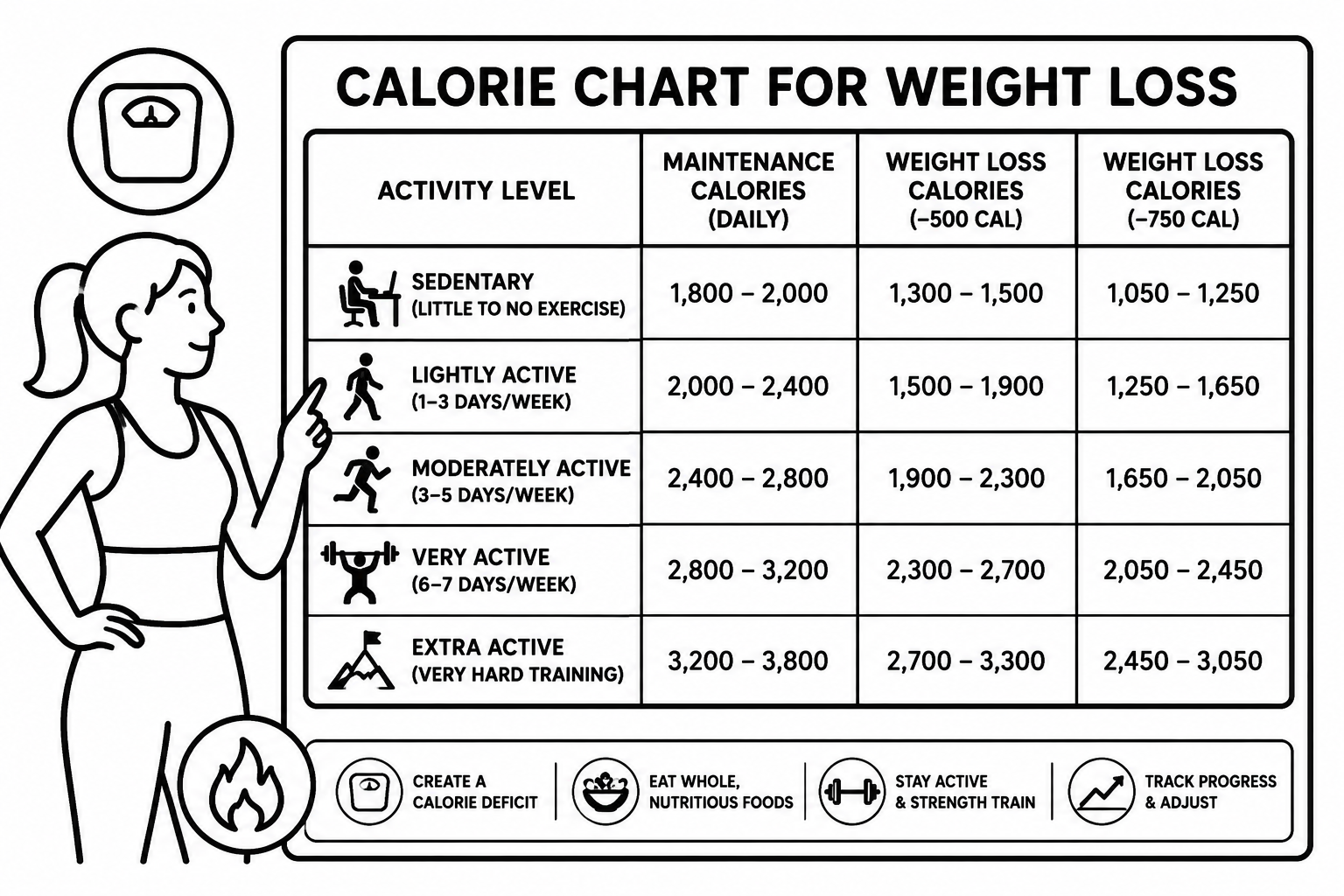
If you are trying to lose weight, one of the first questions you may have is how many calories you should eat each day. A calorie chart to lose weight can provide a quick reference, but calorie needs are highly individual.
Your daily target depends on factors such as age, sex, height, body weight, activity level, and your current energy needs. A chart can show general ranges, while a calculator can use your personal information to produce a more individualized estimate.
Understanding the difference between maintenance calories and a calorie deficit is also important. Weight loss generally occurs when average calorie intake remains below energy expenditure over time.
What Is a Calorie Chart?
A diet calorie chart may organize calorie ranges by:
- Age
- Sex
- Body size
- Activity level
- Weight-management goal
However, a chart cannot account for every individual difference. It should therefore be used as a starting point rather than a precise prescription.
How Calorie Targets Are Estimated
Daily calorie needs are usually estimated by first considering resting energy expenditure and then accounting for physical activity.
One commonly used predictive equation is the Mifflin-St Jeor equation.
For men:
BMR = (10 × weight in kg) + (6.25 × height in cm) − (5 × age) + 5
For women:
BMR = (10 × weight in kg) + (6.25 × height in cm) − (5 × age) − 161
Use the Calorie Calculator
The Calorie Calculator can use your personal measurements and activity level to estimate daily calorie needs.
The BMR Calculator can provide a separate estimate of resting energy expenditure.
Daily Calories and Weight Loss
Weight loss generally requires a sustained energy deficit.
In simple terms:
Calorie deficit = calories burned − calories consumed
If your body uses an average of 2,400 calories per day and you consume about 2,000 calories, the estimated difference is:
2,400 − 2,000 = 400 calories
This does not mean that exactly 400 calories of body fat are lost that day. Body weight is affected by water, glycogen, food in the digestive system, and other factors.
Maintenance Calories vs Weight-Loss Calories
Maintenance calories are the approximate amount of energy you need to keep your body weight relatively stable over time.
A weight-loss calorie target is generally lower than maintenance.
For example:
| Estimated maintenance | Example weight-loss target |
|---|---|
| 2,000 calories | 1,700–1,800 |
| 2,200 calories | 1,800–2,000 |
| 2,400 calories | 2,000–2,200 |
| 2,600 calories | 2,200–2,400 |
| 2,800 calories | 2,400–2,600 |
These are illustrative examples, not universal prescriptions. A suitable calorie target depends on the individual, and a larger deficit is not automatically better.
Calorie Deficit Explained
A calorie deficit occurs when energy intake is lower than energy expenditure over time.
There are several ways to create a deficit:
- Reduce calorie intake
- Increase physical activity
- Combine dietary changes with activity
For example, someone could reduce their intake modestly while adding regular walking.
Example Daily Calorie Ranges
A general chart can help illustrate how calorie needs may vary.
For example, consider these broad reference ranges:
| Daily calorie range | Possible use |
|---|---|
| 1,400–1,600 | Lower-energy intake for some smaller or less-active adults |
| 1,600–1,800 | Possible starting range for some adults |
| 1,800–2,000 | Common range for some adults with moderate needs |
| 2,000–2,400 | May suit some moderately active adults |
| 2,400–3,000+ | May suit some larger or highly active adults |
These ranges should not be interpreted as a personalized diet prescription. Individual calorie requirements can fall below or above these examples.
Very low-calorie diets may require medical supervision and are not appropriate for everyone.
Why Calorie Needs Differ Between People
Two people can have the same goal but require different calorie intakes.
For example, calorie needs can differ because of:
- Age
- Sex
- Height
- Body weight
- Body composition
- Activity level
- Exercise
- Daily movement
Age and Calorie Needs
Age can influence estimated calorie requirements.
As people age, changes in body composition and physical activity can affect total energy expenditure. An older adult who is less active may need fewer calories than a younger adult with similar body measurements and substantially higher activity.
Sex and Calorie Needs
Sex is another variable used in commonly used calorie equations.
The Mifflin-St Jeor equation, for example, uses different constants for men and women.
Height and Calorie Needs
Height contributes to estimated resting energy expenditure.
A person's height is commonly entered into calorie equations because it helps describe body size.
Weight and Calorie Needs
Body weight is another important factor.
Moving a larger body generally requires more energy than moving a smaller body under comparable conditions. Body weight is therefore included in many calorie equations.
Activity Level and Calorie Requirements
Activity level can have a major effect on daily calorie needs.
A sedentary person and a highly active person with similar measurements may have very different total daily energy expenditures.
When using a calorie chart, select the range that most closely matches your usual activity rather than choosing the highest category because of occasional workouts.
How to Use a Calorie Chart
A practical approach is:
- Identify your approximate age group.
- Consider your sex, height, and body weight.
- Estimate your usual activity level.
- Find a general calorie range.
- Use a calorie calculator for a more personalized estimate.
- Monitor your progress over several weeks.
- Adjust your target if necessary.
Related Nutrition Tools
The Macro Calculator can help estimate protein, carbohydrate, and fat targets.
The Ideal Weight Calculator provides a reference estimate based on body measurements.
The Body Fat Calculator can provide additional body-composition information.
Why a Calorie Chart Is Only an Estimate
A chart cannot measure your actual metabolism.
Even two people with identical age, height, weight, and sex may have different energy expenditure because of differences in body composition, activity, fitness, and daily movement.
Food intake can also be difficult to measure precisely. Portion sizes, cooking methods, restaurant meals, and food-label rounding can introduce uncertainty.
When to Adjust Your Calorie Target
You may need to reassess your target when:
- Your body weight changes substantially
- Your activity level changes
- Your exercise routine changes
- Your weight trend remains unchanged for an extended period
- Your current target is difficult to maintain
- Your goal changes
Calories Consumed vs Calories Burned
Weight management depends on the relationship between energy intake and energy expenditure.
Calories consumed come from food and drinks.
Calories burned include resting energy expenditure, physical activity, exercise, digestion, and other energy-consuming processes.
A calorie chart focuses mainly on the intake side, but your actual calorie needs depend on both sides of the energy balance.
Using a Calorie Calculator Instead of Only a Chart
A chart is convenient, but a calculator can be more useful because it incorporates your personal information.
The Calorie Calculator can provide that starting estimate.
Combining Calorie Targets With Protein and Macro Goals
Calories are only one part of nutrition.
Once you have an estimated calorie target, you can also consider protein, carbohydrates, and fat.
For example, a 2,000-calorie plan might include a 120-gram protein target, with the remaining calories distributed between carbohydrates and fat.
Protein is particularly relevant for people who are trying to maintain lean tissue while losing weight.
Summary
A calorie chart to lose weight can provide a convenient reference for understanding daily calorie ranges, but it cannot determine your exact needs.
Your calorie requirements depend on age, sex, height, weight, activity level, body composition, and other individual factors. Weight loss generally requires a sustained calorie deficit, but the appropriate deficit varies between people.
Use a chart as a starting point, then use the Calorie Calculator to obtain a more personalized estimate. Track your intake and body-weight trend over time, and adjust your target when your circumstances or results change.
For a broader nutrition plan, combine your calorie target with appropriate protein and macro goals rather than focusing on calories alone.
References
Mifflin, M. D., St Jeor, S. T., Hill, L. A., Scott, B. J., Daugherty, S. A., & Koh, Y. O. (1990). A new predictive equation for resting energy expenditure in healthy individuals. The American Journal of Clinical Nutrition, 51(2), 241–247. https://doi.org/10.1093/ajcn/51.2.241
National Institute of Diabetes and Digestive and Kidney Diseases. (n.d.). Body Weight Planner. National Institutes of Health. https://www.niddk.nih.gov/health-information/weight-management/body-weight-planner
National Institute of Diabetes and Digestive and Kidney Diseases. (n.d.). Choosing a safe and successful weight-loss program. National Institutes of Health. https://www.niddk.nih.gov/health-information/weight-management/choosing-a-safe-successful-weight-loss-program
National Academies of Sciences, Engineering, and Medicine. (2005). Dietary reference intakes for energy, carbohydrate, fiber, fat, fatty acids, cholesterol, protein, and amino acids. National Academies Press. https://nap.nationalacademies.org/catalog/10490/dietary-reference-intakes-for-energy-carbohydrate-fiber-fat-fatty-acids
U.S. Department of Agriculture. (2020). Dietary Guidelines for Americans, 2020–2025 (9th ed.). https://www.dietaryguidelines.gov/