
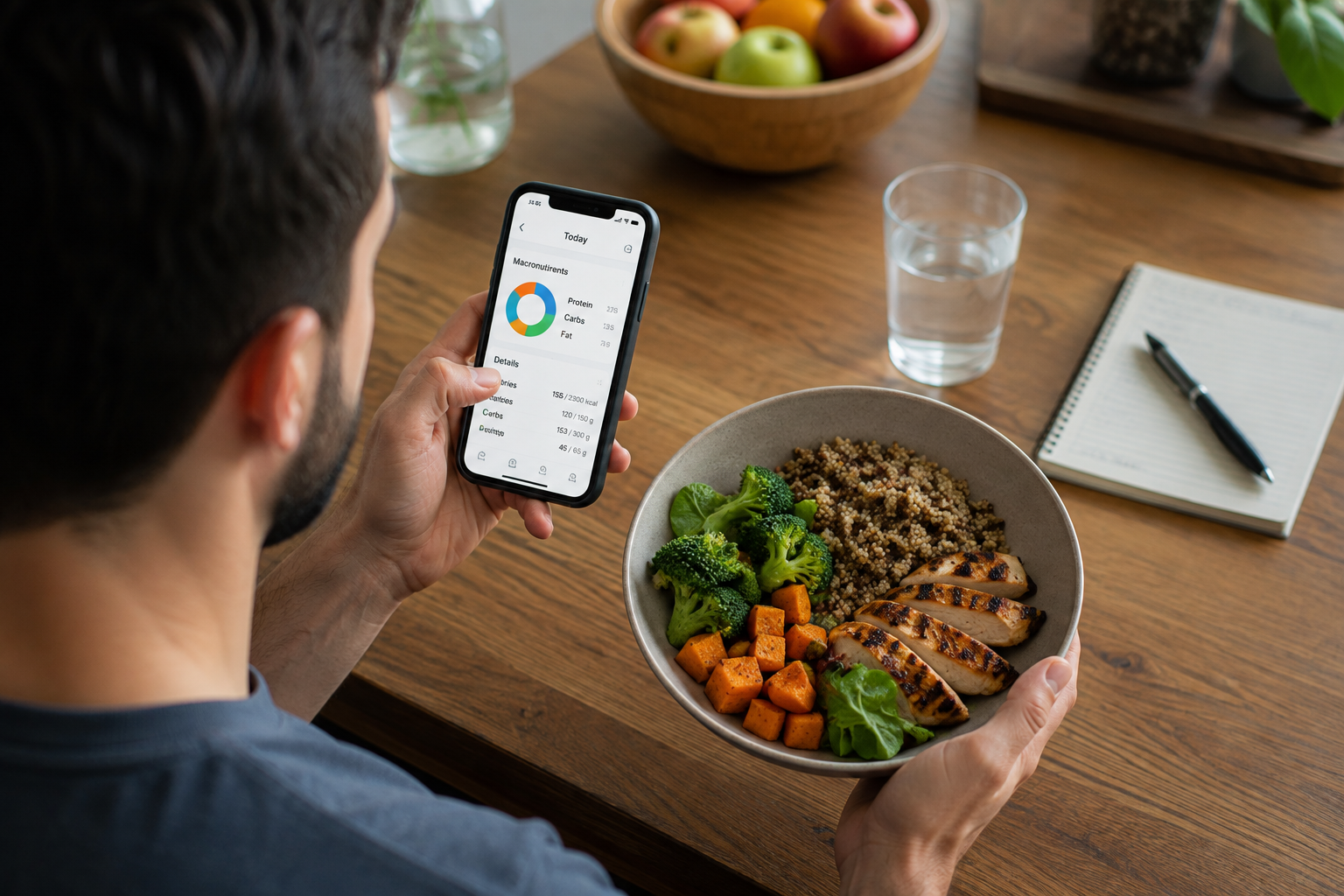
If you have ever wondered how much protein, carbohydrate, and fat you should eat each day, a macro calculator can provide a useful starting point. Macronutrients, often shortened to "macros," are the nutrients that provide most of the energy in your diet: protein, carbohydrates, and fat.
A macro calculation usually starts with estimated calorie needs and then distributes those calories among the three macronutrients. The result can help you organize meals for weight loss, maintenance, muscle gain, or general nutrition.
What Are Macros?
The word macros refers to macronutrients.
The three main macronutrients are:
- Protein
- Carbohydrates
- Fat
Each provides calories:
- Protein: about 4 calories per gram
- Carbohydrates: about 4 calories per gram
- Fat: about 9 calories per gram
Protein, Carbohydrates and Fat
Each macronutrient has different roles.
Protein supplies amino acids needed for building and maintaining body tissues and supporting many physiological processes.
Carbohydrates provide glucose and other forms of energy. They are found in foods such as grains, fruits, vegetables, beans, and dairy products.
Fat provides concentrated energy and supports cell structure and the absorption of fat-soluble vitamins.
What Is a Macro Calculator?
A macro calculator estimates daily protein, carbohydrate, and fat targets from information such as:
- Age
- Sex
- Height
- Weight
- Activity level
- Goal
- Estimated calorie needs
The calculator first estimates how much energy you may need. It then assigns a proportion of those calories to protein, carbohydrates, and fat.
Use the Calorie Calculator
The Calorie Calculator can estimate your daily calorie needs before you set your macro targets.
The BMR Calculator can also provide an estimate of your resting energy expenditure.
How Daily Calorie Needs Affect Macros
Calories and macros are closely connected.
If you increase your daily calorie target while keeping the same macro percentages, the number of grams of protein, carbohydrates, and fat will also increase.
For example, consider a 2,000-calorie diet with a distribution of:
- 30% protein
- 40% carbohydrates
- 30% fat
The calories from each macro would be:
Protein: 2,000 × 0.30 = 600 calories
Carbohydrates: 2,000 × 0.40 = 800 calories
Fat: 2,000 × 0.30 = 600 calories
Convert calories into grams:
Protein: 600 ÷ 4 = 150 g
Carbohydrates: 800 ÷ 4 = 200 g
Fat: 600 ÷ 9 ≈ 67 g
This illustrates how macro percentages are converted into grams.
How to Calculate Protein
Protein targets can be estimated using body weight.
For healthy adults, the established Recommended Dietary Allowance is 0.8 grams per kilogram of body weight per day. People who exercise regularly may use higher targets depending on their training and goals.
That is a practical example of figuring out macros using body weight rather than starting with a percentage.
How to Calculate Carbohydrates
Carbohydrate targets can be calculated after protein and fat targets have been established.
For example, suppose your daily calorie target is 2,200 calories.
You choose:
Protein = 120 g
Protein calories:
120 × 4 = 480 calories
You choose:
Fat = 70 g
Fat calories:
70 × 9 = 630 calories
Calories remaining for carbohydrates:
2,200 − 480 − 630 = 1,090 calories
Convert carbohydrate calories to grams:
1,090 ÷ 4 = 272.5 g
The carbohydrate target would therefore be approximately 273 grams.
This is sometimes called a "calorie remainder" approach because carbohydrates receive the calories left after protein and fat have been assigned.
How to Calculate Fat
Fat can be calculated either from a percentage of total calories or from a specific gram target.
If fat represents 30% of a 2,000-calorie diet:
2,000 × 0.30 = 600 calories
Because fat provides about 9 calories per gram:
600 ÷ 9 ≈ 67 grams
Macro Ratios
A macro ratio describes how total calorie intake is divided among protein, carbohydrates, and fat.
For example:
30% protein / 40% carbohydrate / 30% fat
There is no single macro ratio that is ideal for everyone. The appropriate balance depends on the person's preferences, activity, training, calorie target, and ability to follow the plan consistently.
Macros for Weight Loss
Macros to lose weight should generally be considered after establishing an appropriate calorie target.
Weight loss occurs when average energy intake is lower than energy expenditure over time. Macro distribution can then help determine how those calories are divided.
A very aggressive calorie restriction is not necessary simply because a calculator produces a lower number. A realistic target is more likely to be sustainable.
Macros for Weight Maintenance
For weight maintenance, the calorie target is generally close to estimated energy expenditure.
Macros for Muscle and Weight Gain
People trying to gain muscle may use a calorie surplus together with resistance training and adequate protein.
The remaining calories can be divided between carbohydrates and fat according to preference and training requirements.
Increasing calories alone does not guarantee muscle gain. Resistance training, sufficient protein, recovery, and an appropriate training program also matter.
Tracking Macros
Tracking macros means recording the foods you eat and monitoring their protein, carbohydrate, and fat content.
A simple daily record might look like:
Calorie target: 2,200
Protein target: 120 g
Carbohydrate target: 250 g
Fat target: 70 g
You can compare the nutrition information from your meals with these targets.
Food labels, nutrition databases, recipe calculations, and food-tracking apps can all be used to estimate macro intake.
Macro Targets for Women
A macro calculator for women uses the same fundamental principles as a calculator for men: estimate calorie needs, establish protein and other nutrient targets, and distribute the remaining calories.
However, calorie requirements can differ because body size, body composition, age, activity, and other characteristics vary between individuals.
Women who are pregnant or breastfeeding have different nutritional considerations, so a general macro calculator should not be used as a substitute for individualized professional guidance during those periods.
Why Macro Needs Vary Between People
Two people can have the same body weight but different calorie and macro needs.
Differences can result from:
- Height
- Body composition
- Age
- Activity
- Exercise type
- Training volume
- Daily movement
- Weight-management goals
- Dietary preferences
Calories vs Macros
Calories and macros answer different questions.
Calories: How much energy does your diet provide?
Macros: Where does that energy come from?
For example, two diets can contain 2,000 calories but have very different protein, carbohydrate, and fat distributions.
Common Macro Tracking Mistakes
Some common mistakes include:
- Setting calories and macros independently so they do not add up
- Forgetting that fat contains more calories per gram than protein or carbohydrate
- Underestimating portions
- Ignoring cooking oils and sauces
- Using inaccurate food database entries
- Changing targets too frequently
- Focusing on exact numbers instead of overall patterns
- Treating calculator results as medical prescriptions
When calculating macros, check that your protein, carbohydrate, and fat calories are consistent with your total calorie target.
How to Adjust Macro Targets
Macro targets may need adjustment when your circumstances change.
Consider reviewing them if:
- Your body weight changes substantially
- Your activity level changes
- Your training volume increases or decreases
- Your goal changes
- You consistently struggle to follow the targets
- Your progress does not match your goal
Related Health Calculators
- Calorie Calculator — Estimate daily calorie requirements.
- BMR Calculator — Estimate basal metabolic rate.
- Body Fat Calculator — Estimate body fat percentage.
Summary
A free macro calculator can help estimate daily protein, carbohydrate, and fat targets from your calorie needs, body measurements, activity level, and goal.
For example, a 2,000-calorie diet with 30% protein, 40% carbohydrates, and 30% fat provides approximately 150 g protein, 200 g carbohydrates, and 67 g fat.
There is no universal macro ratio that works for everyone. A useful macro plan is one that provides adequate nutrition, fits your calorie needs, supports your goal, and is practical enough to maintain.
Use the Calorie Calculator to estimate your calorie needs first, then use those calories as the foundation for calculating your macros.
References
Institute of Medicine. (2005). Dietary reference intakes for energy, carbohydrate, fiber, fat, fatty acids, cholesterol, protein, and amino acids. National Academies Press. https://nap.nationalacademies.org/catalog/10490/dietary-reference-intakes-for-energy-carbohydrate-fiber-fat-fatty-acids
Jäger, R., Kerksick, C. M., Campbell, B. I., et al. (2017). International Society of Sports Nutrition position stand: Protein and exercise. Journal of the International Society of Sports Nutrition, 14, 20. https://doi.org/10.1186/s12970-017-0177-8
National Academies of Sciences, Engineering, and Medicine. (2023). Dietary reference intakes for energy. National Academies Press. https://nap.nationalacademies.org/catalog/26818/dietary-reference-intakes-for-energy
National Institute of Diabetes and Digestive and Kidney Diseases. (n.d.). Body Weight Planner. National Institutes of Health. https://www.niddk.nih.gov/health-information/weight-management/body-weight-planner
U.S. Department of Agriculture. (n.d.). Dietary Guidelines for Americans. https://www.dietaryguidelines.gov/