
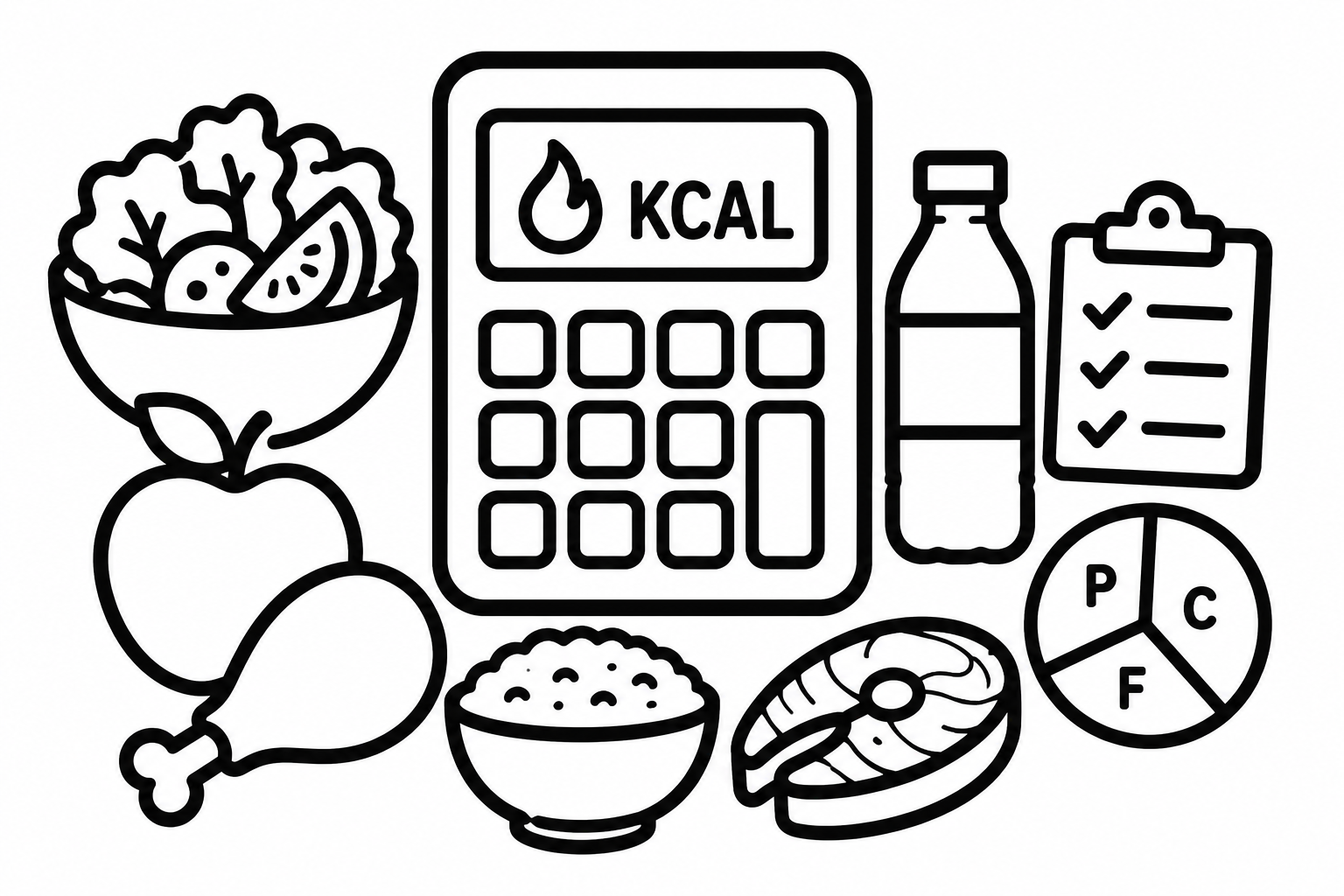
Knowing approximately how many calories are in the food you eat can make it easier to understand your daily energy intake. A free food calorie calculator provides a convenient way to estimate calories from individual foods, portions, and meals.
What Is a Food Calorie Calculator?
A food calorie calculator estimates the energy provided by a particular food or meal.
Depending on the tool, you may enter:
- Food name
- Serving size
- Weight in grams
- Number of servings
- Calories per serving
- Ingredients in a recipe
The calculator then converts that information into an estimated calorie total.
Use the Calorie Calculator
The Calorie Calculator can estimate your broader daily calorie needs. A food calorie estimate tells you how much energy is in the food you eat, while a daily calorie calculator estimates how much energy you may need.
How Calories in Food Are Estimated
Calories represent energy obtained from food and beverages. The energy in food comes primarily from carbohydrates, fat, protein, and, where present, alcohol.
Nutrition values can be determined through laboratory analysis or calculated using established nutrition data. Online food databases provide estimates based on the specific food, preparation method, and serving size.
Calories Per Serving
Nutrition labels normally provide calories for a specified serving.
For example, a label might state:
Serving size: 1 cup
Calories: 250
If you eat one cup, the listed calorie value is 250.
If you eat two cups:
250 × 2 = 500 calories
The U.S. Food and Drug Administration advises consumers to check both serving size and servings per container because the calorie and nutrient values on a Nutrition Facts label generally refer to the stated serving. A package can contain multiple servings.
The serving size on a label is also not a recommendation for how much you should eat.
Calories Per 100 Grams
Calories per 100 grams are useful when comparing foods or calculating portions by weight.
Suppose a food provides:
150 calories per 100 g
You eat 75 g.
The calculation is:
150 × 75 ÷ 100 = 112.5 calories
You could record this as approximately 113 calories.
Portion Size and Calorie Intake
Portion size is one of the most important factors in calorie tracking.
A food can have a relatively low calorie value per serving but still contribute more calories if you eat several servings.
This is why comparing the amount you actually eat with the serving size listed in your nutrition source matters.
Reading Nutrition Labels
When estimating calories from packaged food, start with the serving information.
Look for:
- Serving size
- Servings per container
- Calories
- Protein
- Total carbohydrate
- Total fat
The FDA explains that the calorie amount on the Nutrition Facts label is based on the stated serving size. If you eat two servings, you generally consume twice the calories and nutrients listed for one serving.
Calories From Protein, Carbohydrates and Fat
Calories come primarily from macronutrients.
A commonly used approximation is:
- Protein: 4 calories per gram
- Carbohydrate: 4 calories per gram
- Fat: 9 calories per gram
Raw vs Cooked Food
Raw and cooked foods can have different calorie values per 100 grams because cooking can change water content and therefore the food's weight.
For example, rice absorbs water during cooking. A given weight of cooked rice may therefore contain fewer calories per 100 grams than the same weight of dry rice, even though the underlying food energy has not simply disappeared.
The same issue can occur with meat, vegetables, pasta, and other foods.
When using a food database, make sure the entry matches the state of the food you are weighing:
- Raw chicken vs cooked chicken
- Dry rice vs cooked rice
- Dry pasta vs cooked pasta
- Raw vegetables vs cooked vegetables
Common Food Calorie Mistakes
Several mistakes can make a food calorie estimate inaccurate.
Ignoring serving size
Recording one serving when you actually ate two can significantly underestimate calories.
Forgetting cooking oil
Oil, butter, sauces, and dressings can add calories even when they are not the main part of a meal.
Using the wrong food entry
A generic food may have different calories from the exact brand or preparation you consumed.
Confusing raw and cooked weights
The calorie value should match the food state and serving measurement.
Forgetting drinks
Sweetened beverages, coffee additions, smoothies, and other drinks can contribute to daily calorie intake.
Estimating restaurant portions incorrectly
Restaurant servings can differ from standard database portions, so use official nutrition information when it is available.
Estimating Calories When Nutrition Information Is Unavailable
Not every food has a convenient nutrition label.
For fresh foods, you can use a reputable nutrition database and record the food by weight.
A practical method is:
- Identify the closest matching food.
- Choose raw or cooked correctly.
- Find calories per 100 g or per serving.
- Weigh or estimate your portion.
- Calculate the calorie amount.
- Record the result.
If the food is homemade, estimate the calories of each ingredient and add them together.
For example, a meal containing chicken, rice, vegetables, and cooking oil can be estimated by calculating each ingredient separately and adding the results.
Restaurant Food Calorie Estimates
Restaurant meals can be more difficult because portion sizes and recipes may vary.
When a restaurant publishes nutrition information, use the restaurant's current information whenever possible.
If no nutrition information is available, break the meal into components.
For example:
- Main protein
- Rice, pasta, or bread
- Vegetables
- Cheese
- Sauce
- Dressing
- Cooking oil
- Beverage
- Dessert
Estimate each component separately and add the values.
Packaged Food vs Homemade Food
Packaged foods often have a Nutrition Facts label, which makes calorie tracking relatively straightforward.
Homemade food requires more calculation because you need to account for ingredients and quantities.
For a homemade recipe:
- Record each ingredient.
- Record the amount used.
- Find the calories for each ingredient.
- Add the ingredients together.
- Divide the total by the number of portions.
Food Calories and Daily Calorie Intake
Food calorie estimates become more useful when considered alongside your total daily calorie needs.
For example, suppose your estimated daily requirement is 2,200 calories and you record:
Breakfast = 450 calories
Lunch = 600 calories
Dinner = 750 calories
Snacks = 250 calories
Your recorded intake is:
450 + 600 + 750 + 250 = 2,050 calories
That leaves approximately 150 calories compared with a 2,200-calorie daily target.
Related Health Calculators
- Calorie Calculator — Estimate your daily calorie requirements.
- Body Fat Calculator — Estimate body fat percentage from available measurements.
- BMR Calculator — Estimate basal metabolic rate.
Using a Calorie Calculator to Track Food
A useful calorie-tracking routine does not have to be complicated.
Start with reliable information and focus on the portions you actually consume.
A simple process is:
- Identify the food.
- Check the serving size.
- Measure the portion when practical.
- Confirm whether the food is raw or cooked.
- Record the calories.
- Include sauces, oils, drinks, and extras.
- Add the foods together for your meal or day.
Summary
A free food calorie calculator can help estimate calories in individual foods, portions, recipes, and complete meals.
The most important information is usually the food itself, serving size, weight, and whether the food is raw or cooked. For packaged foods, start with the Nutrition Facts label. For fresh or homemade foods, use reliable nutrition data and calculate portions from the ingredients or food weight.
A simple formula is:
Calories eaten = Calories per serving × Number of servings
Or, when using calories per 100 grams:
Calories eaten = Calories per 100 g × Food weight ÷ 100
For broader calorie planning, use the Calorie Calculator to estimate daily energy needs, then use food calorie estimates to understand how your actual intake compares with that estimate.
References
Food and Drug Administration. (2025). Calories on the Nutrition Facts label. U.S. Department of Health and Human Services. https://www.fda.gov/food/nutrition-facts-label/calories-nutrition-facts-label
Food and Drug Administration. (2025). Serving size on the Nutrition Facts label. U.S. Department of Health and Human Services. https://www.fda.gov/food/nutrition-facts-label/serving-size-nutrition-facts-label
Food and Drug Administration. (2025). How to understand and use the Nutrition Facts label. U.S. Department of Health and Human Services. https://www.fda.gov/food/nutrition-facts-label/how-understand-and-use-nutrition-facts-label
U.S. Department of Agriculture. (n.d.). FoodData Central. Agricultural Research Service. https://fdc.nal.usda.gov/
National Institute of Diabetes and Digestive and Kidney Diseases. (n.d.). Body weight planner. National Institutes of Health. https://www.niddk.nih.gov/health-information/weight-management/body-weight-planner