
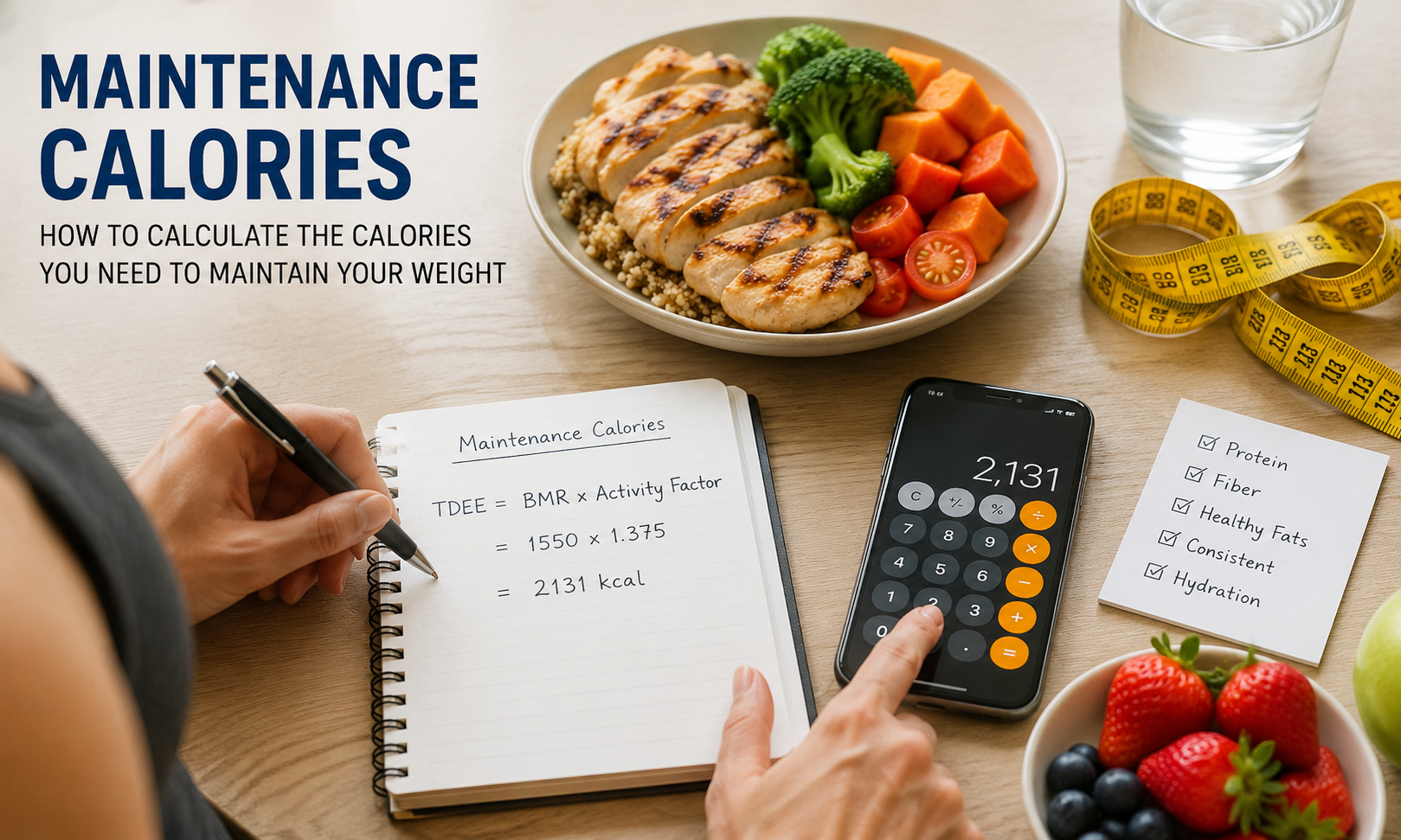
If your goal is to keep your weight relatively stable, one of the most useful numbers to understand is your maintenance calorie level. Maintenance calories are the approximate amount of energy you need to consume to balance the energy your body uses over time.
A maintenance calorie calculator can estimate this number using factors such as age, sex, height, weight, and activity level. The result is a starting estimate, not a fixed number. Your actual needs can change as your body weight, activity, and other factors change.
What Are Maintenance Calories?
Maintenance calories are the approximate number of calories you need to consume to maintain your body weight over time.
If your average calorie intake and average energy expenditure are reasonably balanced, your weight will tend to remain relatively stable. If intake consistently exceeds expenditure, weight may increase. If expenditure consistently exceeds intake, weight may decrease.
Maintenance Calories vs. BMR
Maintenance calories are not the same as basal metabolic rate (BMR).
BMR estimates the energy your body requires to support essential functions at rest. It does not include all the movement, exercise, digestion, and other activities that occur during a normal day.
Your maintenance calorie requirement is therefore generally higher than your BMR.
You can learn more about resting energy expenditure with the BMR Calculator.
What Is TDEE?
Total daily energy expenditure (TDEE) is an estimate of the total amount of energy your body uses during a typical day.
TDEE includes several components:
- Resting energy expenditure
- Physical activity
- Exercise
- Thermic effect of food
- Other daily energy expenditure
Because activity varies from person to person, two people with similar height, weight, and age can have different maintenance calorie needs.
The National Institute of Diabetes and Digestive and Kidney Diseases (NIDDK) uses physical activity information as part of its Body Weight Planner because changes in activity affect the calories needed to reach and maintain a weight goal.
Use a Calorie Calculator
You can use the Calorie Calculator to estimate your daily calorie needs based on your personal measurements and activity level. The result can provide a practical starting point for estimating maintenance calories.
How Activity Level Affects Maintenance Calories
Physical activity is one of the biggest reasons maintenance calorie needs differ between people.
Someone who spends most of the day sitting and rarely exercises will generally use less energy than someone who walks frequently, exercises several times a week, or performs physically demanding work.
Common activity descriptions include:
Sedentary
A sedentary lifestyle involves little structured exercise and relatively low movement during the day.
People with desk-based jobs, limited walking, and little planned physical activity may fall closer to this category.
Lightly Active
Lightly active generally describes people who perform some regular physical activity, such as walking or light exercise, but are not highly active throughout the day.
Moderately Active
Moderately active people usually combine regular exercise with a reasonable amount of everyday movement.
Very Active
Very active individuals may exercise frequently, participate in demanding sports, or have physically demanding jobs.
How Maintenance Calories Are Calculated
A typical calorie maintain calculator first estimates resting energy expenditure and then accounts for activity.
One common approach is to estimate BMR using the Mifflin-St Jeor equation:
For men:
BMR = (10 × weight in kg) + (6.25 × height in cm) − (5 × age) + 5
For women:
BMR = (10 × weight in kg) + (6.25 × height in cm) − (5 × age) − 161
The Mifflin-St Jeor equation was published in 1990 as a predictive equation for resting energy expenditure in healthy individuals (Mifflin et al., 1990).
The estimated BMR can then be combined with an activity factor to produce an approximate daily calorie requirement.
A simplified example is:
Estimated maintenance calories ≈ BMR × activity factor
For example, if an estimated BMR is 1,500 kcal/day and an activity factor of 1.4 is used:
1,500 × 1.4 = 2,100 kcal/day
This would be an estimated maintenance level, not a guarantee that exactly 2,100 calories will maintain weight.
Why Maintenance Calories Are Estimates
A maintenance calorie calc cannot perfectly measure your daily energy expenditure.
Your actual energy use can change with:
- Changes in body weight
- Changes in muscle and fat mass
- Exercise
- Daily movement
- Work demands
- Sleep and recovery
- Food intake
- Physiological changes
- Changes in routine
NIDDK's Body Weight Planner illustrates why calorie and activity estimates are best viewed as part of a model rather than an absolute measurement. It allows both calorie intake and physical activity to be adjusted when planning weight change and maintenance.
How Many Calories Do You Need to Maintain Your Weight?
There is no single maintenance calorie number that applies to everyone.
Your estimated maintenance calories depend on your personal characteristics and activity level. For that reason, a calculator is more useful when it is based on your own measurements rather than a generic calorie chart.
The best starting point is to calculate an estimate, follow your weight trend, and adjust your calorie intake if your results consistently differ from your goal.
How to Adjust Calories Based on Real-World Results
Your body-weight trend can help you determine whether your estimated maintenance calories are close to your actual needs.
A practical approach is:
- Start with your estimated maintenance calories.
- Keep your eating pattern reasonably consistent.
- Track your weight under similar conditions over several weeks.
- Look at the overall trend rather than individual daily changes.
- Adjust your calorie intake gradually if your weight is consistently moving in an unwanted direction.
For example, if your weight is gradually increasing when your goal is maintenance, your actual average energy intake may be above your current expenditure. If your weight is gradually decreasing, your average intake may be below your expenditure.
NIDDK also recommends tracking weight and progress as part of weight-management efforts.
Maintenance Calories and Weight Loss
If your goal is weight loss, maintenance calories provide a useful reference point. Eating below estimated maintenance can create an energy deficit, but your needs may change as body weight and activity change.
Reassess your calorie needs as your weight changes rather than assuming one target will work forever.
NIDDK notes that metabolism and calorie needs can decrease during weight loss, which can make maintaining weight loss more challenging.
Maintenance Calories and Weight Gain
For weight gain, calorie intake generally needs to be higher than the amount of energy your body uses.
If you are trying to gain substantial weight, have an unexplained change in weight, or have a medical condition affecting nutrition, consider discussing your goals with a healthcare professional or registered dietitian.
Using a Calorie Calculator to Estimate Maintenance Needs
A maintenance calorie calculator is most useful as a starting point.
Enter your age, sex, height, weight, and activity level to obtain an estimated daily calorie requirement. You can then use that estimate to plan meals, understand your energy needs, or establish a starting point for weight-management goals.
Remember that the number is not a perfect measurement of your metabolism. Your real-world weight trend provides additional information about whether the estimate is appropriate for you.
Related Health Calculators
- Calorie Calculator — Estimate your daily calorie requirements.
- BMR Calculator — Estimate your basal metabolic rate.
- Body Fat Calculator — Estimate body fat percentage from available measurements.
Summary
Maintenance calories are the approximate amount of energy you need to maintain your weight over time. They are influenced by BMR, physical activity, exercise, digestion, body size, body composition, and other factors.
A calorie maintain calculator can estimate your needs by combining resting energy expenditure with an activity level. The result should be treated as a starting point rather than an exact daily requirement.
The most useful strategy is to compare the estimate with your real-world weight trend. If your weight consistently rises or falls when you want it to remain stable, you can adjust your calorie intake or activity gradually.
For personalized nutrition advice, particularly when managing a medical condition or making major dietary changes, consider speaking with a qualified healthcare professional or registered dietitian.
References
Mifflin, M. D., St Jeor, S. T., Hill, L. A., Scott, B. J., Daugherty, S. A., & Koh, Y. O. (1990). A new predictive equation for resting energy expenditure in healthy individuals. The American Journal of Clinical Nutrition, 51(2), 241–247. https://doi.org/10.1093/ajcn/51.2.241
National Institute of Diabetes and Digestive and Kidney Diseases. (2017). About the Body Weight Planner. National Institutes of Health. https://www.niddk.nih.gov/health-information/weight-management/body-weight-planner
National Institute of Diabetes and Digestive and Kidney Diseases. (2023). Eating & physical activity to lose or maintain weight. National Institutes of Health. https://www.niddk.nih.gov/health-information/weight-management/adult-overweight-obesity/eating-physical-activity
National Institute of Diabetes and Digestive and Kidney Diseases. (2023). Tips to keep moving. National Institutes of Health. https://www.niddk.nih.gov/health-information/weight-management/tips-get-active/tips-keep-moving