
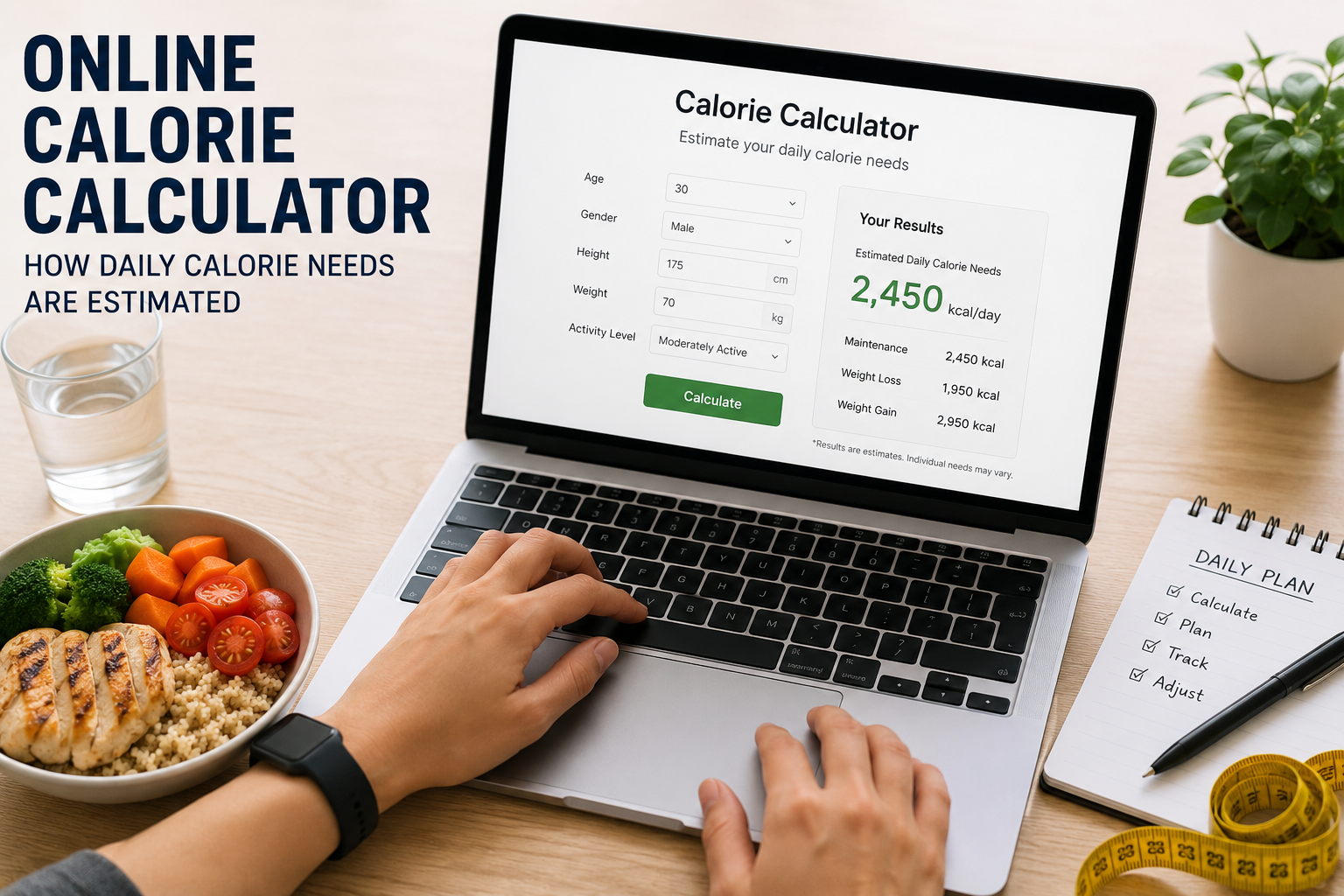
Knowing how many calories you need each day can be useful when you want to maintain your weight, lose weight, or gain weight. But calorie needs are not the same for everyone.
An online calorie calculator estimates your daily energy requirements from information such as age, sex, height, weight, and physical activity. The result can provide a practical starting point, but it should not be treated as an exact measurement of how many calories your body burns.
Understanding how these calculators work can help you interpret the result and use it more effectively.
What Is an Online Calorie Calculator?
An online calorie calculator is a tool that estimates how much energy you may need each day.
Most calculators begin by estimating your resting energy expenditure, often using a predictive equation. They then account for your activity level to estimate your total daily calorie needs.
Use the Calorie Calculator
You can use the Calorie Calculator to estimate your daily calorie needs based on your personal information and activity level.
What Information Does a Calorie Calculator Need?
A typical calculator asks for several basic measurements.
Activity Level
Activity level helps estimate the additional energy used through movement and exercise. A sedentary person generally requires fewer calories than someone who is physically active.
The NIH Body Weight Planner, for example, asks users to enter weight, sex, age, height, and physical activity level when estimating calorie needs and planning weight changes.
Calories and Energy Balance
Calorie calculations are based on the basic concept of energy balance.
If, over time, you consume approximately as much energy as your body uses, your body weight may remain relatively stable. If you consistently consume more energy than you use, weight may increase. If you consistently use more energy than you consume, weight may decrease.
This is why calorie calculators are useful for establishing a starting estimate rather than guaranteeing a particular result.
BMR and Daily Calorie Needs
One important concept behind many calorie calculators is basal metabolic rate (BMR).
BMR represents the energy required to support essential body functions at rest under controlled conditions. It includes processes such as breathing, circulation, temperature regulation, and other basic physiological functions.
However, you do much more than rest during a normal day. You walk, work, exercise, digest food, and perform everyday activities.
Therefore, your daily calorie needs are generally higher than your BMR.
You can use the BMR Calculator to estimate your resting energy requirement and understand how it relates to your total daily calorie needs.
Activity Level and Calorie Requirements
Physical activity can make a substantial difference in daily calorie requirements.
A calculator may place users into broad categories such as:
- Sedentary: Mostly sitting with little planned exercise
- Lightly active: Some regular walking or light exercise
- Moderately active: Regular exercise and everyday movement
- Very active: Frequent exercise or physically demanding daily activity
The NHLBI explains energy balance in similar terms: maintaining weight generally involves balancing calories consumed with calories used, while reducing calorie intake or increasing activity can contribute to weight loss.
Maintenance Calories
Maintenance calories are the approximate number of calories you need to maintain your weight over time.
Your activity, body weight, body composition, food intake, and daily routine can all change your actual energy expenditure. NIDDK's Body Weight Planner also allows users to adjust calorie intake and physical activity because both affect weight change and maintenance.
Calories for Weight Loss
If your goal is weight loss, a calorie target is generally set below estimated maintenance calories.
For example:
Estimated maintenance = 2,200 calories/day
Planned intake = 1,900 calories/day
Estimated difference = 300 calories/day
This creates a starting calorie deficit.
Calories for Weight Gain
For weight gain, calorie intake generally needs to be higher than the amount of energy your body uses.
An online calculator can provide an estimated maintenance level that serves as a reference point. You can then consider an appropriate calorie increase based on your goal, diet, activity, and nutritional needs.
If you have unexplained weight loss or gain, a medical condition, or special nutritional requirements, seek individualized advice from a qualified healthcare professional.
Why Calorie Calculators Produce Estimates
An online calorie calculator cannot directly measure your metabolism.
Instead, it uses mathematical equations and assumptions to estimate energy requirements. Even two people with the same age, height, weight, and activity category can have different actual calorie needs.
NIDDK's research on its Body Weight Planner emphasizes that the body responds dynamically to changes in calorie intake and physical activity. This is one reason simple calorie rules should not be interpreted as exact predictions of future weight change.
How to Use a Calorie Calculator Correctly
A calorie calculator is most useful when you treat its result as a starting point.
Follow these steps:
- Enter accurate measurements. Use your current age, height, weight, and other requested information.
- Choose your activity level honestly. Do not select a higher category simply because you exercise occasionally.
- Understand what the result represents. Determine whether it is an estimate of maintenance calories, resting expenditure, or a weight-loss target.
- Start with a realistic target. Avoid making extreme changes based on a calculator result.
- Monitor your progress. Look at longer-term weight trends rather than reacting to daily fluctuations.
- Reassess when your circumstances change. Your calorie needs can change as your weight or activity changes.
How Often Should Calorie Needs Be Recalculated?
There is no universal schedule for recalculating calorie needs.
You may want to reassess when there is a meaningful change in:
- Body weight
- Activity level
- Exercise routine
- Daily lifestyle
- Weight-management goal
Calculator Estimates vs. Real-World Results
Your real-world results can provide useful information about whether an estimate is close to your actual needs.
Suppose a calculator estimates maintenance at 2,300 calories per day. You consistently eat close to that amount for several weeks, but your weight trend steadily increases. That may suggest your actual maintenance requirement is lower than the estimate, although changes in water and other factors should also be considered.
The NIH Body Weight Planner is designed around this idea: calorie intake, physical activity, and weight change interact over time rather than following a perfectly fixed formula.
Understanding Your Calorie Result
Your calorie result is best interpreted as an estimated range or starting point, not a personal prescription.
For example, if your calculator estimates 2,100 calories per day, this does not mean your body must burn exactly 2,100 calories every day.
Your goal determines how you use it:
- Maintain weight: Start near estimated maintenance.
- Lose weight: Start below estimated maintenance.
- Gain weight: Start above estimated maintenance.
Your response over several weeks can help you determine whether the starting target needs adjustment.
Related Health Calculators
- Calorie Calculator — Estimate your daily calorie requirements.
- BMR Calculator — Estimate basal metabolic rate.
- Body Fat Calculator — Estimate body fat percentage from available measurements.
- Ideal Weight Calculator — Explore an estimated healthy weight range.
Summary
An online calorie calculator estimates daily calorie needs using information such as age, sex, height, weight, and physical activity. Most calculators use an estimate of resting energy expenditure and then account for activity to produce a daily calorie estimate.
The result can help you establish a starting point for maintenance, weight loss, or weight gain. However, it is not a direct measurement of your metabolism.
Your actual calorie needs can change as your body weight, activity, lifestyle, and other factors change. The best way to use a calculator is to combine the initial estimate with your real-world results and reassess when your circumstances change.
For personalized nutrition advice, especially if you have a medical condition or are considering major dietary changes, consult a qualified healthcare professional or registered dietitian.
References
National Heart, Lung, and Blood Institute. (2026). Following the DASH eating plan. National Institutes of Health. https://www.nhlbi.nih.gov/health/dash/following-dash
National Institute of Diabetes and Digestive and Kidney Diseases. (2017). About the Body Weight Planner. National Institutes of Health. https://www.niddk.nih.gov/health-information/weight-management/body-weight-planner
National Institute of Diabetes and Digestive and Kidney Diseases. (2025). Research behind the Body Weight Planner. National Institutes of Health. https://www.niddk.nih.gov/research-funding/at-niddk/labs-branches/laboratory-biological-modeling/integrative-physiology-section/research/body-weight-planner
National Institute of Diabetes and Digestive and Kidney Diseases. (n.d.). Staying active at any size. National Institutes of Health. https://www.niddk.nih.gov/health-information/weight-management/staying-active-at-any-size