
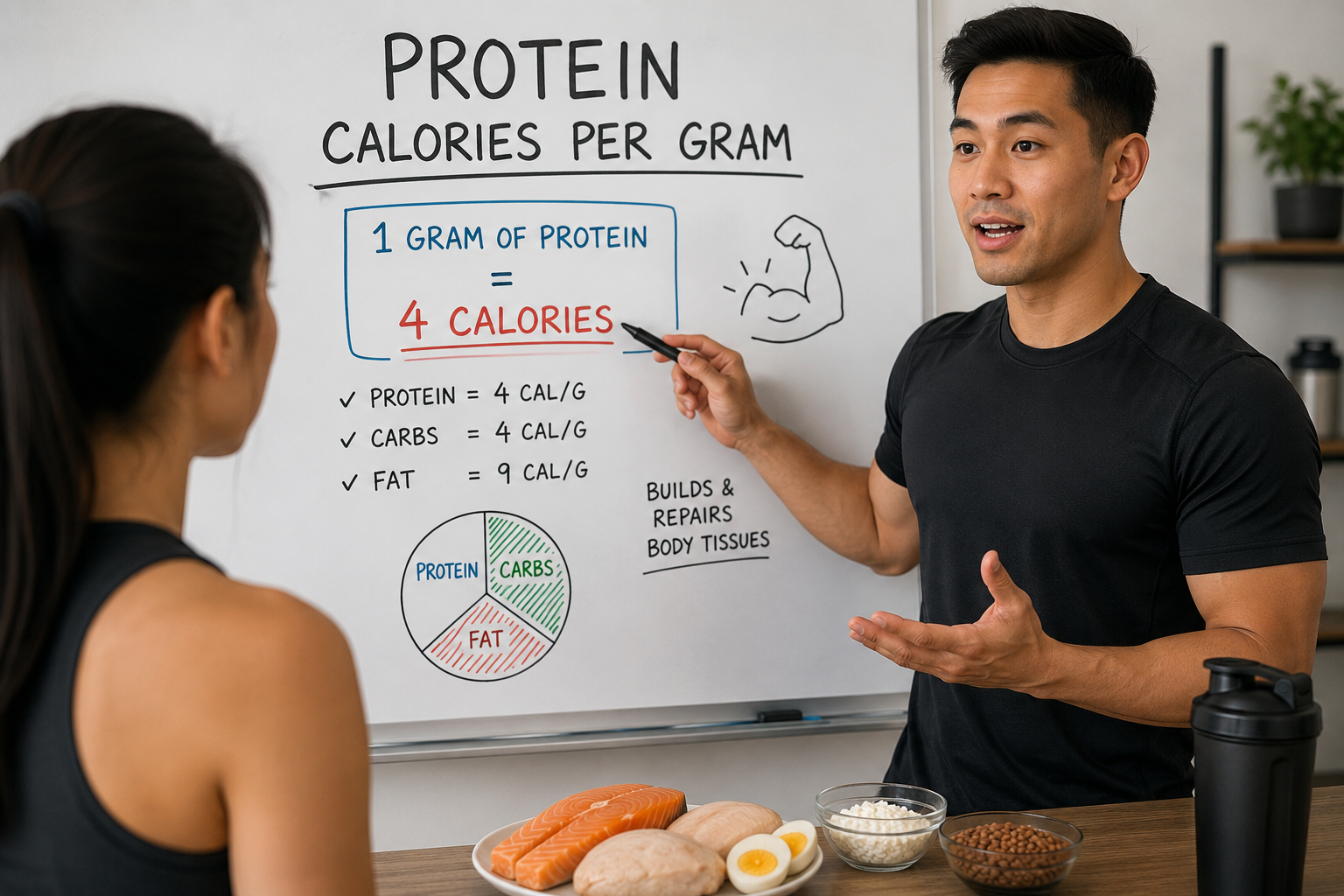
If you are tracking calories or macronutrients, you may wonder how many calories protein provides. The standard nutrition calculation is simple: one gram of protein provides about 4 calories.
That makes it possible to convert protein grams into an estimated calorie contribution. For example, 25 grams of protein would provide about 100 calories.
However, protein is only one part of total calorie intake. Carbohydrates and fat also contribute energy, and the calories listed on a food label may not always match a simple calculation perfectly.
Understanding how the protein cal per gram rule works can make nutrition labels and calorie tracking easier to interpret.
How Many Calories Are in One Gram of Protein?
Protein provides approximately 4 calories per gram.
The calculation is:
Protein calories = Protein grams × 4
For example:
- 10 g protein → about 40 calories
- 20 g protein → about 80 calories
- 25 g protein → about 100 calories
- 30 g protein → about 120 calories
- 50 g protein → about 200 calories
The USDA Food and Nutrition Information Center states that protein provides 4 calories per gram, while carbohydrates provide 4 calories per gram and fat provides 9 calories per gram.
Protein and Calories
Protein is a macronutrient that contributes energy to your diet.
When you eat foods containing protein, the protein contributes to your total calorie intake. Foods may also contain carbohydrates, fats, or both, so the total calories in a meal are usually higher than the calories coming from protein alone.
For example, suppose a food contains:
- 25 g protein
- 20 g carbohydrate
- 10 g fat
Using the standard conversion factors:
Protein: 25 × 4 = 100 calories
Carbohydrate: 20 × 4 = 80 calories
Fat: 10 × 9 = 90 calories
The estimated calorie contribution from these three macronutrients is:
100 + 80 + 90 = 270 calories
The 4 Calories Per Gram Rule
The familiar 4 calories per gram rule comes from standard Atwater factors used to estimate the energy provided by macronutrients.
The commonly used values are:
| Macronutrient | Calories per gram |
|---|---|
| Protein | 4 kcal |
| Carbohydrate | 4 kcal |
| Fat | 9 kcal |
These values are useful for estimating calorie contributions from macronutrient amounts.
The FDA also presents the standard calorie factors as 4 calories per gram for protein and carbohydrate and 9 calories per gram for fat on nutrition-label guidance.
Protein vs. Carbohydrates and Fat
Protein and carbohydrates both provide approximately 4 calories per gram, while fat provides approximately 9 calories per gram.
This means fat is more energy-dense by weight.
For example:
20 g protein = about 80 calories
20 g carbohydrate = about 80 calories
20 g fat = about 180 calories
How Protein Contributes to Total Calorie Intake
Protein calories are part of your overall daily calorie intake.
Suppose your daily diet contains 120 grams of protein:
120 × 4 = 480 calories
Approximately 480 calories would come from protein.
If your total daily intake is 2,000 calories, those protein calories represent:
480 ÷ 2,000 × 100 = 24%
So, in this example, about 24% of total calorie intake comes from protein.
Calculating Calories From Protein
Converting protein grams to calories requires only one step.
Calories from protein = Protein grams × 4
For example, if a meal contains 35 grams of protein:
35 × 4 = 140 calories
The meal therefore contains approximately 140 calories from protein.
This does not mean the entire meal contains 140 calories. If the meal also contains carbohydrates and fat, those nutrients contribute additional calories.
Quick Protein-to-Calorie Examples
| Protein | Estimated calories |
|---|---|
| 5 g | 20 kcal |
| 10 g | 40 kcal |
| 15 g | 60 kcal |
| 20 g | 80 kcal |
| 25 g | 100 kcal |
| 30 g | 120 kcal |
| 40 g | 160 kcal |
| 50 g | 200 kcal |
Protein Grams to Calories
If you are searching for a simple protein grams to calories conversion, the formula is:
Protein calories = grams of protein × 4
To reverse the calculation:
Protein grams = protein calories ÷ 4
For example, if you want approximately 160 calories from protein:
160 ÷ 4 = 40 g protein
So 40 grams of protein corresponds to approximately 160 calories.
Calories and Macronutrients
Macronutrients include protein, carbohydrates, and fat. Each contributes a different amount of energy per gram.
A simple calorie calculation is:
Total calories ≈ (protein × 4) + (carbohydrate × 4) + (fat × 9)
For example:
- 100 g protein = 400 calories
- 200 g carbohydrate = 800 calories
- 60 g fat = 540 calories
Estimated total:
400 + 800 + 540 = 1,740 calories
The FDA explains that calorie values on Nutrition Facts labels are calculated according to regulatory methods, rather than simply requiring consumers to multiply every nutrient by a single universal factor.
Protein Intake and Energy Balance
Protein contributes to energy balance because it provides calories.
If you consume more total calories than your body uses over time, body weight may increase. If you consume fewer calories than your body uses over time, weight loss may occur.
Reading Protein Information on Food Labels
Nutrition Facts labels can make it easier to determine how much protein a food provides.
Start by checking the serving size. The protein amount shown on the label generally applies to that serving.
The FDA recommends paying attention to serving size because the number of servings consumed determines how many calories and nutrients you actually consume.
Why Calorie Values Can Vary Slightly in Real Foods
The 4-calorie-per-gram rule is useful, but it is not a perfect measurement of the energy available from every food.
Food composition varies, and the body's digestion and absorption of nutrients are not identical across all foods.
USDA research has shown that the traditional Atwater system can sometimes overestimate the metabolizable energy of certain foods. For example, research on nuts found that their measured available energy can differ from values predicted by traditional factors.
Food manufacturers also use regulated methods for calculating calories on nutrition labels.
The formula is best viewed as a standardized estimate.
Using Protein Intake as Part of Total Calorie Tracking
If you track calories, protein can be one of the macronutrients you monitor alongside carbohydrates and fat.
For example, suppose your daily target is 2,000 calories and you consume 120 grams of protein:
120 × 4 = 480 calories from protein
That leaves approximately 1,520 calories for the rest of your calorie intake.
Those remaining calories can come from carbohydrates, fat, and other energy-containing components of your diet.
The Calorie Calculator can help estimate your overall daily calorie needs. You can then consider your protein intake within that larger calorie target.
Related Health Calculators
- Calorie Calculator — Estimate daily calorie requirements.
- BMR Calculator — Estimate basal metabolic rate.
- Body Fat Calculator — Estimate body fat percentage from available measurements.
Summary
Protein provides approximately 4 calories per gram.
The basic formula is:
Protein calories = Protein grams × 4
So:
- 10 g protein ≈ 40 calories
- 25 g protein ≈ 100 calories
- 50 g protein ≈ 200 calories
- 100 g protein ≈ 400 calories
Protein is only one contributor to total calorie intake. Carbohydrates also provide about 4 calories per gram, while fat provides about 9 calories per gram.
When tracking food, use the protein amount to estimate calories from protein, but rely on the total calorie value on the nutrition label for the food's overall calorie content.
For a broader view of your daily energy needs, use a Calorie Calculator and consider protein as part of your overall macronutrient and calorie intake.
References
U.S. Department of Agriculture, Agricultural Research Service. (2018). Going nuts over calories. USDA Agricultural Research Service. https://agresearchmag.ars.usda.gov/2018/mar/calories/
U.S. Department of Agriculture, National Agricultural Library. (n.d.). Food and Nutrition Information Center: Frequently asked questions. https://www.nal.usda.gov/programs/fnic
U.S. Food and Drug Administration. (2024). Calories on the Nutrition Facts label. https://www.fda.gov/food/nutrition-facts-label/calories-nutrition-facts-label
U.S. Food and Drug Administration. (2024). How to understand and use the Nutrition Facts label. https://www.fda.gov/food/nutrition-facts-label/how-understand-and-use-nutrition-facts-label
U.S. Food and Drug Administration. (2018). A food labeling guide. https://www.fda.gov/media/81606/download