
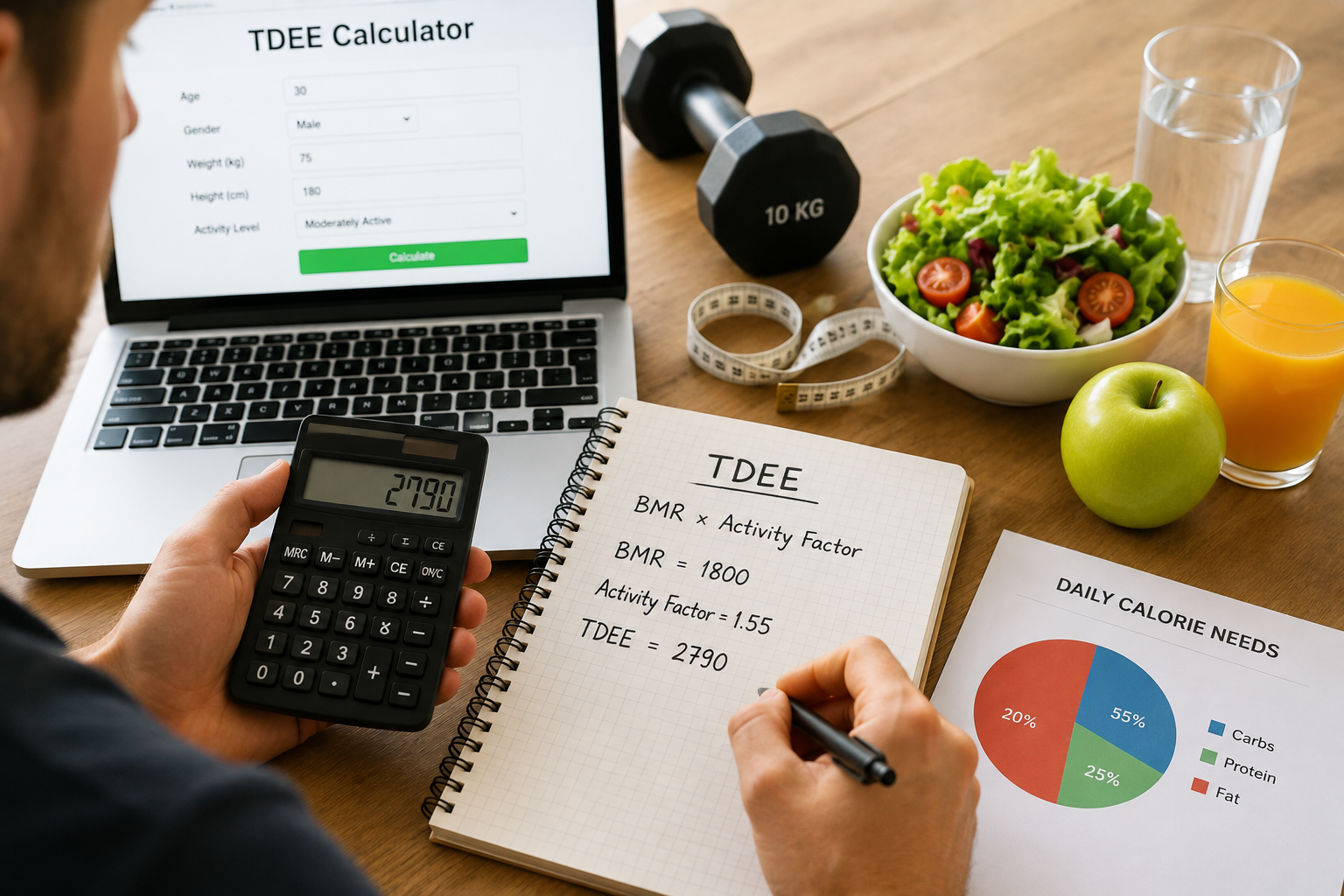
Your body uses energy throughout the day, not only when you exercise. You burn calories while your organs function, while you walk around, while you work out, and while your body digests food. Total daily energy expenditure (TDEE) is an estimate of all of that energy use over a day.
A TDEE calculator combines resting energy needs with activity to estimate the calories you may use each day. The result can provide a starting point for maintenance, weight loss, or weight gain.
What Is TDEE?
TDEE stands for total daily energy expenditure. It is the approximate amount of energy your body uses during a 24-hour period.
TDEE includes several major components:
- Basal or resting energy expenditure
- Physical activity
- Exercise
- Non-exercise activity
- Thermic effect of food
The National Academies describes total energy expenditure as including resting energy expenditure, the thermic effect of food, and physical activity. Resting energy expenditure is generally the largest component.
TDEE is therefore broader than BMR. BMR focuses on the energy needed for basic physiological functions, while TDEE represents your estimated energy use across the entire day.
What Does Total Daily Energy Expenditure Mean?
Think of TDEE as your body's estimated daily calorie budget for energy use.
If your TDEE were approximately 2,300 calories per day, eating around that amount on average might maintain your body weight over time, although real-world results can differ.
TDEE can change when body weight, activity level, body composition, or daily routine changes.
TDEE vs BMR
BMR and TDEE are related but they are not interchangeable.
BMR: Estimated energy required to support essential body functions at rest.
TDEE: Estimated total energy used during the entire day, including activity and digestion.
For example, if a person's estimated BMR is 1,500 calories, their TDEE will generally be higher because they also use energy moving around, exercising, and processing food.
Use the BMR Calculator
The BMR Calculator can estimate your basal metabolic rate. You can then use that estimate as the starting point for understanding your TDEE.
How TDEE Is Calculated
A common simplified approach is:
TDEE = BMR × Activity Factor
First, a calculator estimates BMR. It then applies an activity multiplier representing your typical level of physical activity.
For example:
BMR = 1,600 calories
Activity factor = 1.5
TDEE = 1,600 × 1.5 = 2,400 calories
The estimated TDEE is therefore 2,400 calories per day.
Basal Metabolic Rate
BMR is the foundation of many TDEE calculations.
One commonly used equation is the Mifflin-St Jeor equation, developed from measurements of resting energy expenditure in healthy adults.
For men:
BMR = (10 × weight in kg) + (6.25 × height in cm) − (5 × age) + 5
For women:
BMR = (10 × weight in kg) + (6.25 × height in cm) − (5 × age) − 161
Physical Activity and TDEE
Physical activity is one of the largest sources of variation in TDEE.
Someone who spends most of the day sitting may have a lower TDEE than someone who walks frequently, performs physical work, or exercises regularly.
Physical activity includes more than formal workouts. It includes everyday movement as well as planned exercise.
This is why selecting an activity level carefully is important when using a TDEE calculator.
Exercise Activity
Exercise is the planned, structured physical activity you perform to improve fitness or health.
Regular exercise can increase daily energy expenditure, but exercise is only one part of TDEE.
Non-Exercise Activity
Non-exercise activity thermogenesis (NEAT) refers to energy used for movement that is not sleeping, eating, or formal exercise.
It can include:
- Walking around the house
- Standing
- Cleaning
- Shopping
- Taking stairs
- Fidgeting
- General workplace movement
Thermic Effect of Food
Eating also requires energy.
The thermic effect of food (TEF) is the energy your body uses to digest, absorb, metabolize, and store nutrients. It is one of the components of total daily energy expenditure.
Activity Multipliers
Many TDEE calculators use activity categories such as:
- Sedentary: Little planned exercise and mostly sitting
- Lightly active: Some regular movement or light exercise
- Moderately active: Regular moderate exercise or an active lifestyle
- Very active: Frequent exercise or physically demanding daily activity
- Extremely active: Very high activity levels or physically demanding work combined with substantial exercise
The exact multiplier varies between calculators.
These categories should describe your overall routine, not just how often you visit the gym.
Sedentary TDEE
A sedentary TDEE is generally associated with a lifestyle involving little physical activity outside normal daily tasks.
If your BMR were 1,500 calories and a calculator used an activity factor of 1.2:
1,500 × 1.2 = 1,800 calories
The estimated TDEE would be approximately 1,800 calories.
Active TDEE
An active TDEE reflects greater daily energy expenditure from exercise and/or everyday movement.
For example, if BMR is 1,600 calories and an activity factor of 1.6 is selected:
1,600 × 1.6 = 2,560 calories
The estimated TDEE would be about 2,560 calories.
TDEE for Weight Maintenance
If your goal is to maintain your current weight, your estimated TDEE can provide a starting point for calorie intake.
For example, if your estimated TDEE is 2,400 calories, eating around 2,400 calories per day on average may be a reasonable starting maintenance estimate.
TDEE for Weight Loss
To lose weight, calorie intake generally needs to be below energy expenditure over time.
For example:
Estimated TDEE = 2,400 calories
Daily intake = 2,000 calories
Estimated difference = 400 calories
This creates a theoretical calorie deficit.
TDEE for Weight Gain
Weight gain generally requires a sustained calorie intake above energy expenditure.
For example:
Estimated TDEE = 2,400 calories
Daily intake = 2,700 calories
Estimated surplus = 300 calories
Why TDEE Is an Estimate
No standard online calculator can know exactly how many calories you burn every day.
Therefore, treat a calculator result as an estimate rather than an exact metabolic measurement.
How to Use a TDEE Calculator
To get a useful estimate:
- Enter your current weight accurately.
- Enter your height and age.
- Select the appropriate sex setting.
- Choose the activity level that best matches your normal routine.
- Review your estimated TDEE.
- Use it as a starting point for your calorie goal.
- Monitor your results over several weeks.
- Recalculate when your body weight or activity level changes significantly.
Related Health Calculators
- BMR Calculator — Estimate your basal metabolic rate.
- Calorie Calculator — Estimate daily calorie needs.
- Body Fat Calculator — Estimate body fat percentage from available measurements.
Summary
A TDEE calculator free tool estimates how many calories your body may use in a typical day by combining resting energy expenditure with physical activity and the thermic effect of food.
TDEE is broader than BMR. BMR represents the energy needed for basic physiological functions, while TDEE includes daily movement, exercise, non-exercise activity, and digestion.
A common simplified formula is:
TDEE = BMR × Activity Factor
For example, a 1,600-calorie BMR multiplied by an activity factor of 1.5 produces an estimated TDEE of 2,400 calories.
Use the result as a starting point for weight maintenance, weight loss, or weight gain. Because real energy expenditure varies, compare the estimate with your longer-term results and adjust your calorie intake when necessary.
References
Levine, J. A. (2004). Non-exercise activity thermogenesis (NEAT). Best Practice & Research Clinical Endocrinology & Metabolism, 18(4), 679–702. https://doi.org/10.1016/j.beem.2004.08.002
Mifflin, M. D., St Jeor, S. T., Hill, L. A., Scott, B. J., Daugherty, S. A., & Koh, Y. O. (1990). A new predictive equation for resting energy expenditure in healthy individuals. The American Journal of Clinical Nutrition, 51(2), 241–247. https://doi.org/10.1093/ajcn/51.2.241
National Academies of Sciences, Engineering, and Medicine. (2023). Dietary reference intakes for energy. National Academies Press. https://www.ncbi.nlm.nih.gov/books/NBK591031/
National Institute of Diabetes and Digestive and Kidney Diseases. (n.d.). Body Weight Planner. National Institutes of Health. https://www.niddk.nih.gov/health-information/weight-management/body-weight-planner