
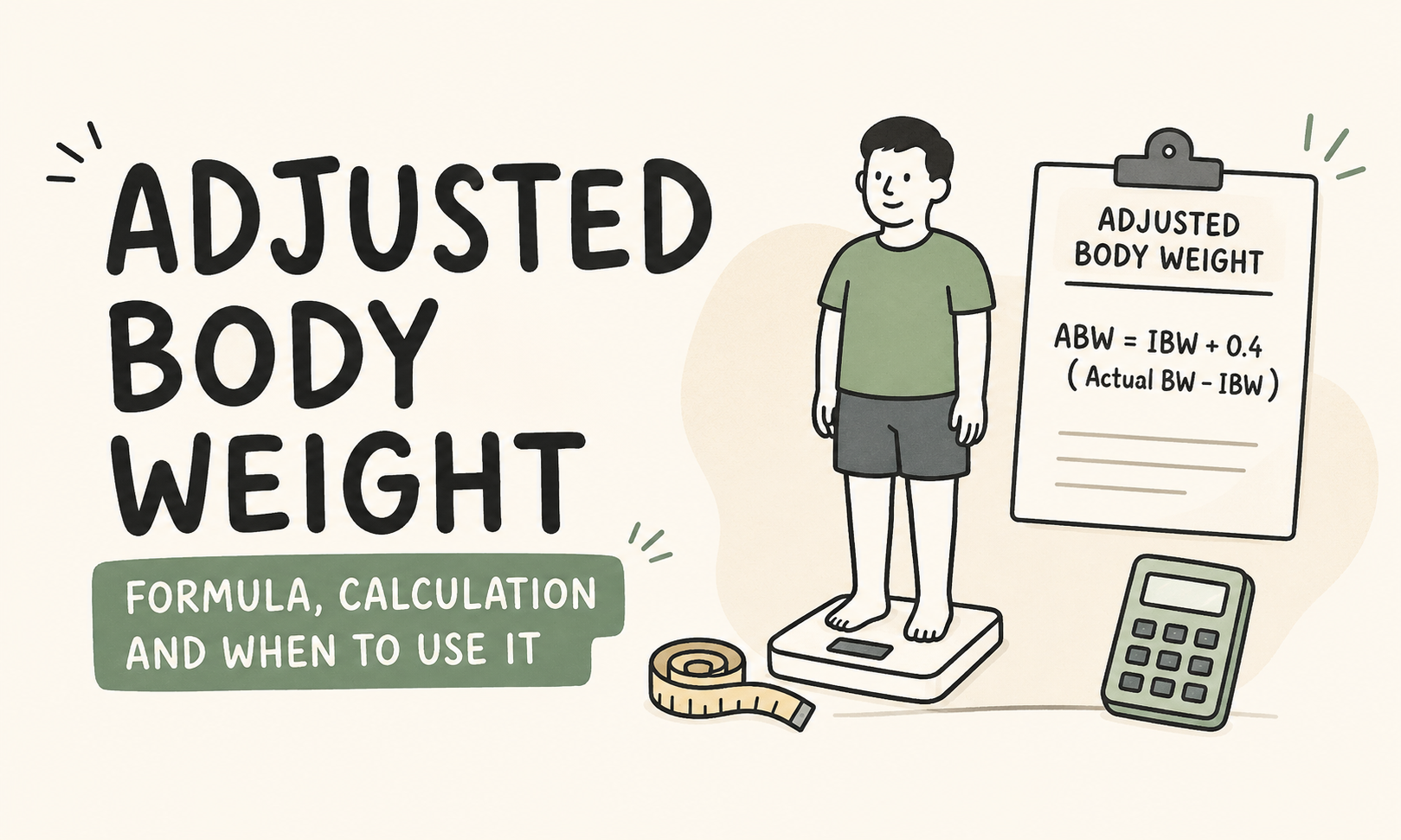
Adjusted Body Weight: Formula, Calculation and When to Use It
Adjusted body weight (AdjBW) is a specialized calculation used in some clinical settings when actual body weight may not be the most appropriate value for a particular medication or dosing calculation.
Unlike a general ideal body weight calculation, adjusted body weight takes both actual body weight and ideal body weight into account. A commonly used equation assumes that only a portion of the difference between actual and ideal weight should be included in the adjusted value.
This makes adjusted body weight a technical concept rather than a general recommendation for what someone should weigh.
What Is Adjusted Body Weight?
Adjusted body weight is a calculated value between ideal and actual body weight when actual weight is substantially higher.
A commonly used equation is:
AdjBW = IBW + 0.4 × (ABW − IBW)
Where:
- AdjBW = adjusted body weight
- IBW = ideal body weight
- ABW = actual body weight
The factor 0.4 is sometimes called the adjustment factor.
The purpose is not to identify a person's "healthy weight." Instead, adjusted body weight is used in selected clinical calculations where the relationship between body size and medication distribution or clearance may make actual body weight alone less suitable.
Different institutions, medications, and clinical protocols may use different methods. Therefore, a calculator result should not automatically be used to determine a medication dose.
Adjusted Body Weight vs. Actual Body Weight
Actual body weight (ABW) is simply the person's current measured weight.
Adjusted body weight is different. It is calculated from actual weight and ideal body weight.
For example, if:
- Actual body weight = 100 kg
- Ideal body weight = 70 kg
Then the difference is:
100 − 70 = 30 kg
Using an adjustment factor of 0.4:
70 + (0.4 × 30) = 82 kg
The adjusted value is therefore 82 kg.
It is important to remember that this number does not mean the person's "real" weight is 82 kg. Their actual weight remains 100 kg. Adjusted body weight is simply a calculated value used for a specific purpose.
Why Is Adjusted Body Weight Calculated?
Adjusted body weight is mainly relevant to specialized clinical calculations.
For some medications, using actual body weight in a person with substantial excess body weight may produce a different dose than using ideal body weight. In selected circumstances, an adjusted value may be considered as an alternative.
The concept is based on the fact that excess body weight is not composed entirely of tissue that contributes to drug distribution in the same way as lean tissue.
However, this does not mean adjusted body weight is appropriate for every medication.
Drug dosing can depend on the specific medication, kidney function, liver function, body composition, clinical condition, and local protocol.
For this reason, adjusted body weight should be treated as a clinical calculation rather than a general-purpose health metric.
Adjusted Body Weight Formula
The commonly used adjusted body weight formula is:
AdjBW = IBW + 0.4 × (ABW − IBW)
You can also think of it as:
AdjBW = IBW + 40% of the difference between actual and ideal body weight
The calculation requires:
- Ideal body weight
- Actual body weight
- Adjustment factor
The 0.4 factor is used in some protocols, but it is not universal. A medication-specific or institutional protocol may specify another approach. citeturn0search0turn0search2
That distinction is particularly important when the calculation is being considered for medication dosing.
Step-by-Step Adjusted Body Weight Calculation
Let's work through the calculation using simple numbers.
Suppose:
- Actual body weight = 100 kg
- Ideal body weight = 70 kg
- Adjustment factor = 0.4
Step 1: Calculate the difference
Subtract ideal body weight from actual body weight:
100 − 70 = 30 kg
Step 2: Multiply by the adjustment factor
30 × 0.4 = 12 kg
Step 3: Add the result to ideal body weight
70 + 12 = 82 kg
Therefore:
Adjusted body weight = 82 kg
Example Calculation
Another example:
- Actual body weight = 120 kg
- Ideal body weight = 75 kg
Using the 0.4 adjustment factor:
AdjBW = 75 + 0.4 × (120 − 75)
First calculate the difference:
120 − 75 = 45 kg
Then calculate 40%:
45 × 0.4 = 18 kg
Finally:
75 + 18 = 93 kg
The adjusted body weight is 93 kg.
Again, 93 kg is not the person's actual weight or a recommended target; it is the output of the selected formula.
Ideal Body Weight vs. Adjusted Body Weight
Ideal body weight (IBW) is an estimated reference weight commonly calculated from height and, depending on the equation, sex.
Adjusted body weight (AdjBW) uses ideal body weight and actual body weight to create another calculated value.
IBW → reference estimate
ABW → measured current weight
AdjBW → calculated value using both IBW and ABW
If you need to calculate ideal body weight first, you can use the Howtigo Ideal Body Weight Calculator.
When Is Adjusted Body Weight Used?
Adjusted body weight is most relevant in specialized clinical settings, particularly when healthcare professionals are evaluating medication dosing in people with obesity or substantial excess body weight.
It may appear in protocols for selected medications where body size affects pharmacokinetics. Evidence is medication-specific, so the same weight descriptor should not be assumed for every drug. citeturn0search3turn0search10
However, there is no universal rule that adjusted body weight should be used whenever someone has obesity.
The appropriate weight scalar can vary according to the medication and clinical situation. Some drugs may use actual body weight, some ideal body weight, some adjusted body weight, and others use a different dosing strategy entirely.
A clinician or pharmacist should therefore determine which calculation is appropriate.
Important Limitations
The adjusted body weight formula is useful only when the underlying assumptions are appropriate.
Important limitations include:
- The 0.4 adjustment factor is not universal.
- Different medications may require different dosing methods.
- Ideal body weight depends on the selected formula.
- Body composition differs substantially between individuals.
- Kidney and liver function can affect dosing.
- Evidence and clinical guidance can change. citeturn0search3turn0search8
Do not use an adjusted body weight calculation by itself to change a prescription dose.
If you are calculating a value for medication dosing, follow the medication's official prescribing information and the instructions of a qualified healthcare professional.
Using a Calculator
Manual calculation is useful for understanding the formula, but a calculator can reduce arithmetic errors when you need to repeat the calculation.
A practical workflow is:
- Determine the appropriate ideal body weight.
- Confirm actual body weight.
- Check the relevant medication or clinical protocol.
- Calculate adjusted body weight.
- Use it only for the intended calculation.
The Howtigo Ideal Body Weight Calculator can help with the ideal body weight part of the process, but it should not be considered a substitute for medication-specific dosing guidance.
Summary
Adjusted body weight is a specialized calculated value that uses actual body weight and ideal body weight.
The commonly used equation is:
AdjBW = IBW + 0.4 × (ABW − IBW)
Remember:
- Adjusted body weight is not the same as actual body weight.
- It is not a recommended target weight.
- It is different from ideal body weight.
- The 0.4 adjustment factor is not universal.
- It may be used in selected clinical and medication-dosing situations.
- The appropriate calculation depends on the medication and clinical protocol.
- A calculated AdjBW should not be used by itself to change medication doses.
Because this is a specialized medical calculation, use it with relevant clinical guidance rather than as a general measure of healthy weight.
Calculate Ideal Body Weight with the Howtigo Ideal Body Weight Calculator
References
Pai, M. P., & Paloucek, F. P. (2000). The origin of the "ideal" body weight equations. The Annals of Pharmacotherapy, 34(9), 1066–1069. https://doi.org/10.1345/aph.19381
Pai, M. P. (2012). Drug dosing based on weight and body surface area: Mathematical assumptions and limitations in obese adults. Pharmacotherapy, 32(9), 856–868. https://doi.org/10.1002/j.1875-9114.2012.01108.x
Roberts, G. W., et al. (2025). Determination of the optimal obesity-adjusted dosing weight for enoxaparin. British Journal of Clinical Pharmacology, 91(4), 1182–1190. https://doi.org/10.1111/bcp.16338