
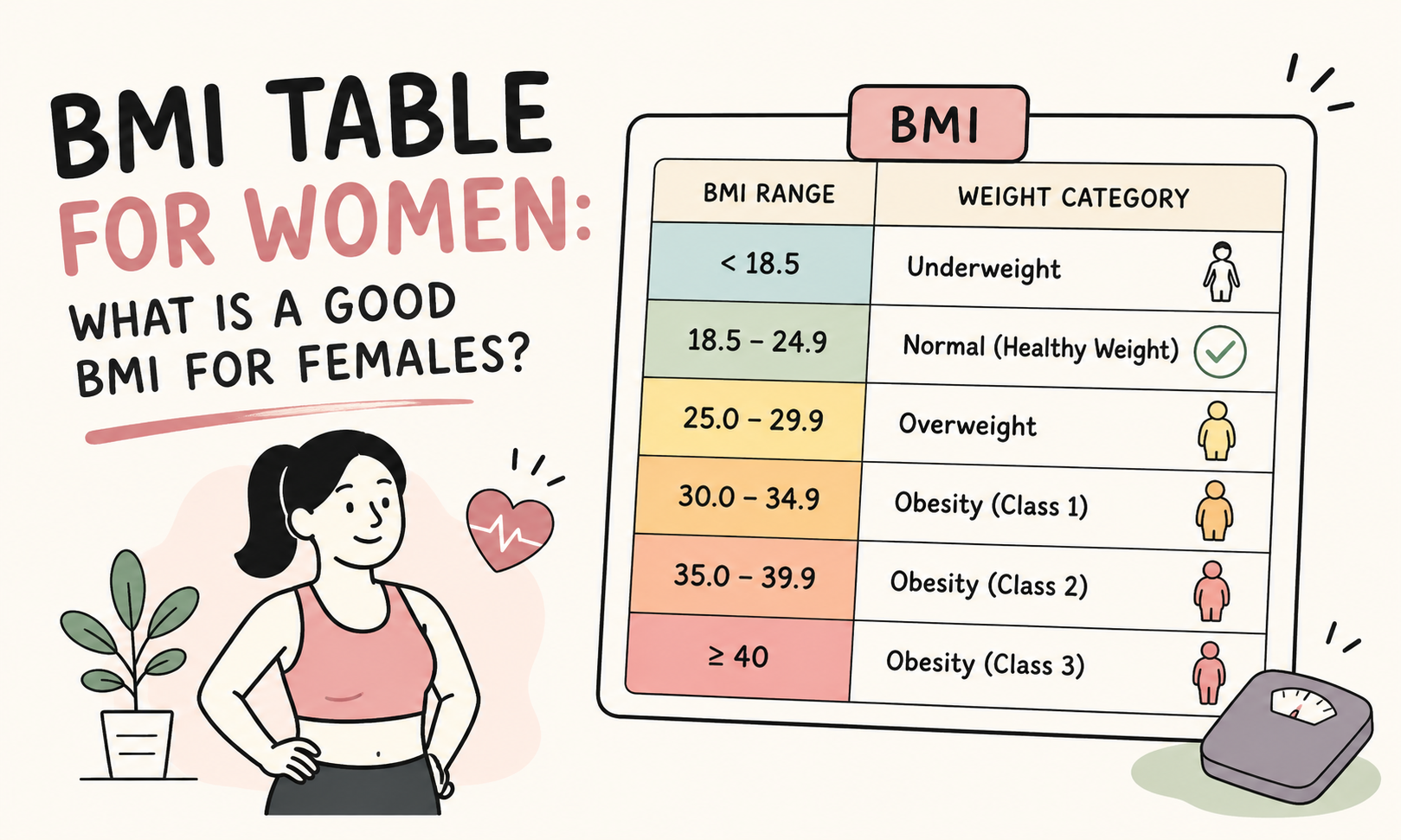
BMI Table for Women: What Is a Good BMI for Females?
If you are searching for a BMI table for female adults, you may want to know what BMI is considered healthy for women and whether women have different BMI ranges from men.
For adults, the standard BMI categories are generally the same for women and men. A BMI from 18.5 to less than 25 is classified as healthy weight, while lower or higher values fall into other screening categories. citeturn0search22turn0search0
However, BMI is only a screening measure. It uses height and weight but does not directly measure body fat, muscle mass, or fat distribution. This means two women with the same BMI can have different body compositions.
This guide explains the adult BMI categories for women, how to calculate BMI, and why a "good BMI for women" should be interpreted alongside other health information.
What Is BMI?
Body mass index (BMI) is a numerical value calculated from weight and height.
The standard formula is:
BMI = weight in kilograms ÷ height in meters²
For example, a woman who weighs 60 kg and is 1.65 meters tall has:
BMI = 60 ÷ (1.65 × 1.65)
BMI = 22.0
BMI is commonly used to screen adults for weight categories. It is simple, inexpensive, and does not require specialized equipment. The CDC uses fixed BMI categories for adults rather than separate categories for women and men. citeturn0search0turn0search22
BMI Categories for Adults
The standard adult BMI categories are:
| BMI | Weight status |
|---|---|
| Below 18.5 | Underweight |
| 18.5–24.9 | Healthy weight |
| 25.0–29.9 | Overweight |
| 30.0 or higher | Obesity |
These categories apply to adult women and men. In other words, there is not a separate standard BMI cutoff specifically for adult women. citeturn0search22
BMI Table for Women
The following BMI table for women uses the standard adult categories.
| BMI range | Category | General interpretation |
|---|---|---|
| Less than 18.5 | Underweight | Below the standard healthy-weight range |
| 18.5–24.9 | Healthy weight | Standard adult healthy-weight category |
| 25.0–29.9 | Overweight | Above the standard healthy-weight category |
| 30.0+ | Obesity | Above the standard obesity threshold |
The healthy-weight category is what people often mean by a good BMI for women.
What Is Considered a Healthy BMI?
For adult women, a BMI of 18.5 to less than 25 falls within the standard healthy-weight category.
This same range is used for adult men. The standard adult BMI classification does not change simply because someone is female.
Is There a Different BMI Range for Women?
For standard adult BMI screening, no. The standard categories are the same for women and men.
Men and women can differ in body composition, even at similar BMI values.
BMI does not adjust for these differences because it is calculated using only height and weight.
For children and teenagers, the interpretation is different. BMI is assessed using age- and sex-specific growth references rather than the fixed adult categories.
How to Calculate BMI
You can calculate BMI manually using:
BMI = weight (kg) ÷ height (m)²
For example:
- Weight = 70 kg
- Height = 1.70 m
Calculation:
70 ÷ (1.70 × 1.70) = 24.2
The BMI is approximately 24.2, which falls within the standard adult healthy-weight category.
If your weight is in pounds and height is in inches, the commonly used formula is:
BMI = 703 × weight (lb) ÷ height (in)²
Use the Howtigo BMI Calculator
BMI vs. Ideal Body Weight
BMI and ideal body weight are not the same measurement.
BMI uses your actual weight and height to produce a numerical index.
An ideal body weight formula usually produces an estimated reference weight based mainly on height and, depending on the formula, sex.
For example, an ideal body weight calculator might estimate one reference weight for a woman based on her height, while BMI can show whether her current weight falls within a standard BMI category.
You can use the Howtigo Ideal Body Weight Calculator if you want a separate formula-based ideal-weight estimate.
Limitations of BMI
BMI has several important limitations.
It does not directly measure:
- Body-fat percentage
- Muscle mass
- Bone density
- Fat distribution
- Fitness level
- Individual body composition
A woman who has substantial muscle mass may have a higher BMI because muscle contributes to body weight. Conversely, someone with a BMI in the standard healthy range may still have relatively high body fat.
CDC guidance describes BMI as an initial screening measure and notes that other factors, including fat distribution and fitness, contribute to health risk. citeturn0search22
When BMI May Not Accurately Reflect Body Composition
BMI may be less informative when body composition differs substantially from the assumptions behind the height-and-weight calculation.
Examples include:
Muscular women
Women who participate in strength training or have unusually high muscle mass may weigh more for their height. BMI may therefore classify them into a higher category without accurately reflecting their body-fat level.
Older adults
Older adults can experience changes in muscle mass and body fat as they age. A similar BMI can therefore represent different body compositions in different people.
Pregnancy
Standard adult BMI categories are not intended to assess pregnancy weight gain. Pregnancy requires pregnancy-specific recommendations based on factors such as pre-pregnancy BMI and clinical guidance.
Different body-fat distributions
Two women can have the same BMI while storing body fat differently. BMI cannot identify these differences.
What About a "Body BMI Calculator Male"?
If you encountered the keyword body BMI calculator male, the calculation itself is the same for adult men and women:
BMI = weight ÷ height²
The standard adult BMI categories are also the same for both sexes. What differs between individuals is their body composition and health context, not the basic adult BMI equation or standard cutoff categories. citeturn0search22
Using a BMI Calculator
A BMI calculator is useful when you want a quick result without manually applying the formula.
To use one:
- Enter your weight.
- Enter your height.
- Select the appropriate units.
- Calculate your BMI.
- Compare the result with the standard adult categories.
- Consider the result alongside other health information.
Calculate Your BMI with the Howtigo BMI Calculator
If your BMI is outside the standard healthy-weight category, it does not automatically diagnose a health problem. Discuss concerns about your weight or health risks with a qualified healthcare professional.
Summary
A BMI table for women uses the same standard adult BMI categories as the table for men.
The key points are:
- BMI is calculated from weight and height.
- For adults, 18.5 to less than 25 is the standard healthy-weight category.
- Adult BMI cutoffs are generally the same for women and men.
- BMI does not directly measure body fat or muscle mass.
- Muscular women may have a higher BMI without having excessive body fat.
- Pregnancy requires different weight-assessment guidance.
- BMI is a screening measure, not a complete health assessment.
- Ideal body weight and BMI are different calculations.
Use a BMI calculator to identify your standard adult category, then consider the result alongside broader health information.
Use the Howtigo BMI Calculator
Calculate Your Ideal Body Weight
References
Centers for Disease Control and Prevention. (2024). Adult BMI categories. https://www.cdc.gov/bmi/adult-calculator/bmi-categories.html
Centers for Disease Control and Prevention. (2024). About body mass index (BMI) for adults. https://www.cdc.gov/bmi/about/index.html
Centers for Disease Control and Prevention. (2017). National Health and Nutrition Examination Survey: Anthropometry procedures manual. https://stacks.cdc.gov/view/cdc/51795/
National Heart, Lung, and Blood Institute. (1998). Clinical guidelines on the identification, evaluation, and treatment of overweight and obesity in adults. National Institutes of Health. https://www.nhlbi.nih.gov/health-pro/guidelines/current/obesity-guidelines
Flegal, K. M., Kit, B. K., & Graubard, B. I. (2014). Body mass index categories in observational studies of weight and risk of death. American Journal of Epidemiology, 180(3), 288–296. https://doi.org/10.1093/aje/kwu120