
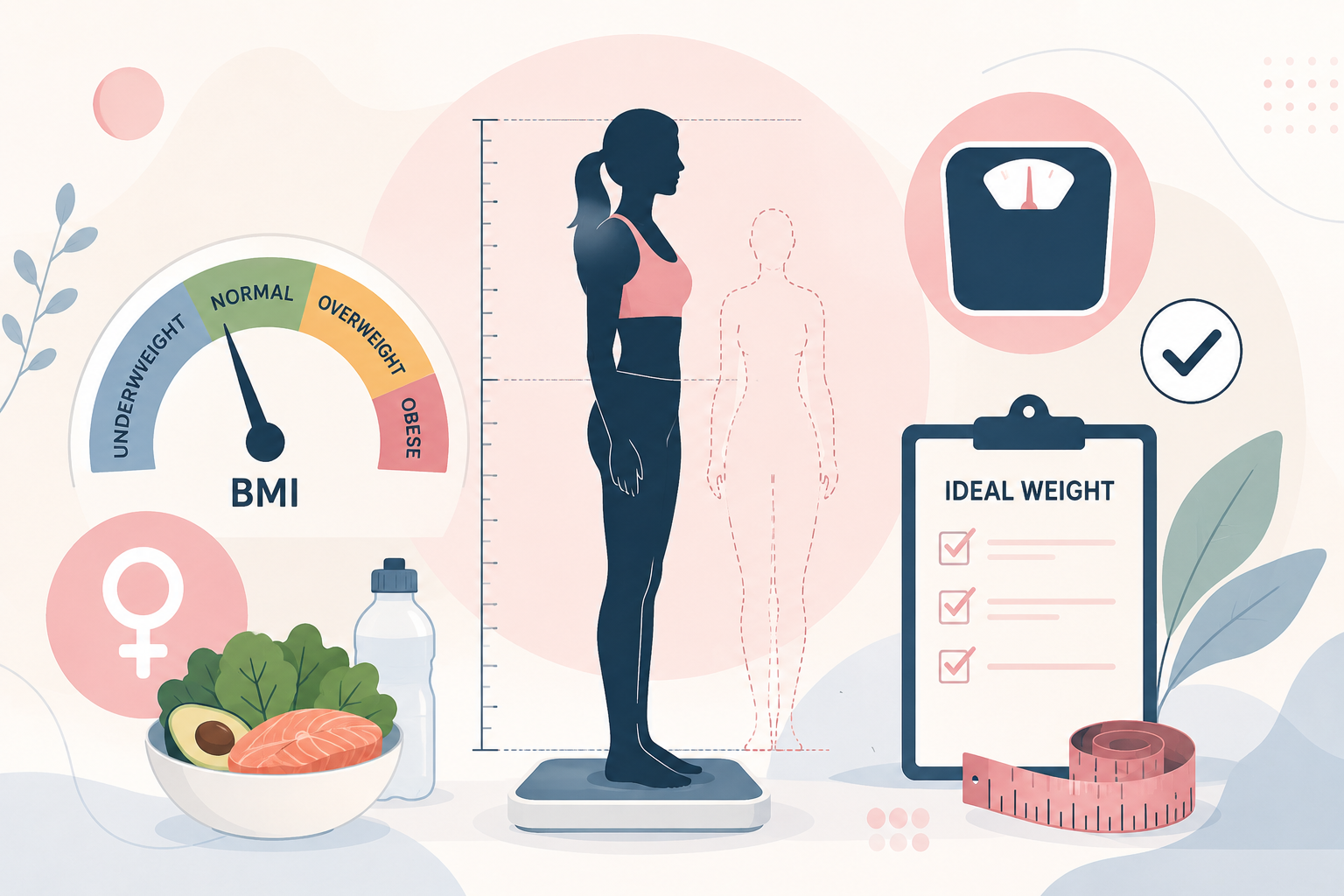
BMI and Ideal Weight for Women: What Should You Weigh?
If you are looking for a BMI calculator for female ideal weight, you may want to know what weight is healthy for your height. BMI can help estimate a standard healthy-weight range, while an ideal body weight formula provides a separate reference estimate.
For adult women, the standard BMI categories are the same as those used for adult men. A BMI from 18.5 to less than 25 is classified as the healthy-weight category.
How BMI Is Calculated for Women
BMI is calculated from two measurements:
BMI = weight in kilograms ÷ height in meters²
The calculation is the same for adult women and men.
For example, suppose a woman weighs 65 kg and is 1.65 m tall:
BMI = 65 ÷ (1.65 × 1.65)
BMI = 23.9
Her BMI is approximately 23.9, which falls within the standard adult healthy-weight category.
If your height is recorded in centimeters, convert it to meters first:
165 cm ÷ 100 = 1.65 m
You can also use an online calculator to perform the conversion and calculation automatically.
Healthy BMI Range for Women
For adult women, the standard BMI categories are:
| BMI | Adult weight category |
|---|---|
| Below 18.5 | Underweight |
| 18.5–24.9 | Healthy weight |
| 25.0–29.9 | Overweight |
| 30.0 or higher | Obesity |
These categories are standard adult screening categories and do not change simply because a person is female.
A healthy weight for women by BMI therefore generally refers to a BMI between 18.5 and less than 25.
However, BMI categories should not be treated as exact boundaries between healthy and unhealthy people. A BMI of 24.9 and 25.0 are very close numerically.
Does BMI Differ for Women?
For standard adult BMI calculations, no. The formula and standard categories are generally the same for women and men.
For children and teenagers, BMI is interpreted differently using age- and sex-specific growth references.
BMI and Ideal Weight for Women
BMI and ideal body weight answer different questions.
BMI asks:
How does my current weight relate to my height?
Ideal body weight asks:
What reference weight does a selected formula estimate for my height?
A traditional ideal body weight equation may use sex-specific values.
For example, the Devine formula for women is:
IBW = 45.5 kg + 2.3 kg × each inch over 5 feet
A woman who is 5 feet 6 inches tall would have:
45.5 + (2.3 × 6) = 59.3 kg
This is a formula-based estimate, not a required or perfect weight.
You can calculate a separate estimate using the Howtigo Ideal Body Weight Calculator.
Ideal Weight for Women by Height
Height strongly affects both BMI-based weight ranges and traditional ideal body weight estimates.
For example, using the Devine formula:
| Female height | Estimated Devine IBW |
|---|---|
| 5'0" | 45.5 kg |
| 5'2" | 50.1 kg |
| 5'4" | 54.7 kg |
| 5'6" | 59.3 kg |
| 5'7" | 61.6 kg |
| 5'8" | 63.9 kg |
| 5'10" | 68.5 kg |
For a broader height-based reference, see the Howtigo Female Height and Weight Chart.
BMI and Weight for a 5'2 Female in kg
A woman who is 5 feet 2 inches tall is approximately 1.575 m.
To estimate the weight associated with the standard adult healthy BMI range, use:
Weight = BMI × height²
At the lower boundary:
18.5 × 1.575² ≈ 45.9 kg
At the upper boundary:
24.9 × 1.575² ≈ 61.8 kg
So a 5'2 adult woman has an approximate 45.9–61.8 kg weight range corresponding to BMI 18.5–24.9.
BMI and Weight for a 5'7 Female
A woman who is 5 feet 7 inches tall is approximately 1.702 m.
Using the same BMI-based calculation:
Lower boundary:
18.5 × 1.702² ≈ 53.6 kg
Upper boundary:
24.9 × 1.702² ≈ 72.1 kg
So the approximate weight range associated with BMI 18.5–24.9 is 53.6–72.1 kg.
Ideal BMI for a 5-Foot Female
A 5-foot female is approximately 1.524 m tall.
The corresponding weight range is approximately:
Lower boundary:
18.5 × 1.524² ≈ 43.0 kg
Upper boundary:
24.9 × 1.524² ≈ 57.8 kg
BMI in Kilograms and Centimeters
If you use kilograms and centimeters, the metric BMI formula requires height in meters.
For example:
- Weight = 70 kg
- Height = 170 cm
Convert:
170 cm = 1.70 m
Then:
BMI = 70 ÷ (1.70 × 1.70)
BMI = 24.2
If you use pounds and inches instead, the formula is:
BMI = 703 × weight in pounds ÷ height in inches²
The underlying BMI calculation is the same; only the units and conversion factor change.
Why BMI Does Not Directly Measure Body Fat
BMI is useful because it is simple, but it has an important limitation: it does not directly measure body fat.
Two women can have the same BMI while having different:
- Muscle mass
- Body-fat percentages
- Bone structure
- Fat distribution
- Fitness levels
For example, a woman who has developed significant muscle through resistance training may weigh more and have a higher BMI without having excessive body fat.
Conversely, a woman with a BMI in the standard healthy-weight category may still have a relatively high body-fat percentage.
This is why BMI should be interpreted as a screening measure rather than a complete description of body composition.
Pregnancy and BMI Considerations
Pregnancy requires special consideration.
Standard adult BMI categories are not intended to evaluate whether pregnancy weight gain is appropriate. Pregnancy weight recommendations are based on factors such as pre-pregnancy BMI and should be discussed with a healthcare professional.
If you are pregnant or planning a pregnancy, use guidance from your maternity or healthcare provider rather than applying a standard adult BMI range to pregnancy weight gain.
How to Use a Female BMI Calculator
Using a female BMI calculator is simple:
- Enter your current weight.
- Enter your height.
- Select kilograms and centimeters or pounds and inches.
- Calculate your BMI.
- Compare the result with the standard adult BMI categories.
- Consider the result alongside other health information.
The Howtigo BMI Calculator can calculate BMI from your height and weight.
If you also want a formula-based reference weight, use the Howtigo Ideal Body Weight Calculator.
Summary
If you are searching for a BMI calculator female ideal weight, remember that BMI and ideal body weight are different calculations.
Key points:
- The adult BMI formula is the same for women and men.
- The standard adult healthy BMI category is 18.5 to less than 25.
- Height determines the weight range associated with a particular BMI.
- A 5'2 female has an approximate healthy-BMI weight range of 45.9–61.8 kg.
- A 5'7 female has an approximate healthy-BMI weight range of 53.6–72.1 kg.
- A 5-foot female has an approximate healthy-BMI weight range of 43.0–57.8 kg.
- Traditional ideal body weight formulas provide a separate reference estimate.
- BMI does not directly measure body fat.
- Pregnancy requires different weight-assessment guidance.
- Use the Howtigo BMI Calculator to calculate your BMI and the Howtigo Ideal Body Weight Calculator to calculate a formula-based reference weight.
References
Centers for Disease Control and Prevention. (2024). Adult BMI categories. https://www.cdc.gov/bmi/adult-calculator/bmi-categories.html
Centers for Disease Control and Prevention. (2011). Body mass index: Considerations for practitioners. https://stacks.cdc.gov/view/cdc/25368/
Centers for Disease Control and Prevention. (2017). National Health and Nutrition Examination Survey: Anthropometry procedures manual. https://stacks.cdc.gov/view/cdc/51795/
Centers for Disease Control and Prevention. (2024). Weight gain during pregnancy. https://www.cdc.gov/maternal-infant-health/pregnancy-weight/index.html
Institute of Medicine. (2009). Weight gain during pregnancy: Reexamining the guidelines. National Academies Press. https://doi.org/10.17226/12584
Pai, M. P., & Paloucek, F. P. (2000). The origin of the "ideal" body weight equations. The Annals of Pharmacotherapy, 34(9), 1066–1069. https://doi.org/10.1345/aph.19381