
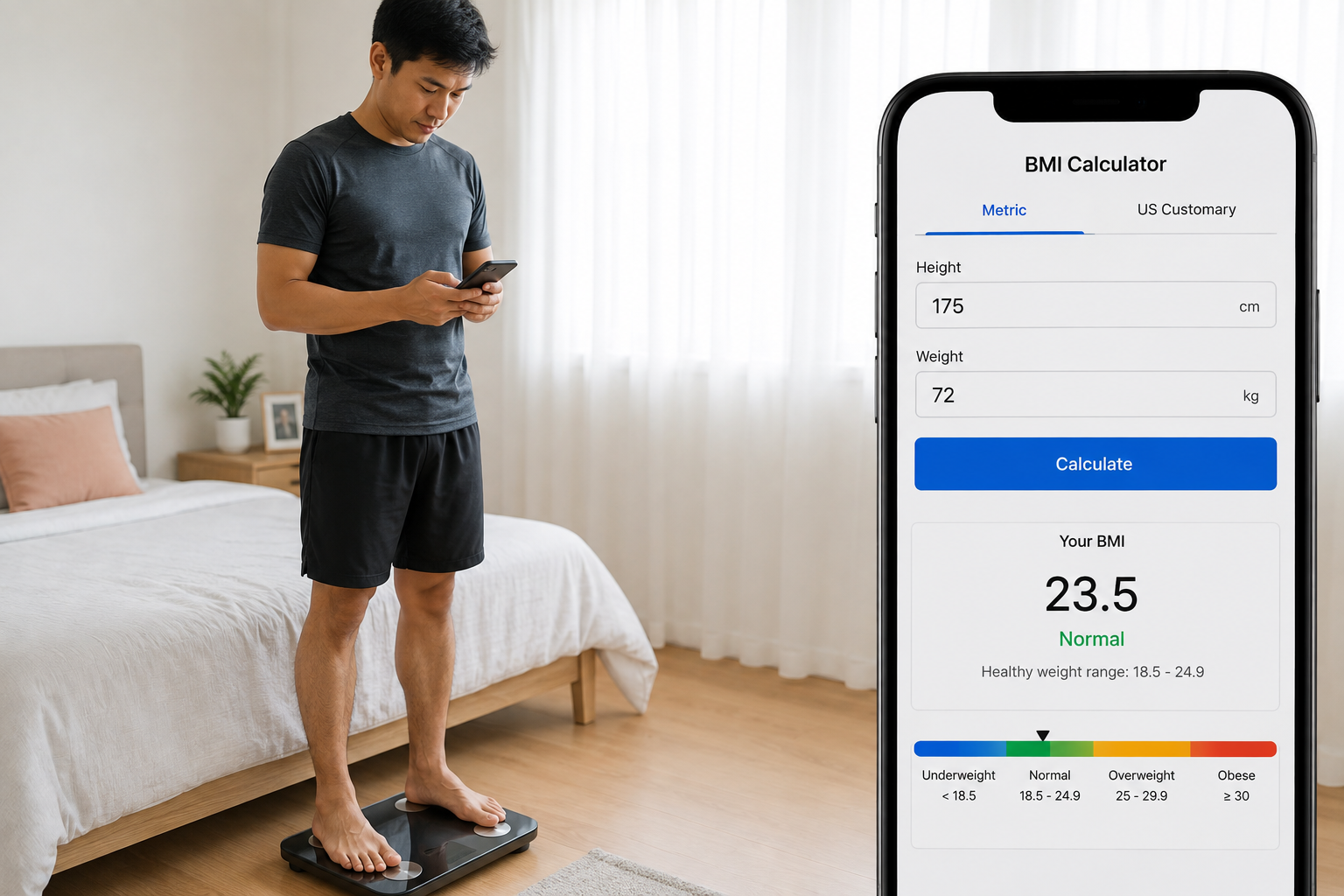
BMI Calculator Using Height and Weight: How to Calculate Your BMI
A BMI calculator using height and weight gives you a quick way to calculate your body mass index (BMI) and see which standard adult weight category your result falls into.
BMI uses two measurements: your current weight and your height. You can calculate it manually with metric measurements or pounds and inches, or enter the measurements into an online calculator.
The result can be useful for screening, but BMI is not a direct measurement of body fat and does not tell you everything about your health. Muscle mass, age, sex, and body-fat distribution can affect how a BMI value should be interpreted.
What Is BMI?
Body mass index (BMI) is a numerical measure of weight relative to height. It is widely used as a screening measure for adults.
The standard adult categories are:
| BMI | Adult weight category |
|---|---|
| Below 18.5 | Underweight |
| 18.5–24.9 | Healthy weight |
| 25.0–29.9 | Overweight |
| 30.0 or higher | Obesity |
These categories are intended for adults. Children and teenagers are assessed differently using BMI-for-age references that account for age and sex.
How BMI Is Calculated From Height and Weight
The metric BMI formula is:
BMI = weight in kilograms ÷ height in meters²
For example, if you weigh 70 kg and are 1.75 m tall:
BMI = 70 ÷ (1.75 × 1.75) = 22.9
The important detail is that height must be entered in meters for the metric formula.
How to Calculate BMI in kg and cm
If your measurements are in kilograms and centimeters, convert centimeters to meters first.
For example:
- Weight = 80 kg
- Height = 180 cm
Convert height:
180 cm ÷ 100 = 1.80 m
Then:
BMI = 80 ÷ (1.80 × 1.80) = 24.7
So the BMI is approximately 24.7.
An online calculator can accept centimeters directly and perform the conversion automatically.
How to Calculate BMI in Pounds and Inches
If you use pounds and inches, the formula is:
BMI = 703 × weight in pounds ÷ height in inches²
For example, someone weighing 154 lb and measuring 68 inches tall has:
BMI = 703 × 154 ÷ (68 × 68) ≈ 23.4
The 703 is a conversion factor that allows the formula to use pounds and inches.
What Is a Healthy BMI?
For adults, a BMI from 18.5 to less than 25 is classified as healthy weight. BMI below 18.5 is underweight, 25 to less than 30 is overweight, and 30 or higher is obesity.
These are screening categories rather than exact boundaries between healthy and unhealthy people. There is also no single "perfect BMI" that everyone should achieve.
What Does Your BMI Number Mean?
Your BMI provides a starting point for understanding how your current weight relates to your height.
Examples:
- BMI 17.8: below the standard adult healthy-weight category.
- BMI 22.0: within the standard adult healthy-weight category.
- BMI 27.0: within the standard adult overweight category.
- BMI 32.0: within the standard adult obesity category.
The category does not explain why a person's BMI is high or low. Significant weight changes or health concerns should be interpreted in context.
Why BMI Is Only a Screening Measure
BMI is useful because it is simple, but it has important limitations.
BMI does not distinguish between:
- Muscle and fat
- Bone and other lean tissue
- Different patterns of body-fat distribution
- Individual differences in body composition
A muscular person may have a higher BMI because muscle contributes to total body weight. CDC guidance notes that muscle mass, age, sex, and other factors can affect the relationship between BMI and body fat.
BMI also does not show where body fat is stored. Two people can have the same BMI but different waist measurements and body compositions.
BMI and Body Composition
Body composition describes what your body weight is made of, including fat mass and lean tissue.
Two people who are both 80 kg and 1.80 m tall have a BMI of about 24.7, but one may have considerably more muscle and less body fat than the other.
This is why a BMI calculator cannot tell you your exact body-fat percentage.
If you want another estimate, the Howtigo Body Fat Calculator can provide a body-fat percentage estimate. It should also be treated as an estimate.
BMI vs. Ideal Body Weight
BMI and ideal body weight answer different questions.
BMI uses your actual weight and height to calculate an index.
An ideal body weight formula usually estimates a reference weight based mainly on height and, depending on the formula, sex.
For example, if your actual weight is 75 kg and an ideal-weight formula estimates 70 kg, BMI still uses the 75 kg actual weight.
Use the Howtigo Ideal Body Weight Calculator if you want a separate formula-based ideal-weight estimate.
How to Use a BMI Calculator
Using a my body mass index calculator is straightforward:
- Enter your current weight.
- Enter your height.
- Select kilograms and centimeters or pounds and inches.
- Calculate your BMI.
- Compare the result with the adult BMI categories.
- Consider the result alongside other health information.
The Howtigo BMI Calculator can calculate BMI from your height and weight and provide the corresponding adult category.
What About a "Desired BMI" or "Perfect BMI"?
Searches for a desired BMI calculator or perfect BMI calculator can imply that everyone should target one number.
There is no single perfect BMI. The standard adult healthy-weight category covers 18.5 to less than 25, so several BMI values can fall within it.
A personal weight goal, when needed, should take into account individual health circumstances rather than an arbitrary BMI target.
Summary
A BMI calculator using height and weight uses your current weight and height to calculate body mass index.
Remember:
- BMI = weight in kilograms ÷ height in meters².
- The pounds-and-inches formula uses a 703 conversion factor.
- For adults, 18.5 to less than 25 is the standard healthy-weight category.
- BMI is a screening measure, not a direct measurement of body fat.
- Muscle mass and body composition can affect interpretation.
- There is no single perfect or desired BMI for everyone.
- BMI and ideal body weight are different calculations.
- Body-fat percentage and other measurements can provide additional context.
For a quick result, use the Howtigo BMI Calculator, then interpret the number as one piece of information rather than a complete assessment of health.
Calculate Your BMI with the Howtigo BMI Calculator
Calculate Your Ideal Body Weight
Estimate Your Body Fat Percentage
References
Centers for Disease Control and Prevention. (2011). Body mass index: Considerations for practitioners. https://stacks.cdc.gov/view/cdc/25368/
Centers for Disease Control and Prevention. (2017). National Health and Nutrition Examination Survey: Anthropometry procedures manual. https://stacks.cdc.gov/view/cdc/51795/
Centers for Disease Control and Prevention. (2024). Adult BMI categories. https://www.cdc.gov/bmi/adult-calculator/bmi-categories.html
Centers for Disease Control and Prevention. (2026). NCHS releases updates to obesity estimates. https://blogs.cdc.gov/nchs/2026/02/25/7876/
Flegal, K. M., Kit, B. K., & Graubard, B. I. (2014). Body mass index categories in observational studies of weight and risk of death. American Journal of Epidemiology, 180(3), 288–296. https://doi.org/10.1093/aje/kwu120