
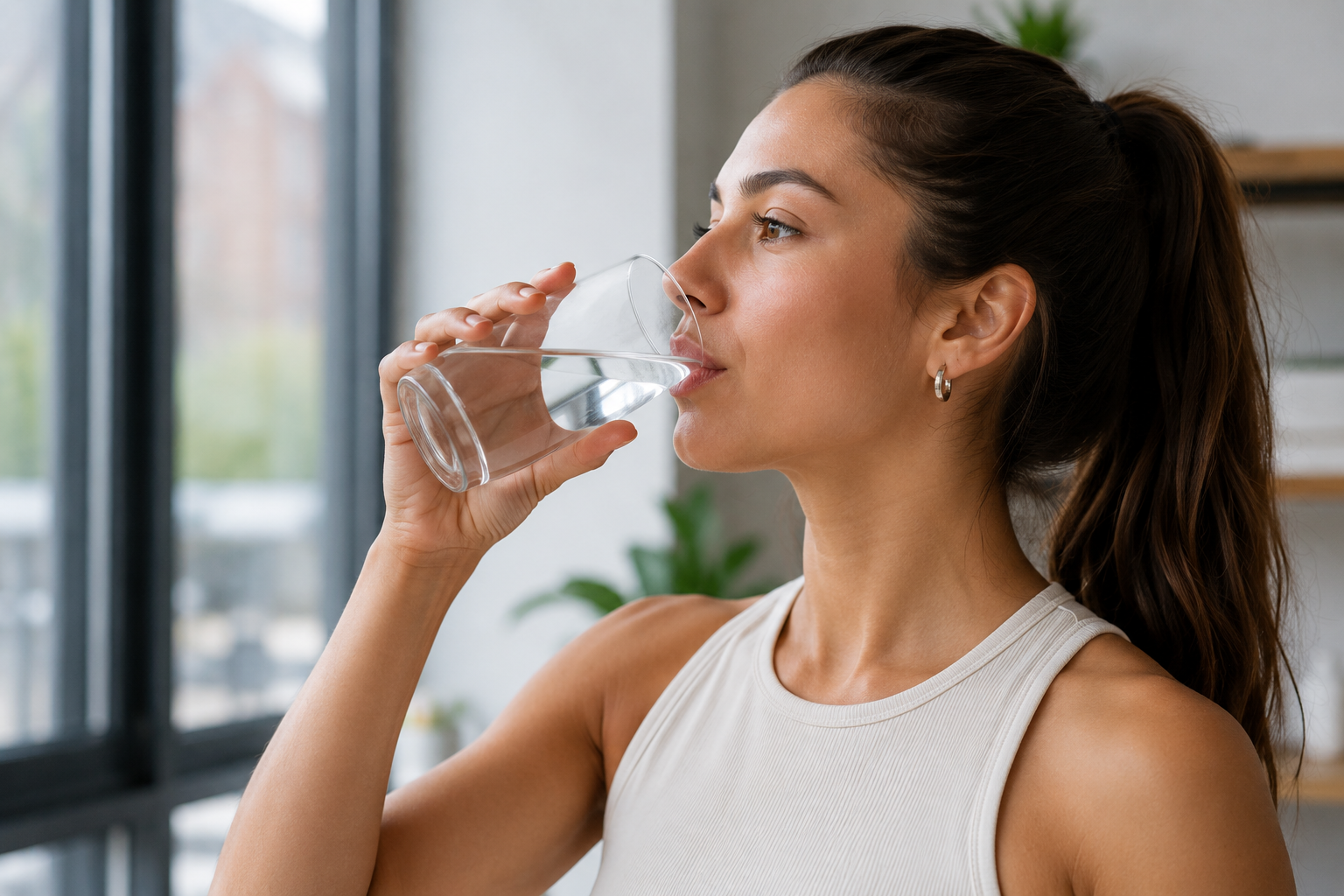
If you are wondering how much water you should drink a day by weight, your body weight can be used as a simple starting point for estimating daily fluid needs. However, there is no single amount that works for everyone.
Hydration needs depend on more than weight. Activity, sweating, climate, age, diet, illness, pregnancy, and certain medical conditions can all affect how much fluid a person needs.
How Much Water Should You Drink Based on Weight?
One commonly used rule of thumb is to estimate around 30–35 milliliters of fluid per kilogram of body weight per day.
For example, a person weighing 70 kg could calculate:
70 × 30 = 2,100 mL
and:
70 × 35 = 2,450 mL
That gives an estimated range of approximately 2.1–2.45 liters per day.
Why Body Weight Can Be Used to Estimate Fluid Needs
Body water is closely related to body size, so body weight provides a useful starting point for estimating fluid requirements.
However, people of the same weight can have different hydration needs.
For example, a 70 kg person who spends most of the day indoors may need less fluid than a 70 kg person who works outdoors in hot, humid weather and sweats heavily.
This is why a weight-based formula should not be treated as an exact daily prescription.
Water Intake Formula by Weight
A simple calculation is:
Daily fluid estimate = body weight in kg × 30–35 mL
You can use the lower end for a basic starting estimate and consider the higher end when appropriate.
For example:
| Body weight | 30 mL/kg | 35 mL/kg |
|---|---|---|
| 50 kg | 1.50 L | 1.75 L |
| 60 kg | 1.80 L | 2.10 L |
| 70 kg | 2.10 L | 2.45 L |
| 80 kg | 2.40 L | 2.80 L |
| 90 kg | 2.70 L | 3.15 L |
| 100 kg | 3.00 L | 3.50 L |
How to Calculate Water Needs From Kilograms
If your weight is already in kilograms, the calculation is straightforward.
Suppose you weigh 65 kg.
Using 30 mL per kilogram:
65 × 30 = 1,950 mL
Using 35 mL per kilogram:
65 × 35 = 2,275 mL
Your estimated range would therefore be about 1.95–2.28 liters per day.
How to Calculate Water Needs From Pounds
If your weight is given in pounds, convert it to kilograms first.
The conversion is:
Kilograms = pounds ÷ 2.205
For example, a person weighing 154 pounds weighs approximately:
154 ÷ 2.205 ≈ 69.8 kg
Then apply the weight-based estimate:
69.8 × 30 ≈ 2,094 mL
69.8 × 35 ≈ 2,443 mL
That is approximately 2.1–2.4 liters per day as a general weight-based estimate.
A calculator can perform these conversions automatically.
Example Water Calculations
Consider three different body weights.
55 kg
55 × 30–35 mL = 1,650–1,925 mL
That is approximately 1.65–1.93 liters.
75 kg
75 × 30–35 mL = 2,250–2,625 mL
That is approximately 2.25–2.63 liters.
90 kg
90 × 30–35 mL = 2,700–3,150 mL
That is approximately 2.7–3.15 liters.
Does Height Affect Water Requirements?
Height can provide useful context, but it is not usually the main variable in a simple weight-based hydration formula.
Two people can have the same height but different body weights and activity levels.
Likewise, two people with the same weight can have different fluid requirements because one may exercise more or live in a hotter environment.
For this reason, height alone is not enough to determine how much water someone should drink.
Does Age Affect Water Requirements?
Age can influence hydration needs and how the body responds to changes in fluid intake.
Older adults may be more vulnerable to dehydration and may have changes in thirst sensation or other factors that affect hydration.
Children also have different fluid requirements from adults.
A simple adult weight-based formula should therefore not automatically be applied to children.
Older adults, people with medical conditions, and anyone with a clinician-directed fluid restriction should follow individualized guidance rather than relying only on a general calculator.
Activity Level and Water Needs
Physical activity increases fluid loss through sweating and breathing.
If you exercise regularly, your daily fluid needs may be higher than a basic weight-based estimate.
For example, someone who walks for 30 minutes in an air-conditioned environment will generally have different fluid losses from someone who performs intense exercise outdoors for several hours.
The amount of additional fluid needed depends on exercise duration, intensity, temperature, humidity, clothing, and individual sweat rate.
Exercise and Sweating
Sweat is one of the body's main ways of losing water during exercise.
If you sweat heavily, replacing lost fluid becomes more important.
For longer or intense exercise, electrolytes may also matter because sweat contains sodium and other electrolytes.
Hot Weather and Hydration
Hot and humid weather can increase fluid losses because the body may sweat more.
If you exercise or work outdoors in hot conditions, you may need more fluid than your normal weight-based estimate.
The Centers for Disease Control and Prevention recommends drinking more water than usual during hot conditions and paying attention to symptoms of heat-related illness.
Why Weight-Based Formulas Are Only Estimates
A weight-based calculation does not know:
- How much you sweat
- How hot your environment is
- How much water you obtain from food
- How much you exercise
- Whether you are ill
- Whether you take medications that affect fluid balance
- Whether a healthcare professional has prescribed a fluid restriction
Water vs Total Fluid Intake
When people ask, "How much water should I drink?", they often mean plain drinking water.
But hydration does not come exclusively from plain water.
Total water intake includes:
- Plain water
- Milk and other beverages
- Moisture in foods
- Other drinks
The National Academies' reference values for total water intake illustrate this distinction. For young adults, the adequate intake is about 3.7 liters per day for men and 2.7 liters for women, but those values include water from beverages and food rather than requiring that much plain water.
How to Use a Water Intake Calculator
A Water Intake Calculator can simplify the process.
Typically, you enter information such as:
- Body weight
- Weight unit
- Activity level
- Other relevant factors supported by the calculator
The tool then produces an estimated daily target.
When You May Need More or Less Fluid
You may need more fluid when you:
- Exercise or sweat heavily
- Spend time in hot or humid weather
- Have a fever
- Experience vomiting or diarrhea
- Spend extended periods outdoors
You may need individualized advice when you:
- Have a condition that affects fluid balance
- Have been told to restrict fluids
- Take medications that affect fluid balance
- Are pregnant or breastfeeding
- Have unusual or persistent symptoms related to hydration
In these situations, a general weight-based formula may not be appropriate as your only guide.
A Practical Way to Think About Daily Hydration
Instead of trying to hit one perfect number, use three pieces of information together:
1. Weight-based estimate
Use your body weight to establish a starting range.
2. Daily conditions
Increase attention to fluids when exercise, sweating, heat, or illness increases fluid losses.
3. Body signals
Pay attention to thirst and other signs of inadequate hydration.
Summary
If you are asking how much water you should drink by weight, a common starting estimate is around 30–35 mL per kilogram of body weight per day.
For example, a 70 kg adult would calculate approximately 2.1–2.45 liters using this range.
However, body weight is only one factor. Exercise, sweating, hot weather, age, illness, diet, pregnancy, medications, and medical conditions can all change fluid needs.
Remember that total water intake includes water from beverages and food, not only plain drinking water.
Use the Water Intake Calculator to estimate a starting target, and consider your daily activity and environment when adjusting your hydration routine. The Calorie Calculator and BMR Calculator can provide additional health and nutrition estimates, but neither replaces individualized medical guidance when a medical condition affects fluid requirements.
References
Institute of Medicine. (2005). Dietary reference intakes for water, potassium, sodium, chloride, and sulfate. The National Academies Press. https://doi.org/10.17226/10925
Mayo Clinic. (2026). Water: How much should you drink every day? Mayo Clinic. https://www.mayoclinic.org/healthy-lifestyle/nutrition-and-healthy-eating/in-depth/water/art-20044256
Centers for Disease Control and Prevention. (2026). About water and healthier drinks. U.S. Department of Health and Human Services. https://www.cdc.gov/healthy-weight-growth/water-healthy-drinks/
Centers for Disease Control and Prevention. (2024). Heat and athletes. U.S. Department of Health and Human Services. https://www.cdc.gov/heat-health/risk-factors/heat-and-athletes.html
Sawka, M. N., Burke, L. M., Eichner, E. R., Maughan, R. J., Montain, S. J., & Stachenfeld, N. S. (2007). American College of Sports Medicine position stand: Exercise and fluid replacement. Medicine & Science in Sports & Exercise, 39(2), 377–390. https://doi.org/10.1249/mss.0b013e31802ca597