
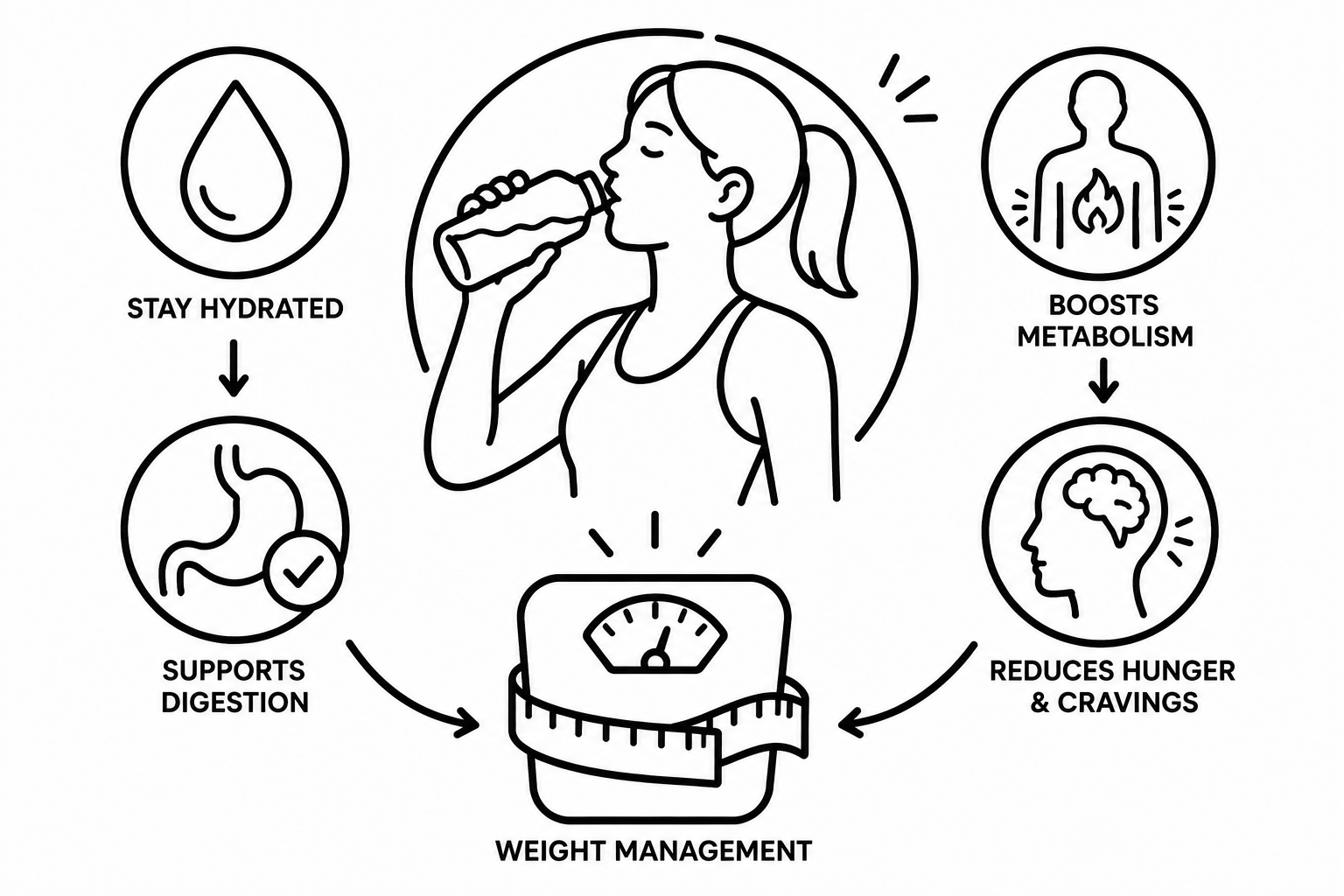
If you are searching for how much water to drink to lose weight, it helps to separate hydration from the actual process of losing body fat. Drinking enough fluid supports normal body function, but water by itself does not create a calorie deficit.
Does Drinking Water Help With Weight Loss?
Water can support a weight-loss plan, but it is not a fat-burning treatment.
Water contains no calories, so replacing calorie-containing drinks with plain water can reduce energy intake.
For example, replacing a sugary soft drink with water removes the calories from that drink without requiring you to reduce the amount of food you eat.
How Hydration Relates to Weight Management
Adequate hydration supports normal physiological processes, including temperature regulation and physical performance.
When you are dehydrated, you may experience symptoms such as thirst, fatigue, headache, or reduced exercise performance.
The goal should be adequate hydration rather than forcing yourself to drink excessive amounts.
Water vs Sugary Drinks
One of the clearest connections between water and weight management is beverage substitution.
Common calorie-containing drinks include:
- Regular soft drinks
- Sweetened coffee drinks
- Energy drinks
- Sweetened teas
- Fruit drinks
- Some flavored beverages
Water generally provides no calories.
Replacing a high-calorie drink with water can therefore lower daily energy intake.
For example, replacing one 200-calorie beverage every day would remove approximately 1,400 calories from a week, assuming no compensatory increase in food or other drinks.
Calories in Beverages
Checking nutrition labels can help identify how many calories a drink provides.
When weight loss is the goal, choosing water more often can be a simple way to reduce unnecessary liquid calories.
Drinking Water Before Meals
However, the effect is not guaranteed and should not be viewed as a stand-alone weight-loss strategy.
Water Intake and Appetite
Thirst and hunger can sometimes occur at similar times, which can make it difficult to identify what your body needs.
Drinking water when you are thirsty is a reasonable habit.
However, water should not be used as a replacement for food when you are genuinely hungry.
How Much Water Should You Drink During Weight Loss?
There is no special amount of water that automatically causes weight loss.
A practical starting point for healthy adults is to estimate fluid needs based on body weight and then consider activity and environmental conditions.
One commonly used general estimate is around 30–35 mL of fluid per kilogram of body weight per day.
For example, someone weighing 70 kg could calculate:
70 × 30 = 2,100 mL
70 × 35 = 2,450 mL
That produces an estimated range of approximately 2.1–2.45 liters per day.
Water Needs Based on Body Weight
A weight-based estimate can be useful when starting a hydration routine.
| Body weight | 30 mL/kg | 35 mL/kg |
|---|---|---|
| 50 kg | 1.50 L | 1.75 L |
| 60 kg | 1.80 L | 2.10 L |
| 70 kg | 2.10 L | 2.45 L |
| 80 kg | 2.40 L | 2.80 L |
| 90 kg | 2.70 L | 3.15 L |
| 100 kg | 3.00 L | 3.50 L |
These values are starting estimates.
Your actual needs may be different because water requirements are affected by factors beyond body weight.
Exercise and Water Requirements
Exercise increases fluid loss through sweating.
Someone exercising outdoors for two hours in hot weather can lose considerably more fluid than someone doing a short indoor workout.
For strenuous or prolonged activity, electrolytes may also be relevant because sweat contains sodium and other electrolytes.
Sweating and Fluid Replacement
Sweating is a normal cooling mechanism, but significant sweat loss can lead to dehydration if fluids are not replaced.
One practical way to understand your personal sweat rate is to compare body weight before and after exercise while accounting for fluids consumed and urine produced.
For example, if body weight falls substantially after a long workout, some of that difference may reflect fluid loss.
Water Intake During Calorie Restriction
However, changes in diet can alter fluid intake.
For example, a person who eats more fruits, vegetables, soups, or other water-rich foods may obtain more fluid from food.
A person following a higher-protein or higher-fiber diet may also change their beverage habits.
Why More Water Is Not a Substitute for a Calorie Deficit
This is one of the most important points.
Drinking water does not cancel out excess calorie intake.
If you consume more energy than your body uses over time, simply increasing water intake will not turn that surplus into a deficit.
Water can support weight management by replacing calorie-containing drinks and helping maintain hydration, but fat loss still depends on the overall energy balance.
The Calorie Deficit Calculator can help estimate a calorie target for a weight-loss plan.
Hydration and Exercise
Good hydration can support normal exercise performance.
If you begin exercise dehydrated or lose substantial fluid through sweating, performance and comfort may be affected.
Avoid treating a daily calculator target as a maximum or minimum that must be followed regardless of the day's circumstances.
How to Track Water Intake
Tracking can be useful if you frequently forget to drink.
You can record intake using:
- A marked water bottle
- A notebook
- A smartphone app
- A spreadsheet
- A daily checklist
For example, if your estimated daily target is 2.4 liters, you could use a 600 mL bottle and aim to consume four bottles throughout the day.
Signs You May Need More Fluids
Thirst is an important signal that your body needs fluid.
Other possible signs of dehydration can include:
- Dry mouth
- Darker urine
- Fatigue
- Headache
- Dizziness
- Reduced exercise performance
Severe or persistent symptoms require appropriate medical attention rather than simply increasing water intake.
Why Individual Water Needs Vary
Two people can have the same body weight but different fluid requirements.
Differences can result from:
- Activity level
- Sweat rate
- Climate
- Humidity
- Diet
- Age
- Pregnancy
- Illness
- Medications
- Medical conditions
This is why asking how much water should I drink a day for weight loss cannot be answered with one number for everyone.
Using a Water Intake Calculator
A Water Intake Calculator can estimate daily fluid needs from information such as body weight and activity level.
Use the result as a guide.
You can then consider whether your activity, weather, sweating, and diet suggest that your needs may be different on a particular day.
The calculator should not be used to override medical advice.
A Practical Weight-Loss Hydration Strategy
A simple approach is:
- Start with a reasonable weight-based fluid estimate.
- Drink water regularly throughout the day.
- Choose water more often instead of sugary drinks.
- Increase attention to fluids during exercise and hot weather.
- Track intake if you frequently forget to drink.
- Pay attention to thirst and other hydration signals.
- Avoid forcing excessive amounts of water.
- Focus on your overall calorie intake for weight loss.
Summary
If you are wondering how much water you should drink to lose weight, there is no special water amount that directly causes fat loss.
A useful starting estimate for many healthy adults is around 30–35 mL per kilogram of body weight per day, adjusted for activity, sweating, weather, and other circumstances.
Water can support weight management because it contains no calories and can replace sugary or calorie-containing drinks. Drinking water before meals may also help some people reduce food intake modestly, but it is not a substitute for a sustainable calorie deficit.
Use the Water Intake Calculator to estimate a daily starting target. For the weight-loss side of the equation, the Calorie Calculator and Calorie Deficit Calculator can help estimate energy needs and calorie targets.
The Body Fat Calculator can provide additional information about body-composition changes as you track progress.
References
Institute of Medicine. (2005). Dietary reference intakes for water, potassium, sodium, chloride, and sulfate. The National Academies Press. https://doi.org/10.17226/10925
Sawka, M. N., Burke, L. M., Eichner, E. R., Maughan, R. J., Montain, S. J., & Stachenfeld, N. S. (2007). American College of Sports Medicine position stand: Exercise and fluid replacement. Medicine & Science in Sports & Exercise, 39(2), 377–390. https://doi.org/10.1249/mss.0b013e31802ca597
Centers for Disease Control and Prevention. (2024). Heat and athletes. U.S. Department of Health and Human Services. https://www.cdc.gov/heat-health/risk-factors/heat-and-athletes.html
Dennis, E. A., Dengo, A. L., Comber, D. L., Flack, K. D., Savla, J., Davy, K. P., & Davy, B. M. (2010). Water consumption increases weight loss during a hypocaloric diet intervention in middle-aged and older adults. Obesity, 18(2), 300–307. https://doi.org/10.1038/oby.2009.235
Muckelbauer, R., Sarganas, G., Grüneis, A., & Müller-Nordhorn, J. (2013). Association between water consumption and body weight outcomes: A systematic review. The American Journal of Clinical Nutrition, 98(6), 1728–1737. https://doi.org/10.3945/ajcn.113.073056