
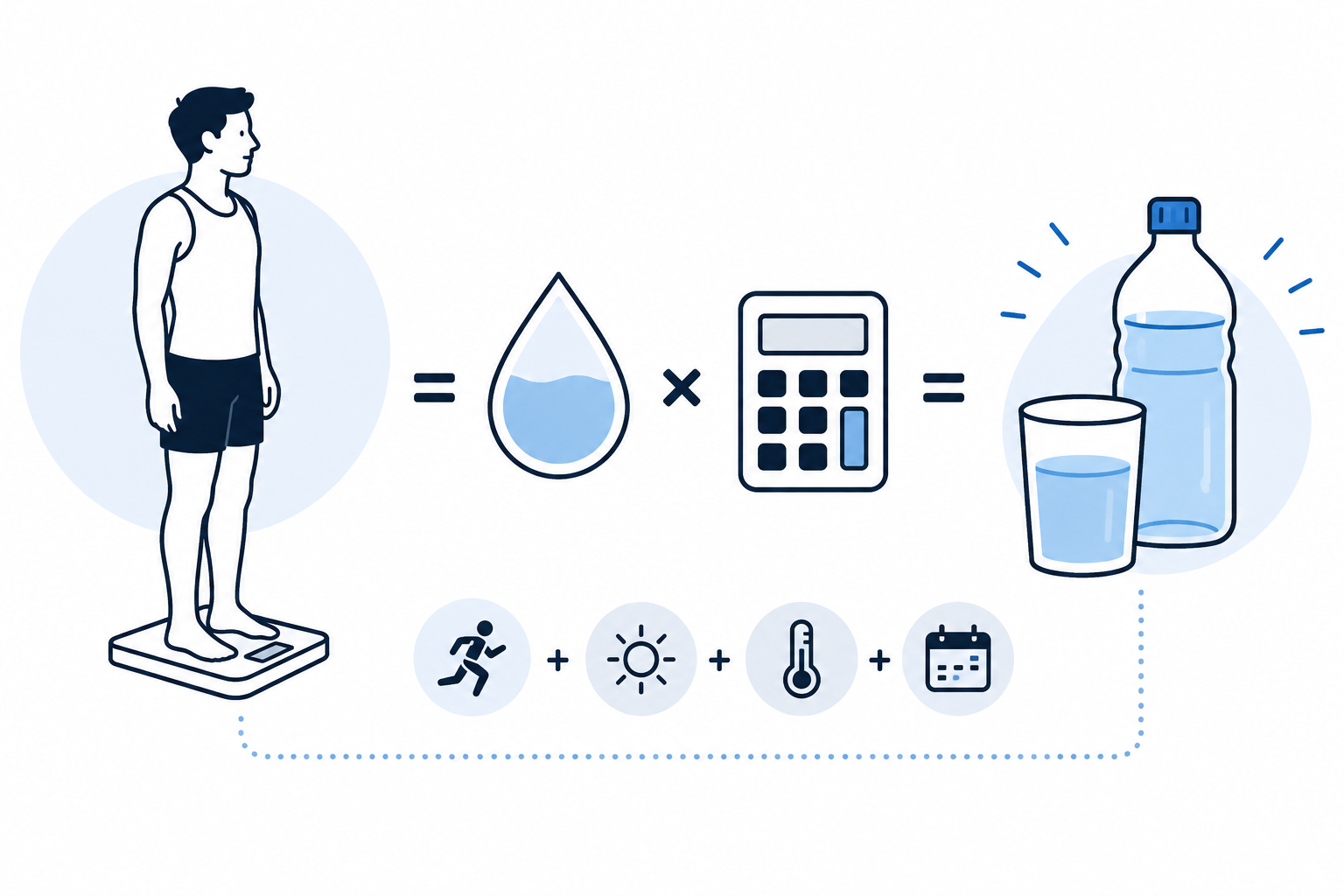
Knowing how to calculate water intake can be useful when you want a practical starting point for daily hydration. A water-intake formula can estimate fluid needs from body weight or other factors, but no single equation applies perfectly to everyone.
Your fluid requirements change with exercise, sweating, climate, age, diet, illness, pregnancy, and certain medical conditions. A formula is therefore best used as an estimate rather than an exact daily prescription.
This guide explains common approaches to calculating water intake, how weight and height fit into the calculation, how to convert units, and when a formula may not be appropriate.
What Is a Water Intake Formula?
A water intake formula is a mathematical rule used to estimate how much fluid a person may need.
One simple approach uses body weight:
Estimated daily fluid = body weight × a chosen fluid factor
A commonly used general estimate is around 30–35 mL of fluid per kilogram of body weight per day.
For example, a 70 kg adult would calculate:
70 × 30 = 2,100 mL
and:
70 × 35 = 2,450 mL
That gives a starting range of approximately 2.1–2.45 liters per day.
How Daily Water Needs Are Estimated
There are several ways to estimate daily fluid needs.
A calculation may consider:
- Body weight
- Age
- Sex
- Activity level
- Exercise duration
- Sweat losses
- Climate
- Food and beverage intake
- Health conditions
For everyday use, body weight is often a convenient starting point because it provides a simple relationship between body size and estimated fluid needs.
Weight-Based Water Intake Formulas
A weight-based formula can be written as:
Water estimate = weight in kg × 30–35 mL
For an 80 kg person:
80 × 30 = 2,400 mL
80 × 35 = 2,800 mL
The estimated range is therefore approximately 2.4–2.8 liters.
The calculation can be repeated for other weights:
| Body weight | 30 mL/kg | 35 mL/kg |
|---|---|---|
| 50 kg | 1.50 L | 1.75 L |
| 60 kg | 1.80 L | 2.10 L |
| 70 kg | 2.10 L | 2.45 L |
| 80 kg | 2.40 L | 2.80 L |
| 90 kg | 2.70 L | 3.15 L |
| 100 kg | 3.00 L | 3.50 L |
These numbers are examples of a weight-based calculation, not fixed targets for every person.
Height and Water Intake
Height is sometimes included in searches for a water intake calculator by height, but height alone is not usually enough to determine fluid requirements.
Two people with the same height may have different body weights, activity levels, sweat rates, and environmental exposures.
Body weight can therefore be more useful in a simple hydration formula.
Age and Hydration Needs
Age can affect hydration needs and the way the body responds to fluid changes.
Children have different fluid requirements from adults, so an adult weight-based formula should not automatically be applied to them.
Older adults may also face greater dehydration risk because thirst perception and other physiological factors can change with age.
For these groups, age-appropriate guidance is more useful than applying a generic adult formula.
Daily Fluid Intake vs Water Intake
"Water intake" and "total fluid intake" are not always the same thing.
Total water intake can include:
- Plain water
- Other beverages
- Water contained in foods
The National Academies' reference values illustrate this distinction. For young adults, the adequate intake for total water is approximately 3.7 liters per day for men and 2.7 liters for women, including water from food and beverages.
This does not mean everyone needs to drink that exact amount of plain water.
The amount of water a person obtains from food and beverages varies considerably.
Activity and Exercise
Physical activity can increase fluid losses.
During exercise, the body loses water through sweating and respiration. The amount depends on:
- Exercise intensity
- Exercise duration
- Temperature
- Humidity
- Clothing
- Individual sweat rate
A person exercising for several hours in hot weather may need considerably more fluid than their normal weight-based estimate.
Sweat Loss and Hydration
Sweat is an important source of fluid loss during exercise.
People vary considerably in how much they sweat, so a single formula cannot precisely predict everyone's exercise hydration needs.
For longer or more intense exercise, monitoring body-weight changes before and after exercise can provide useful information about fluid loss.
For example, a decrease in body weight after exercise, when food and fluid intake are accounted for, can help estimate the amount of fluid lost through sweating.
Hot Weather and Fluid Needs
Heat can increase sweating and therefore increase fluid requirements.
Hot and humid environments can make it more difficult for sweat to evaporate, potentially increasing heat strain during exercise or outdoor work.
When conditions are hot:
- Drink regularly.
- Carry fluids when spending extended periods outdoors.
- Take breaks in cooler environments.
- Pay attention to thirst and other symptoms.
- Increase attention to hydration during prolonged exercise.
Why There Is No Single Perfect Water Formula
No formula can know exactly how much fluid you lose each day.
Your needs can change because of:
- Weather
- Exercise
- Sweating
- Diet
- Illness
- Pregnancy
- Medications
- Medical conditions
How to Convert Liters to Cups
If your water target is given in liters, you can convert it to cups.
A U.S. customary cup is approximately 237 mL.
For example:
2.4 liters = 2,400 mL
2,400 ÷ 237 ≈ 10.1 cups
So 2.4 liters is approximately 10 U.S. cups.
How to Convert Milliliters to Ounces
To convert milliliters to U.S. fluid ounces:
Fluid ounces ≈ milliliters ÷ 29.57
For example:
2,400 ÷ 29.57 ≈ 81.2 fl oz
So 2.4 liters is approximately 81 U.S. fluid ounces.
Example Water-Intake Calculations
Example 1: 60 kg
Using 30–35 mL/kg:
60 × 30–35 = 1,800–2,100 mL
Estimated range:
1.8–2.1 liters
Example 2: 75 kg
75 × 30–35 = 2,250–2,625 mL
Estimated range:
2.25–2.63 liters
Example 3: 90 kg
90 × 30–35 = 2,700–3,150 mL
Estimated range:
2.7–3.15 liters
How a Water Calculator Estimates Your Needs
A Water Intake Calculator can perform the mathematics automatically.
Depending on the calculator, you may enter:
- Body weight
- Weight unit
- Activity level
- Other information relevant to the calculation
The calculator then converts the inputs and applies its selected formula.
When Formula-Based Estimates May Not Apply
A general water formula may not be appropriate as your only guide if you:
- Have a medical condition affecting fluid balance
- Have been prescribed a fluid restriction
- Take medications that affect hydration or electrolyte balance
- Are pregnant or breastfeeding
- Are recovering from significant vomiting or diarrhea
- Are managing a condition requiring individualized fluid guidance
In these situations, follow guidance from your healthcare professional rather than trying to override it with a general calculator.
Understanding Hydration Signals
A formula is only one part of hydration planning.
Thirst is an important signal, although it should not be considered the only measure in every situation.
Urine color can also provide a rough indication of hydration status, but it can be affected by foods, supplements, medications, and other factors.
Summary
A water intake formula provides a practical way to estimate daily fluid needs.
A simple weight-based calculation is:
Body weight in kg × 30–35 mL
For example, an 80 kg adult would get an estimated range of 2.4–2.8 liters per day from this formula.
However, body weight is only one factor. Exercise, sweating, heat, age, diet, illness, pregnancy, medications, and medical conditions can change fluid needs.
Remember that total water includes water from food and beverages, not just plain drinking water.
Use the Water Intake Calculator for a convenient estimate, and adjust your approach based on your daily conditions. The BMR Calculator and Calorie Calculator can provide additional estimates for other aspects of health and nutrition.
References
Institute of Medicine. (2005). Dietary reference intakes for water, potassium, sodium, chloride, and sulfate. The National Academies Press. https://doi.org/10.17226/10925
Sawka, M. N., Burke, L. M., Eichner, E. R., Maughan, R. J., Montain, S. J., & Stachenfeld, N. S. (2007). American College of Sports Medicine position stand: Exercise and fluid replacement. Medicine & Science in Sports & Exercise, 39(2), 377–390. https://doi.org/10.1249/mss.0b013e31802ca597
Centers for Disease Control and Prevention. (2024). Heat and athletes. U.S. Department of Health and Human Services. https://www.cdc.gov/heat-health/risk-factors/heat-and-athletes.html
Mayo Clinic. (2026). Water: How much should you drink every day? Mayo Clinic. https://www.mayoclinic.org/healthy-lifestyle/nutrition-and-healthy-eating/in-depth/water/art-20044256