
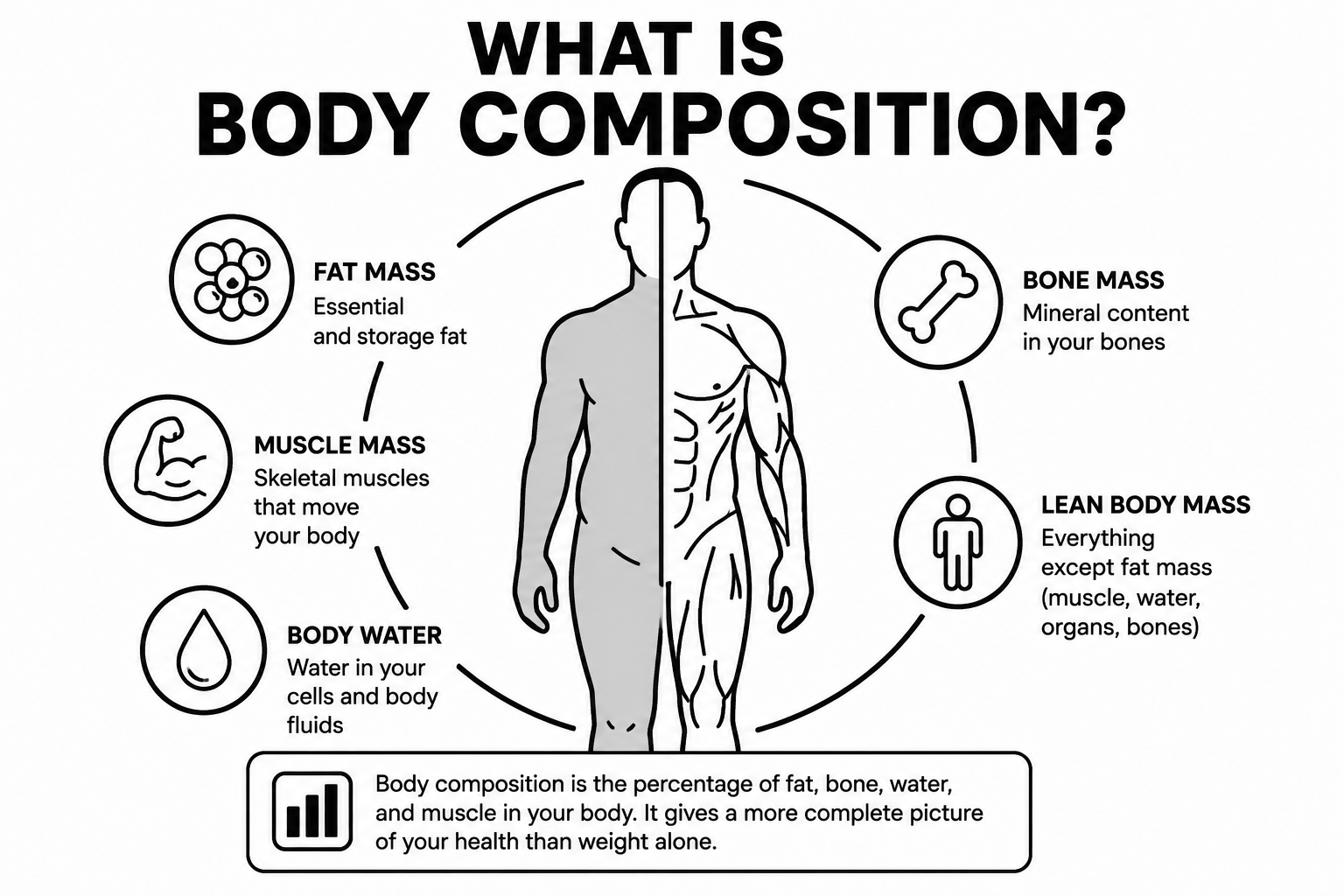
Body composition describes what your body weight is made of, including fat mass, lean tissue, water, and bone-related components. Body composition analysis can provide information that body weight and BMI alone cannot show.
For example, two people can have the same body weight but very different amounts of body fat and lean tissue. This is why body-composition measurements can be useful when tracking fitness, weight loss, or muscle-building progress.
There are several ways to estimate body composition, from simple online calculators and measuring tapes to professional methods such as DEXA. Each has different advantages, costs, and limitations.
What Is Body Composition?
Body composition refers to the different components that make up total body weight.
Body Fat vs Body Composition
Body fat is only one part of body composition.
Someone might have a body-fat percentage of 20%, but that number does not tell you exactly how much muscle, water, bone, or organ tissue they have.
A broader body composition analysis attempts to describe several components.
Fat Mass
Fat mass is the amount of body weight attributed to fat.
A simple calculation is:
Fat mass = body weight × body-fat percentage
For example, if someone weighs 80 kg and has an estimated body-fat percentage of 25%:
80 × 0.25 = 20 kg
The estimated fat mass would be 20 kg.
This is an estimate because the body-fat percentage itself is an estimate.
Lean Body Mass
Lean body mass generally refers to body weight minus fat mass.
Using the previous example:
80 kg − 20 kg = 60 kg
The estimated lean body mass would therefore be 60 kg.
This is an important distinction when a smart scale reports "muscle mass."
Muscle Mass
Muscle is one component of lean tissue.
Body Water
Water makes up a substantial proportion of the human body and is included in many body-composition models.
Changes in hydration can affect body weight and can also influence some body-composition estimates, particularly those based on bioelectrical impedance.
Bone Mass
Some body-composition devices report an estimated bone-mass value.
This should not be confused with a clinical measurement of bone mineral density.
DEXA can provide bone mineral information, but consumer smart-scale bone-mass values are generally calculated estimates.
Why Body Composition Matters
Body weight provides one overall number.
Body composition adds context by separating weight into different components.
This can be useful when:
- Tracking fat loss
- Monitoring muscle-building progress
- Evaluating body recomposition
- Comparing changes during a training program
- Understanding why scale weight changes slowly
How Body Composition Is Measured
Common approaches include:
- Bioelectrical impedance analysis
- Skinfold measurements
- Circumference measurements
- DEXA/DXA
- Hydrostatic weighing
- Air displacement plethysmography
- Height- and weight-based equations
Body-Fat Scales and BIA
Many consumer body-composition scales use bioelectrical impedance analysis (BIA).
A BIA device sends a very small electrical current through the body and measures electrical impedance. An algorithm then combines this measurement with information such as height, weight, age, and sex to estimate body composition.
However, BIA results can be influenced by hydration, recent exercise, food and fluid intake, body position, device design, and the prediction equation.
For home tracking, the same device and similar measurement conditions can make trends more useful.
Skinfold Measurements
Skinfold calipers measure the thickness of subcutaneous fat at selected body locations.
The measurements are entered into a prediction equation to estimate body density or body-fat percentage.
Common sites can include the triceps, abdomen, thigh, chest, and areas around the shoulder blade, depending on the protocol.
Skinfold testing can be inexpensive and practical, but technique matters. Incorrect site selection or inconsistent handling of the skinfold can affect the result.
DEXA Body Composition Analysis
DEXA, also written DXA, uses low-dose X-rays to assess body composition.
It can provide information about:
- Fat mass
- Lean soft tissue
- Bone mineral content
- Regional body composition
Hydrostatic Weighing
Hydrostatic weighing estimates body composition using body density.
Air Displacement Methods
Air displacement plethysmography estimates body volume by measuring air displacement inside a specialized chamber.
Body Composition Calculators
A body composition analysis calculator can provide a convenient estimate without specialized equipment.
Depending on the calculator, you may enter:
- Height
- Weight
- Age
- Sex
- Waist circumference
- Neck circumference
- Hip circumference
The calculator then applies a prediction equation.
The Body Fat Calculator can provide an estimated body-fat percentage, which can then be used to understand estimated fat mass and lean body mass.
Body Composition vs BMI
BMI is a height-and-weight index:
BMI = weight in kilograms ÷ height in meters²
BMI is useful as a general screening measure, but it does not distinguish fat from muscle.
A person with substantial muscle mass can have a relatively high BMI without having a correspondingly high body-fat percentage.
The BMI Calculator can calculate BMI, while a body-fat calculator can provide additional information about estimated body composition.
Body Composition and Weight Loss
During weight loss, body composition can change in different ways.
A reduction in scale weight can include changes in:
- Fat mass
- Muscle and other lean tissue
- Water
- Glycogen
- Digestive contents
Tracking waist circumference, body-fat estimates, strength, and body weight can provide a broader view of progress.
The Calorie Calculator can also help estimate calorie needs when planning a weight-management approach.
Body Composition and Muscle Gain
When building muscle, scale weight may increase.
That increase can come from muscle tissue, water, glycogen, fat, or a combination.
Body Recomposition
Body recomposition refers to changing body composition by reducing fat while maintaining or increasing lean tissue.
The Macro Calculator can help organize estimated calorie and macronutrient targets when nutrition planning is part of a body-recomposition goal.
Why Body Composition Estimates Vary
Different methods can produce different results because they use different measurement principles and prediction models.
Results may also vary because of:
- Hydration
- Food and fluid intake
- Exercise
- Measurement technique
- Device differences
- Prediction equations
- Body-fat distribution
- Testing conditions
How to Track Changes in Body Composition
For long-term tracking, consistency is usually more useful than chasing a perfect number.
Choose a method and keep the conditions similar.
For example:
- Use the same device or measurement protocol.
- Measure at a similar time of day.
- Follow the same preparation routine.
- Record every result.
- Review trends over several weeks or months.
- Combine body composition with other measurements.
Useful additional measurements include body weight, waist circumference, progress photographs, and exercise performance.
A Practical Body Composition Tracking Routine
A simple routine can be enough for most personal tracking.
Step 1: Establish a Baseline
Record your weight, waist measurement, and body-fat estimate.
Step 2: Choose One Main Method
Use a BIA scale, tape-based calculator, calipers, or another repeatable method.
Step 3: Standardize Conditions
Keep timing, hydration, equipment, and measurement technique as consistent as practical.
Step 4: Track Over Time
Compare several readings rather than focusing on one result.
Step 5: Add Supporting Measures
Use waist circumference, strength, body weight, and other relevant indicators.
Summary
Body composition analysis looks beyond total body weight to estimate components such as fat mass, lean mass, body water, and bone-related measures.
Methods range from simple calculators and circumference measurements to BIA scales, skinfolds, DEXA, hydrostatic weighing, and air displacement.
Each method has strengths and limitations. Home methods are convenient and useful for tracking trends, while professional methods can provide more detailed assessments.
BMI remains useful as a general screening index, but it does not distinguish fat from muscle. Combining BMI with body-fat estimates and other measurements can provide more context.
The Body Fat Calculator, BMI Calculator, Ideal Weight Calculator, and Macro Calculator can help organize different aspects of body-composition and nutrition tracking.
References
Kyle, U. G., Bosaeus, I., De Lorenzo, A. D., Deurenberg, P., Elia, M., Gómez, J. M., Heitmann, B. L., Kent-Smith, L., Melchior, J.-C., Pirlich, M., Scharfetter, H., Schols, A. M. W. J., & Pichard, C. (2004). Bioelectrical impedance analysis—Part I: Review of principles and methods. Clinical Nutrition, 23(5), 1226–1243. https://doi.org/10.1016/j.clnu.2004.06.004
Ward, L. C. (2019). Bioelectrical impedance analysis for body composition assessment: Reflections on accuracy, clinical utility, and standardisation. European Journal of Clinical Nutrition, 73, 122–131. https://doi.org/10.1038/s41430-018-0335-3
Fields, D. A., Goran, M. I., & McCrory, M. A. (2002). Body-composition assessment via air-displacement plethysmography in adults and children: A review. The American Journal of Clinical Nutrition, 75(3), 453–467. https://doi.org/10.1093/ajcn/75.3.453
Gallagher, D., Heymsfield, S. B., Heo, M., Jebb, S. A., Murgatroyd, P. R., & Sakamoto, Y. (2000). Healthy percentage body fat ranges: An approach for developing guidelines based on body mass index. The American Journal of Clinical Nutrition, 72(3), 694–701. https://doi.org/10.1093/ajcn/72.3.694
Heymsfield, S. B., Lohman, T., Wang, Z., & Going, S. (Eds.). (2005). Human body composition (2nd ed.). Human Kinetics.