
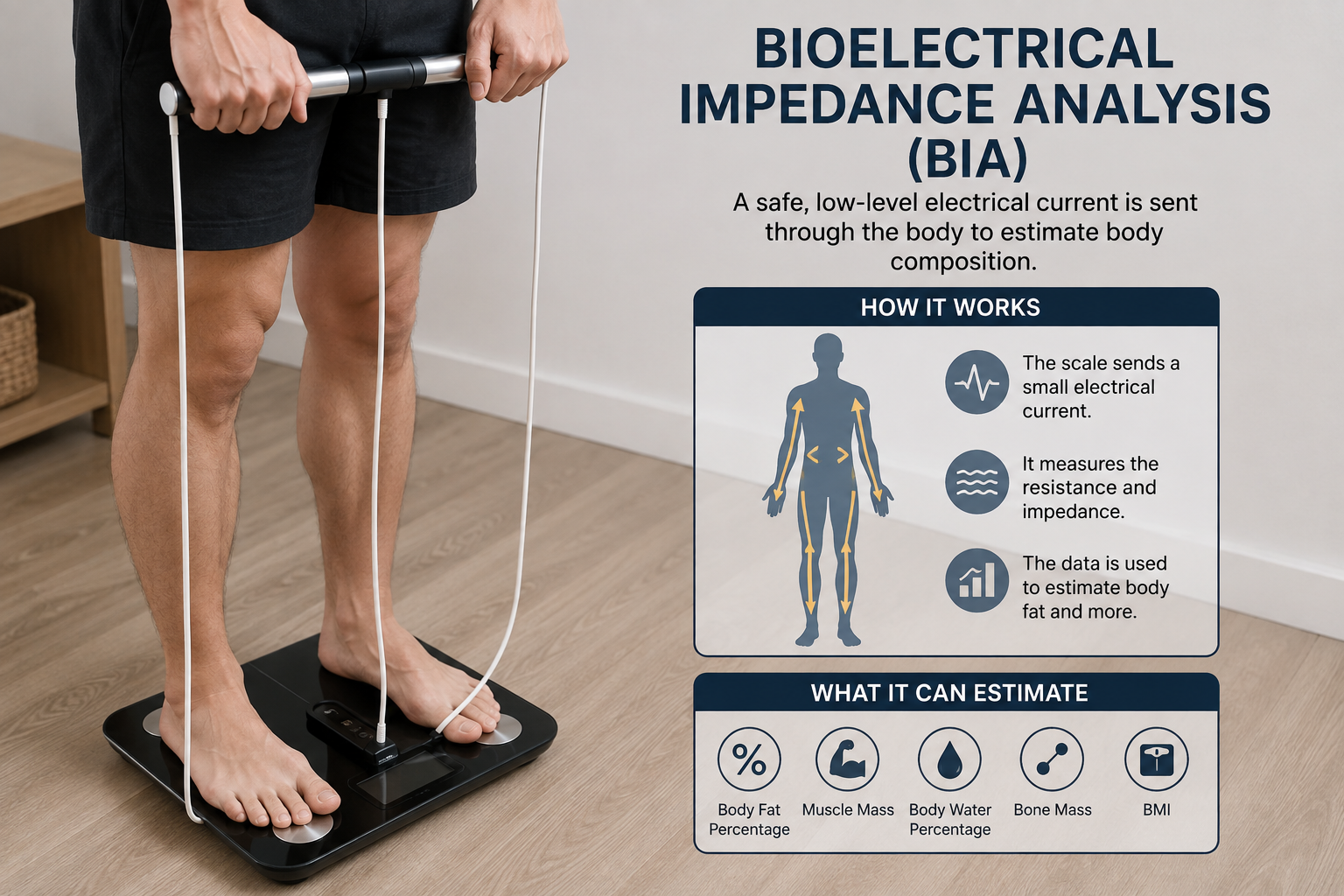
A modern bathroom scale can do much more than display body weight. Many smart scales estimate body fat, BMI, muscle mass, water percentage, and other body-composition measurements.
If you are searching for a scale that can measure body fat, a body fat BMI scale, or a body mass weight scale, it is important to understand what the device actually measures.
Most consumer body-fat scales use bioelectrical impedance analysis (BIA). The scale measures electrical impedance and combines the result with information such as height, weight, age, and sex to estimate body composition.
What Is a Body-Fat Scale?
A body-fat scale is a weighing scale that uses additional sensors and software to estimate body composition.
Depending on the model, it may report:
- Body weight
- Body-fat percentage
- BMI
- Muscle mass
- Body water
- Bone mass
- Visceral-fat estimates
- Other calculated metrics
The scale measures body weight directly. Most of the other values are calculated from measurements and prediction equations.
How Body-Fat Scales Work
Most smart body-fat scales use BIA.
When you stand on the scale's electrodes, the device sends a very small electrical current through the body and measures electrical impedance. Body water and lean tissue generally conduct electrical current differently from adipose tissue.
The device then combines the impedance measurement with information such as:
- Weight
- Height
- Age
- Sex
- Sometimes additional user information
An algorithm uses these inputs to estimate body composition.
Bioelectrical Impedance Analysis (BIA)
BIA is widely used because it is fast, non-invasive, and relatively inexpensive.
This is why two different BIA devices can produce different body-fat percentages for the same person.
How Scales Estimate Body Fat
A simplified process looks like this:
Electrical impedance + body measurements → prediction equation → estimated body-fat percentage
The algorithm is usually proprietary in consumer products, so the exact calculation may not be publicly available.
The device may also use a reference population to estimate how your impedance relates to body composition.
Can a Scale Really Measure Body Fat?
A body-fat scale can provide an estimate of body fat, but it does not directly measure total body fat in the same way a laboratory analysis would.
The scale directly measures your body weight.
Body-fat percentage is calculated indirectly.
Therefore, a displayed value such as 22.5% body fat should be interpreted as an estimate produced by that device's method.
This does not make the measurement useless. It simply means you should understand its limitations.
Body Fat Scale Accuracy
The accuracy of BIA varies between devices and circumstances.
Factors That Affect BIA Readings
Several factors can affect a body-fat scale reading.
Hydration
Changes in body water can influence electrical impedance.
A reading taken when you are unusually dehydrated may differ from one taken when you are normally hydrated.
Food and Fluid Intake
Eating and drinking can temporarily change body weight and body water distribution.
Exercise
Recent exercise can alter fluid distribution and other physiological conditions that may influence the reading.
Body Position
The measurement path through the body can differ depending on the device design and how the person stands on the scale.
Device and Algorithm
Different manufacturers can use different electrode arrangements, equations, and software.
For this reason, switching between devices can make comparisons difficult.
Hydration and Body-Fat Readings
Hydration deserves particular attention because BIA relies partly on the body's electrical properties.
If you take one measurement after intense exercise and another after a normal day, the difference may partly reflect changes in hydration and fluid distribution rather than a rapid change in body fat.
Food, Exercise and Measurement Timing
A practical routine might be:
- Measure at approximately the same time
- Use the same scale
- Follow the same posture
- Measure under similar hydration conditions
- Avoid comparing readings immediately after unusual exercise or meals
Body Fat Scales vs BMI
BMI and body-fat percentage are different measurements.
BMI uses height and weight:
BMI = weight in kilograms ÷ height in meters²
It does not directly measure body fat.
A body-fat scale may calculate BMI from your weight and height while separately estimating body fat through BIA.
Therefore, a scale that measures BMI is not necessarily measuring BMI with a sensor.
The BMI Calculator can perform the same basic BMI calculation without requiring a smart scale.
Why a Scale Does Not Directly Measure BMI
BMI is an index calculated from body weight and height.
There is no special sensor that "measures" BMI.
For example, if you weigh 75 kg and are 1.70 m tall:
BMI = 75 ÷ (1.70 × 1.70)
BMI ≈ 26.0
A smart scale can automatically perform this calculation after recording your weight and using your stored height.
This is why terms such as weight scale BMI, BMI fat scale, and body mass scale can sometimes be misleading.
Body Fat Scales vs Calipers
Skinfold calipers estimate body fat by measuring the thickness of subcutaneous fat at selected locations.
BIA scales instead use electrical impedance and an algorithm.
| Feature | BIA scale | Skinfold calipers |
|---|---|---|
| Main measurement | Electrical impedance | Skinfold thickness |
| Ease of use | Very easy | Requires practice |
| Cost | Low to moderate | Low |
| Hydration influence | Yes | Less direct |
| Technique dependence | Moderate | High |
| Best use | Convenient repeated estimates | Repeated measurements with consistent technique |
Neither method is automatically perfect.
A skilled tester using calipers may produce more consistent measurements than an inexperienced user, while a BIA scale can be much easier for regular home tracking.
Body Fat Scales vs DEXA
DEXA, or DXA, uses low-dose X-rays to assess body composition and can provide regional information about fat mass, lean soft tissue, and bone mineral content.
It is more sophisticated than a typical consumer smart scale, but it requires specialized equipment.
How to Use a Body-Fat Scale Consistently
If your goal is to track body-composition changes, establish a repeatable routine.
Try to:
- Use the same scale.
- Place it on a firm, level surface.
- Measure at a similar time of day.
- Follow the same standing position.
- Use similar hydration conditions.
- Avoid unusual measurement conditions.
- Record results over time.
Why Readings Can Change From Day to Day
That does not necessarily mean your body composition changed dramatically overnight.
Short-term changes in:
- Water
- Food
- Exercise
- Hydration
- Measurement conditions
can influence the result.
This is why reacting to every individual reading can be misleading.
Should You Trust One Body-Fat Reading?
A single reading should be treated cautiously.
Instead, look at a series of measurements collected under similar conditions.
Tracking Trends Instead of Individual Readings
For example:
| Week | Body weight | Estimated body fat |
|---|---|---|
| 1 | 80.0 kg | 25.0% |
| 2 | 79.5 kg | 24.8% |
| 3 | 79.2 kg | 25.1% |
| 4 | 78.7 kg | 24.4% |
Summary
A body fat scale usually uses bioelectrical impedance analysis to estimate body composition.
The scale directly measures body weight, while body-fat percentage is calculated indirectly using electrical impedance and an algorithm.
BIA readings can be influenced by hydration, food, exercise, body position, equipment, and the prediction equation. Therefore, a smart scale should not be treated as a perfect body-fat measurement device.
BMI is different. A scale calculates BMI from measured weight and stored height; it does not directly measure BMI with a sensor.
For home use, the most practical approach is to use the same scale consistently and focus on longer-term trends rather than individual readings. The Body Fat Calculator and BMI Calculator can provide additional context, while the Ideal Weight Calculator can provide another general reference.
References
Kyle, U. G., Bosaeus, I., De Lorenzo, A. D., Deurenberg, P., Elia, M., Gómez, J. M., Heitmann, B. L., Kent-Smith, L., Melchior, J.-C., Pirlich, M., Scharfetter, H., Schols, A. M. W. J., & Pichard, C. (2004). Bioelectrical impedance analysis—Part I: Review of principles and methods. Clinical Nutrition, 23(5), 1226–1243. https://doi.org/10.1016/j.clnu.2004.06.004
Ward, L. C. (2019). Bioelectrical impedance analysis for body composition assessment: Reflections on accuracy, clinical utility, and standardisation. European Journal of Clinical Nutrition, 73, 122–131. https://doi.org/10.1038/s41430-018-0335-3
National Institutes of Health. (1996). Bioelectrical impedance analysis in body composition measurement: NIH Technology Assessment Conference statement. American Journal of Clinical Nutrition, 64(3 Suppl.), 524S–532S. https://pubmed.ncbi.nlm.nih.gov/8780375/
Gallagher, D., Heymsfield, S. B., Heo, M., Jebb, S. A., Murgatroyd, P. R., & Sakamoto, Y. (2000). Healthy percentage body fat ranges: An approach for developing guidelines based on body mass index. The American Journal of Clinical Nutrition, 72(3), 694–701. https://doi.org/10.1093/ajcn/72.3.694
Heymsfield, S. B., Lohman, T., Wang, Z., & Going, S. (Eds.). (2005). Human body composition (2nd ed.). Human Kinetics.