
Body fat percentage estimates how much of a person's total body weight is fat. Unlike body weight alone, it provides some information about body composition. This makes female percentage body fat a useful measurement to consider alongside weight, BMI, waist circumference, and other health information.
Women naturally tend to have a higher body-fat percentage than men. This difference is related to normal physiological functions and reproductive biology, so a body-fat number that looks high on a male chart should not automatically be applied to women.
There is also no single body-fat percentage that is perfect for every woman. Age, genetics, muscle mass, activity, pregnancy status, and measurement method can all affect how a result should be understood.
What Is Body Fat Percentage?
Body fat percentage is the proportion of total body weight that consists of fat.
Body fat has important functions. It provides stored energy, helps protect organs, contributes to insulation, and participates in normal physiological processes.
Why Women Naturally Have Different Body-Fat Levels
Typical Body Fat Percentage Ranges for Women
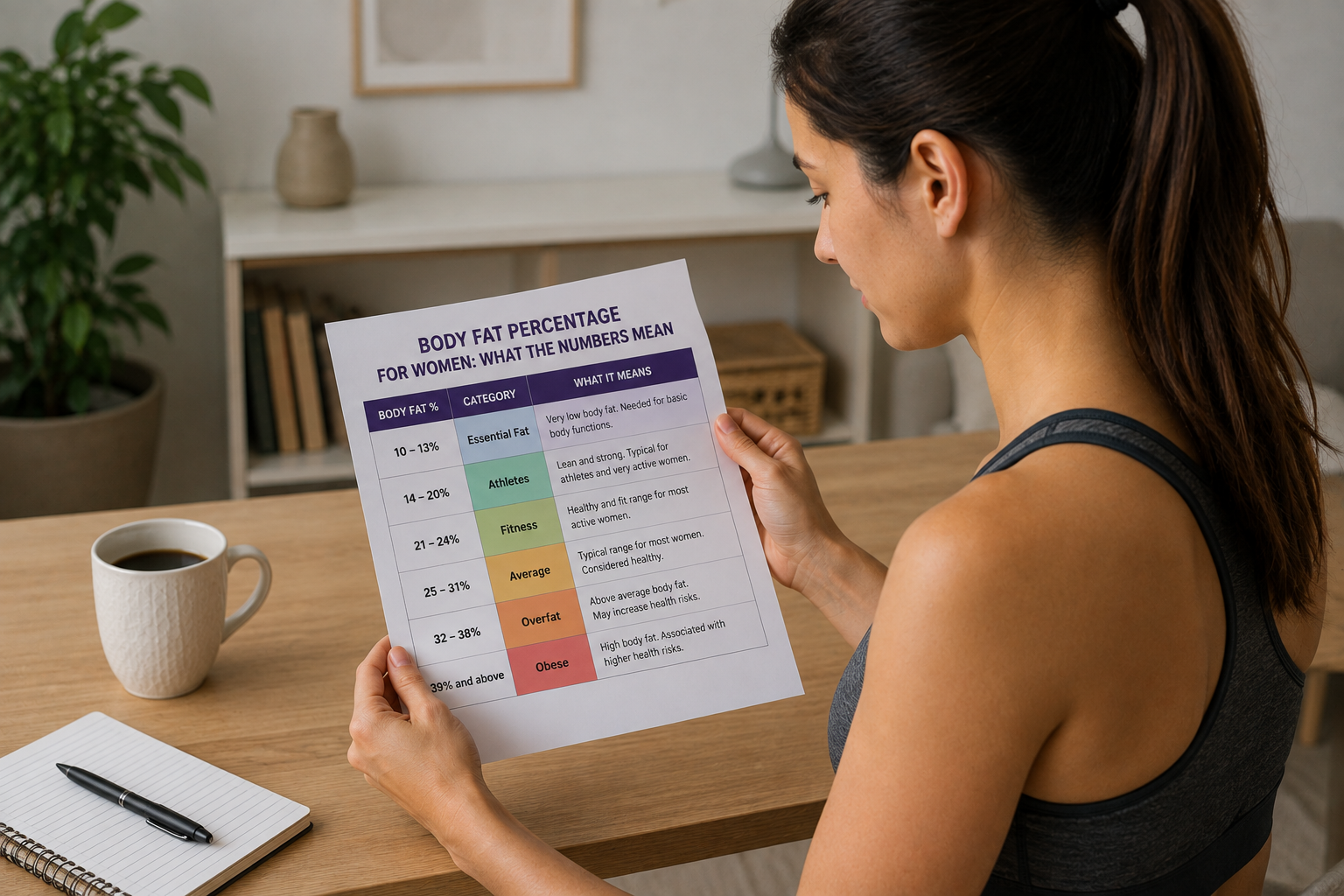
Body-fat categories vary between sources, populations, and measurement methods. A commonly cited general reference classification for adult women is:
| Body fat percentage | General description |
|---|---|
| 10–13% | Essential fat |
| 14–20% | Athletes |
| 21–24% | Fitness |
| 25–31% | Average |
| 32%+ | Higher body fat |
Essential Body Fat
Essential body fat is the amount of fat needed for normal physiological function.
Fat contributes to:
- Cell structure
- Hormone-related functions
- Protection of internal organs
- Insulation
- Energy storage
- Absorption of fat-soluble vitamins
- Normal reproductive function
Women generally require more essential body fat than men.
Extremely low body-fat levels should therefore not automatically be viewed as an ideal fitness goal. Insufficient energy availability and very low body fat can affect normal physiological function in some women.
Fitness-Level Body Fat
Women who participate in sports or regular strength training may have lower body-fat levels than the general population.
However, being "fit" cannot be determined by body-fat percentage alone.
Fitness also includes:
- Cardiovascular endurance
- Strength
- Muscular endurance
- Mobility
- Power
- Recovery
- Physical performance
A woman can have a relatively low body-fat percentage without being highly fit. Likewise, a woman with a higher body-fat percentage may still have good cardiovascular fitness, strength, or other measures of physical performance.
Average Body Fat
Higher Body Fat Levels
Higher levels of body fat can be associated with increased risk of conditions such as cardiovascular disease, type 2 diabetes, and other chronic health problems.
A higher woman fat percentage result should therefore be considered alongside broader health information rather than treated as a diagnosis.
Age and Body Fat Percentage
Regular physical activity, resistance training, adequate nutrition, and healthy lifestyle habits can help support body composition throughout adulthood.
Body Fat vs BMI
BMI and body-fat percentage measure different things.
BMI is calculated from height and weight:
BMI = weight in kilograms ÷ height in meters²
Body-fat percentage estimates the proportion of body weight that is fat.
BMI cannot distinguish muscle from fat. A woman who has substantial muscle mass may therefore have a higher BMI without having an unusually high body-fat percentage.
The BMI Calculator can provide a general screening measure, while the Body Fat Calculator can provide an additional estimate of body composition.
Neither number should be interpreted as a complete measure of health.
Body Composition and Muscle Mass
Muscle mass can change how body weight should be interpreted.
For example, a woman who begins resistance training may gain muscle while losing fat. Her body weight might change very little even though her body composition improves.
How Women's Body Fat Can Be Measured
There are several ways to estimate or measure body fat.
Common methods include:
- Skinfold measurements
- Bioelectrical impedance analysis
- Circumference-based equations
- Air displacement methods
- Dual-energy X-ray absorptiometry, or DEXA
- Other specialized clinical or research methods
Use the Body Fat Calculator
The Body Fat Calculator can provide an estimate using the measurements supported by the calculator.
For additional context, the Ideal Weight Calculator can provide a separate reference based on body measurements.
These tools are intended for information and estimation, not diagnosis.
Different Body-Fat Measurement Methods
Why Body-Fat Results Vary
Different measurement methods can produce different results for the same woman.
Variation can come from:
- Hydration
- Food and fluid intake
- Exercise before measurement
- Time of day
- Measurement technique
- Device differences
- Formula differences
- Normal changes in body composition
How to Interpret a Body Fat Percentage
Start by treating the result as an estimate.
Then consider:
- Your age
- Your activity level
- Your muscle mass
- Your waist circumference
- Your overall health
- The measurement method
- Your trend over time
The most useful interpretation considers the number together with the rest of your health and fitness information.
Limitations of Body-Fat Estimates
Every practical body-fat calculator has limitations.
If you are monitoring body composition, try to measure under similar conditions:
- Similar time of day
- Similar hydration
- Similar equipment
- Similar measurement method
- Similar posture and technique
Avoid placing too much importance on small changes between individual readings. Longer-term trends are usually more informative.
Body Fat and Weight Management
If reducing body fat is your goal, changes generally involve nutrition, physical activity, and time.
A balanced approach may include:
- An appropriate calorie intake
- Adequate protein
- Resistance training
- Cardiovascular activity
- Sufficient sleep
- Consistent monitoring
Summary
Female percentage body fat is an estimate of how much of total body weight consists of fat. Women naturally have higher essential body-fat requirements than men, so female results should be interpreted using appropriate female reference ranges.
Common reference charts may describe essential, athletic, fitness, average, and higher body-fat categories, but these are broad guidelines rather than universal health rules.
Age, muscle mass, hydration, measurement technique, and other factors can affect the result. Different methods can therefore produce different estimates for the same woman.
For a practical estimate, use the Body Fat Calculator and consider the result alongside BMI, waist circumference, fitness, and overall health. The BMI Calculator and Ideal Weight Calculator can provide additional context.
References
Gallagher, D., Heymsfield, S. B., Heo, M., Jebb, S. A., Murgatroyd, P. R., & Sakamoto, Y. (2000). Healthy percentage body fat ranges: An approach for developing guidelines based on body mass index. The American Journal of Clinical Nutrition, 72(3), 694–701. https://doi.org/10.1093/ajcn/72.3.694
National Heart, Lung, and Blood Institute. (2022). Overweight and obesity: Symptoms and diagnosis. National Institutes of Health. https://www.nhlbi.nih.gov/health/overweight-and-obesity/symptoms
National Institute of Diabetes and Digestive and Kidney Diseases. (n.d.). Am I at a healthy weight? National Institutes of Health. https://www.niddk.nih.gov/health-information/weight-management/adult-overweight-obesity/am-i-healthy-weight
Kyle, U. G., Bosaeus, I., De Lorenzo, A. D., et al. (2004). Bioelectrical impedance analysis—Part I: Review of principles and methods. Clinical Nutrition, 23(5), 1226–1243. https://doi.org/10.1016/j.clnu.2004.06.004
Heymsfield, S. B., Lohman, T., Wang, Z., & Going, S. (Eds.). (2005). Human body composition (2nd ed.). Human Kinetics.