
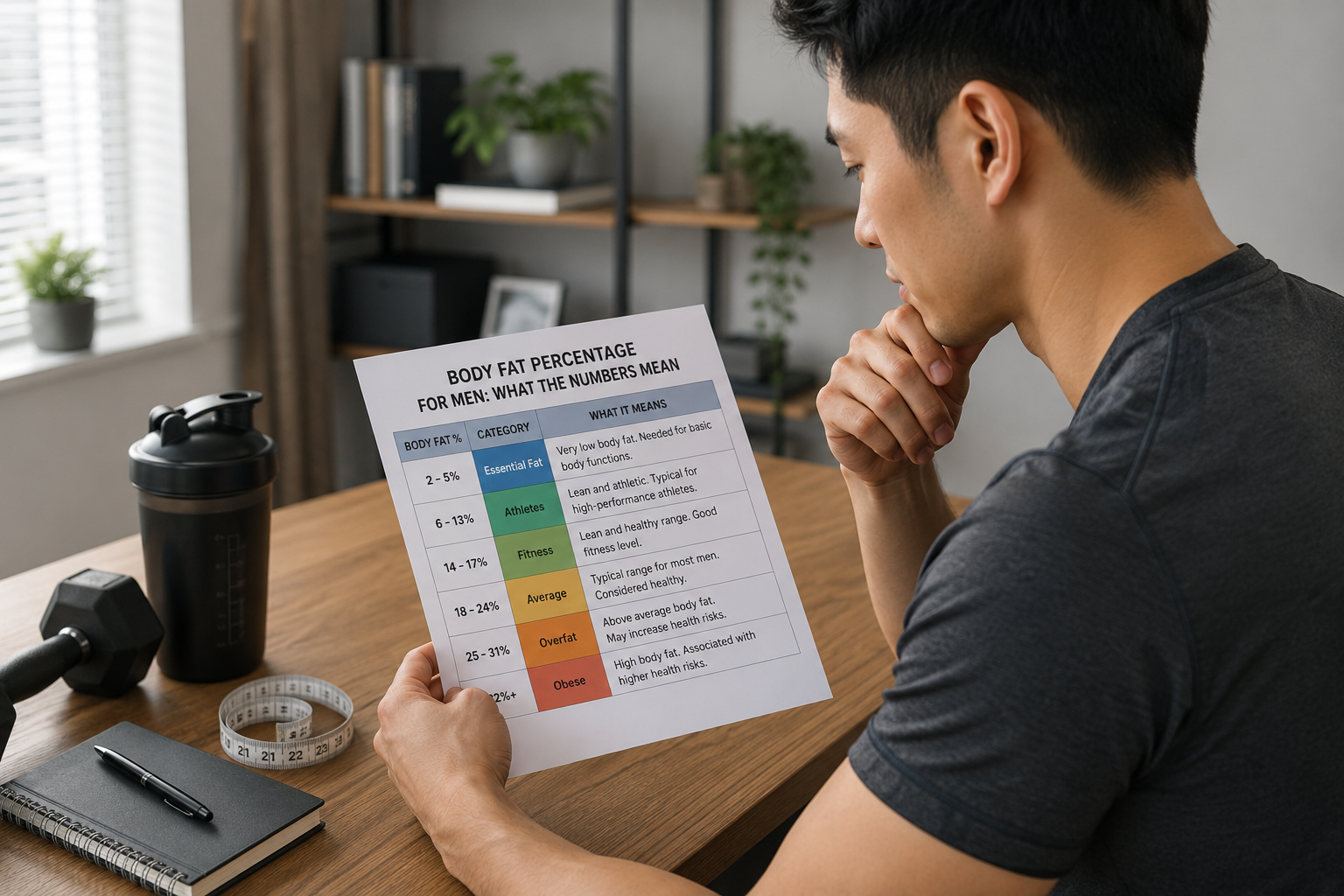
Body fat percentage tells you approximately how much of your total body weight is fat. Unlike body weight alone, it provides information about body composition. This is why men body fat percentage is often considered alongside BMI, waist circumference, and body weight.
A body-fat calculator can provide a useful estimate, but the number should be interpreted as one piece of information rather than a complete measure of health or fitness.
What Is Body Fat Percentage?
Body fat percentage is the proportion of total body weight that consists of fat.
Body fat is not unnecessary. Some fat is essential for normal physiological functions, while additional stored fat serves as an energy reserve.
Why Body Fat Percentage Matters
Body composition can provide information that body weight and BMI cannot provide on their own.
Two men can weigh the same amount but have very different proportions of muscle and fat.
However, a single body-fat number does not diagnose a health condition.
Typical Body Fat Percentage Ranges for Men
There is no universal set of categories that applies to every population or measurement method. Reference ranges also vary between organizations and sources.
A commonly cited set of general adult categories for men is:
| Body fat percentage | General description |
|---|---|
| 2–5% | Essential fat |
| 6–13% | Athletes |
| 14–17% | Fitness |
| 18–24% | Average |
| 25%+ | Higher body fat |
These figures are broad reference points, not strict definitions of health.
Very low body-fat levels may be difficult to maintain and are not automatically healthier. At the other end of the scale, higher levels of body fat can be associated with increased health risks.
Essential Body Fat
Essential body fat is the minimum amount of fat needed for normal physiological function.
Fat is involved in:
- Cell structure
- Hormone production
- Protection of organs
- Insulation
- Energy storage
- Absorption of fat-soluble vitamins
The amount of essential fat differs between men and women. Men generally have a lower essential body-fat requirement than women.
Extremely low body-fat levels are not a suitable goal for most people.
Fitness-Level Body Fat
Men who participate in sports or regular strength and conditioning may have lower body-fat levels than the general population.
However, fitness should not be defined by body-fat percentage alone.
Physical fitness also involves cardiovascular endurance, strength, muscular endurance, mobility, power, recovery, and physical performance.
Average Body Fat
Average body-fat levels vary by population, age, measurement method, and study.
As men age, body composition commonly changes. Muscle mass may decrease while fat mass or the proportion of body fat increases.
For this reason, comparing your result with a single number without considering age and measurement method can be misleading.
A useful approach is to look at trends over time using the same measurement method.
Higher Body Fat Levels
Higher body-fat levels can be associated with increased risk of several chronic health conditions, particularly when excess fat is concentrated around the abdomen.
However, body-fat percentage is not the only factor that matters.
Waist circumference, blood pressure, blood glucose, cholesterol, physical activity, diet, sleep, and family history can all contribute to an individual's health risk.
If your body-fat estimate is high, view it as one reason to consider the broader health picture rather than as a diagnosis.
Body Fat Percentage and Age
Age can affect body composition.
Many men gradually lose muscle mass and gain fat as they get older, particularly when physical activity and resistance training decrease.
This can cause body-fat percentage to rise even when body weight changes very little.
Body Fat vs BMI
BMI and body-fat percentage measure different things.
BMI is calculated from height and weight:
BMI = weight in kilograms ÷ height in meters²
Body-fat percentage estimates the proportion of body weight that is fat.
BMI does not distinguish muscle from fat. This can make it less informative for some muscular men.
The BMI Calculator can provide BMI for general screening, while the Body Fat Calculator can provide an additional estimate of body composition.
Body Fat Percentage and Muscle Mass
Muscle mass can strongly affect how body weight should be interpreted.
A man who gains muscle through resistance training may see his body weight increase without a corresponding increase in body fat.
Tracking body weight together with waist circumference, strength, photographs, or a consistent body-fat measurement method can provide a more complete picture.
How Men Can Estimate Body Fat
There are several ways to estimate body fat.
Common methods include:
- Skinfold measurements
- Bioelectrical impedance analysis
- Circumference-based equations
- Air displacement methods
- Dual-energy X-ray absorptiometry
- Other specialized clinical or research techniques
Use the Body Fat Calculator
The Body Fat Calculator can provide an estimate using the measurements supported by the calculator.
For additional context, the Ideal Weight Calculator can provide a separate reference estimate based on body measurements.
These calculators should be used as informational tools rather than diagnostic instruments.
Different Body-Fat Measurement Methods
Skinfold Measurements
Calipers measure skinfold thickness at specific locations. Results depend partly on technique and the equation used.
Bioelectrical Impedance
These devices estimate body composition from electrical resistance. Hydration, food intake, exercise, and device characteristics can affect results.
Circumference-Based Calculations
Equations can estimate body fat from measurements such as waist and neck circumference and height. They are convenient but remain estimates.
DEXA
Dual-energy X-ray absorptiometry, or DEXA, provides detailed body-composition information and is used in clinical or research settings. It is more specialized than consumer devices.
Why Body-Fat Results Vary
It is normal for different methods to produce different body-fat estimates.
Results can vary because of:
- Hydration
- Food and fluid intake
- Exercise before measurement
- Time of day
- Measurement technique
- Device differences
- Formula differences
- Changes in body composition
Rather than comparing unrelated methods, use the same method consistently when monitoring trends.
How to Interpret a Body Fat Percentage
Start by treating the result as an estimate.
Then consider:
- Your age
- Your physical activity
- Your muscle mass
- Your waist circumference
- Your overall health
- The measurement method
- Changes over time
A body-fat percentage that looks high or low on a general chart does not automatically mean something is wrong.
The most useful question is often whether the measurement is consistent and whether it fits the rest of your health and fitness information.
When Body Fat Percentage Is Only an Estimate
Every practical body-fat calculator produces an estimate.
Even advanced methods have measurement uncertainty. Consumer devices may be particularly sensitive to hydration and other short-term changes.
If you are monitoring progress, use the same conditions whenever possible:
- Similar time of day
- Similar hydration
- Similar measurement method
- Similar equipment
- Similar posture and technique
Longer-term trends are generally more useful than isolated readings.
Body Fat and Weight Management
If reducing body fat is your goal, changes usually involve a combination of nutrition, physical activity, and time.
Summary
Men body fat percentage provides an estimate of the proportion of body weight that is fat. It can add useful information beyond body weight or BMI, particularly when you are interested in body composition.
General reference categories often describe very low, athletic, fitness, average, and higher body-fat levels, but these categories are not universal health rules.
Age, muscle mass, measurement technique, hydration, and other factors can affect the result. Different methods can therefore produce different estimates for the same person.
For a practical estimate, use the Body Fat Calculator and interpret the result alongside BMI, waist measurements, fitness, and overall health. The BMI Calculator and Ideal Weight Calculator can provide additional context.
References
American Council on Exercise. (n.d.). ACE body fat percentage categories. American Council on Exercise.
Gallagher, D., Heymsfield, S. B., Heo, M., Jebb, S. A., Murgatroyd, P. R., & Sakamoto, Y. (2000). Healthy percentage body fat ranges: An approach for developing guidelines based on body mass index. The American Journal of Clinical Nutrition, 72(3), 694–701. https://doi.org/10.1093/ajcn/72.3.694
National Heart, Lung, and Blood Institute. (2022). Overweight and obesity: Symptoms and diagnosis. National Institutes of Health. https://www.nhlbi.nih.gov/health/overweight-and-obesity/symptoms
National Institute of Diabetes and Digestive and Kidney Diseases. (n.d.). Am I at a healthy weight? National Institutes of Health. https://www.niddk.nih.gov/health-information/weight-management/adult-overweight-obesity/am-i-healthy-weight
Kyle, U. G., Bosaeus, I., De Lorenzo, A. D., et al. (2004). Bioelectrical impedance analysis—Part I: Review of principles and methods. Clinical Nutrition, 23(5), 1226–1243. https://doi.org/10.1016/j.clnu.2004.06.004
Heymsfield, S. B., Lohman, T., Wang, Z., & Going, S. (Eds.). (2005). Human body composition (2nd ed.). Human Kinetics.