
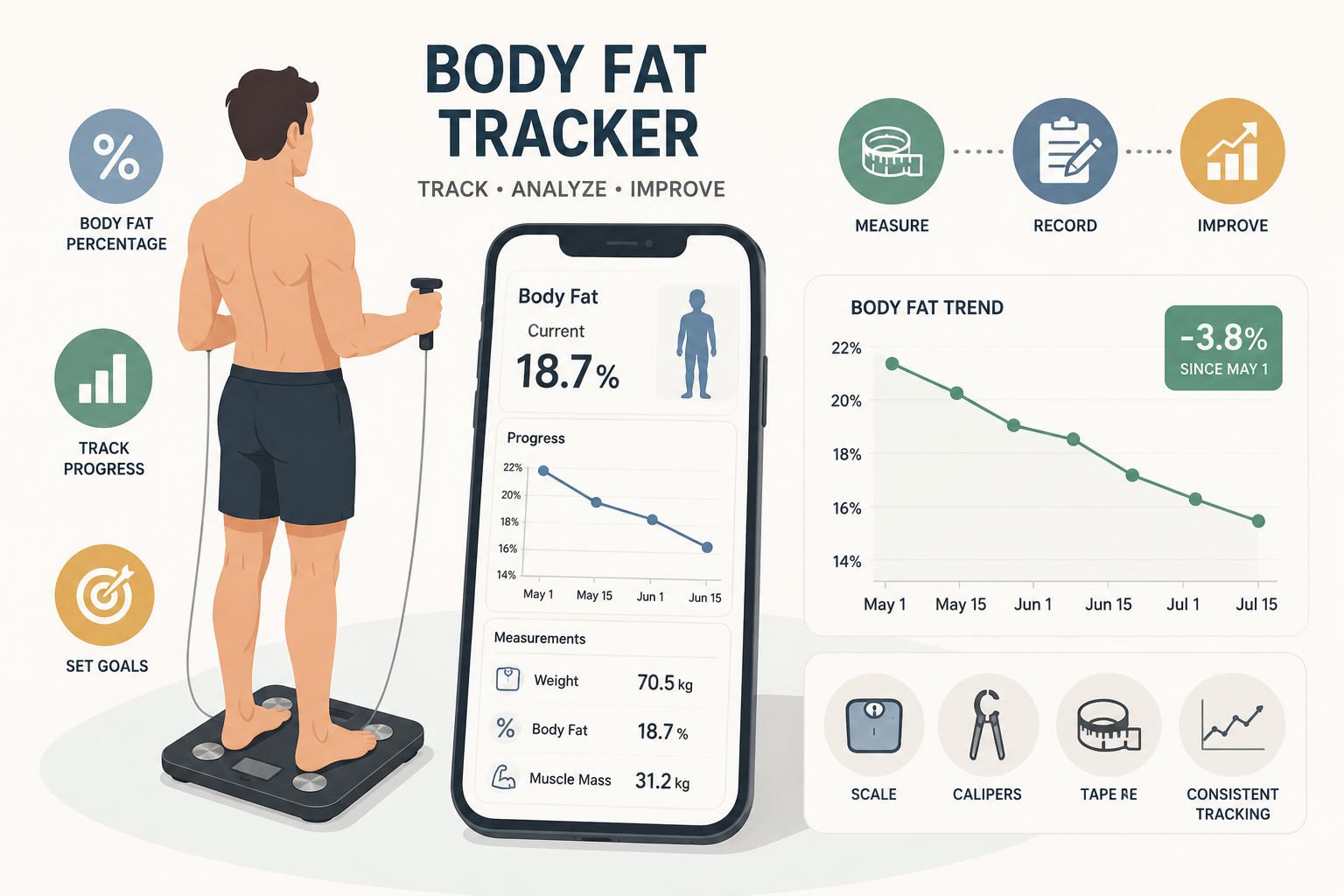
Tracking body fat can help you understand changes in body composition that a bathroom scale cannot show on its own. A body fat tracker can refer to a smart scale, spreadsheet, app, calculator, or simple measurement routine used to record estimated body-fat percentages over time.
What Is a Body-Fat Tracker?
A body-fat tracker is any system that records body-fat measurements so you can compare them over time.
You might use:
- A body-fat scale
- Skinfold calipers
- A measuring tape
- An online body-fat calculator
- A spreadsheet
- A fitness or health app
Why Track Body-Fat Percentage?
Body weight alone does not show what is changing inside the body.
A person can lose weight because of changes in:
- Body fat
- Water
- Muscle
- Glycogen
- Food stored in the digestive system
Body-fat tracking can therefore provide additional context.
For example, someone following a resistance-training program may see relatively little change on the scale while gradually reducing body fat and maintaining or increasing lean mass.
Body Weight vs Body-Fat Percentage
Body weight and body-fat percentage measure different things.
Body weight tells you how much your body weighs.
Body-fat percentage estimates what proportion of that weight is fat.
For example, a person weighing 80 kg with an estimated body-fat percentage of 25% would have approximately 20 kg of body fat.
That does not mean the remaining 60 kg is entirely muscle. It includes water, organs, bones, connective tissue, and other lean components.
This distinction is important when evaluating progress.
Tracking Body Composition Changes
Body composition can change even when body weight changes very little.
Consider a simplified example:
- Starting weight: 80 kg
- Starting estimated body fat: 25%
- Later weight: 80 kg
- Later estimated body fat: 23%
The scale weight is unchanged, but the estimated composition has changed.
How Often Should You Measure Body Fat?
There is no single measurement schedule that works for everyone.
Tracking With a Body-Fat Scale
Many smart scales use bioelectrical impedance analysis (BIA).
The scale measures electrical impedance and uses an algorithm to estimate body composition.
For tracking purposes, use:
- The same scale
- The same location
- A similar time of day
- Similar hydration conditions
- A consistent standing position
Tracking With Calipers
Skinfold calipers measure the thickness of subcutaneous fat at selected body locations.
The measurements are then entered into a prediction equation to estimate body-fat percentage.
Calipers can be useful for tracking changes when:
- The same sites are measured
- The same technique is used
- The same equation is used
- The measurements are taken consistently
Technique is particularly important. An inexperienced user may obtain inconsistent results from the same site.
Tracking With Tape Measurements
A measuring tape can be used to record waist, hip, neck, and other circumference measurements.
Some body-fat equations use these measurements to estimate body-fat percentage.
Even when you do not calculate body fat, circumference measurements can be useful for tracking changes in body size.
For example, a decreasing waist circumference can provide additional evidence of changing body composition during weight loss.
Taking Measurements Under Consistent Conditions
Consistency is one of the most important principles of body-fat tracking.
Try to measure under similar conditions each time.
Useful factors to standardize include:
- Time of day
- Hydration
- Clothing
- Measurement location
- Equipment
- Body position
- Recent exercise
- Food and fluid intake
Recording Body-Fat Measurements
A simple tracking table can be enough.
| Date | Weight | Body fat estimate | Waist |
|---|---|---|---|
| Week 1 | 80.0 kg | 25.0% | 90 cm |
| Week 3 | 79.4 kg | 24.7% | 89 cm |
| Week 5 | 78.8 kg | 24.5% | 88 cm |
| Week 7 | 78.6 kg | 24.1% | 87 cm |
Why Body-Fat Readings Fluctuate
Body-fat estimates can change even when your actual body composition has not changed significantly.
Possible influences include:
- Hydration
- Food and fluid intake
- Exercise
- Time of day
- Body temperature
- Measurement technique
- Device differences
BIA measurements are particularly sensitive to factors affecting electrical impedance and body water.
Circumference measurements can also vary because of tape placement, posture, breathing, and temporary abdominal fullness.
Tracking Trends Instead of Single Measurements
Suppose your estimated body-fat readings are:
- 24.5%
- 24.9%
- 24.2%
- 24.6%
- 23.9%
It would be unhelpful to treat every increase as fat gain or every decrease as fat loss.
Instead, look at the overall pattern.
Body Fat and Weight-Loss Progress
During weight loss, body-fat tracking can provide another way to evaluate progress.
If body weight and estimated body fat both decline over time, the measurements may support the conclusion that body composition is moving toward lower fat mass.
The Calorie Calculator can also help estimate calorie needs when planning a weight-management approach.
Body Recomposition and Body-Fat Tracking
Body recomposition involves changing the balance of fat and lean tissue.
This can make scale weight particularly difficult to interpret.
For example, if someone loses body fat while gaining some muscle, the scale may change only slightly.
A body-fat tracker can therefore provide useful additional information.
What Happens When Weight Decreases but Body Fat Changes Differently?
Weight and body-fat percentage do not have to move in exactly the same direction every week.
Short-term changes in body water can affect scale weight.
Training can also influence glycogen and water storage.
Common Body-Fat Tracking Mistakes
Changing Measurement Methods
Comparing a BIA reading with a skinfold estimate can create apparent changes that are partly caused by the different methods.
Measuring Under Different Conditions
A morning reading and a post-workout reading may not be directly comparable.
When to Use Multiple Measurements
Using multiple measurements can be helpful when you want a broader view of progress.
You might track:
- Body weight
- Body-fat estimate
- Waist circumference
- Hip circumference
- Strength
- Progress photographs
The Body Fat Calculator can provide an additional estimate, while the BMI Calculator can provide a height-and-weight-based screening measure.
A Simple Body-Fat Tracking Routine
A practical routine could look like this:
Step 1: Choose One Method
Select a BIA scale, calipers, tape-based method, or calculator.
Summary
A body fat tracker is a practical way to record estimated body-fat measurements and observe changes over time.
You can track body fat using a BIA scale, skinfold calipers, tape measurements, or an online calculator. For a broader picture, combine body-fat estimates with body weight, waist circumference, physical performance, and other progress measures.
The Body Fat Calculator can help estimate body fat, while the BMI Calculator, Ideal Weight Calculator, and Calorie Calculator can provide additional context.
References
Kyle, U. G., Bosaeus, I., De Lorenzo, A. D., Deurenberg, P., Elia, M., Gómez, J. M., Heitmann, B. L., Kent-Smith, L., Melchior, J.-C., Pirlich, M., Scharfetter, H., Schols, A. M. W. J., & Pichard, C. (2004). Bioelectrical impedance analysis—Part I: Review of principles and methods. Clinical Nutrition, 23(5), 1226–1243. https://doi.org/10.1016/j.clnu.2004.06.004
Ward, L. C. (2019). Bioelectrical impedance analysis for body composition assessment: Reflections on accuracy, clinical utility, and standardisation. European Journal of Clinical Nutrition, 73, 122–131. https://doi.org/10.1038/s41430-018-0335-3
Heyward, V. H., & Wagner, D. R. (2004). Applied body composition assessment (2nd ed.). Human Kinetics.
Gallagher, D., Heymsfield, S. B., Heo, M., Jebb, S. A., Murgatroyd, P. R., & Sakamoto, Y. (2000). Healthy percentage body fat ranges: An approach for developing guidelines based on body mass index. The American Journal of Clinical Nutrition, 72(3), 694–701. https://doi.org/10.1093/ajcn/72.3.694