
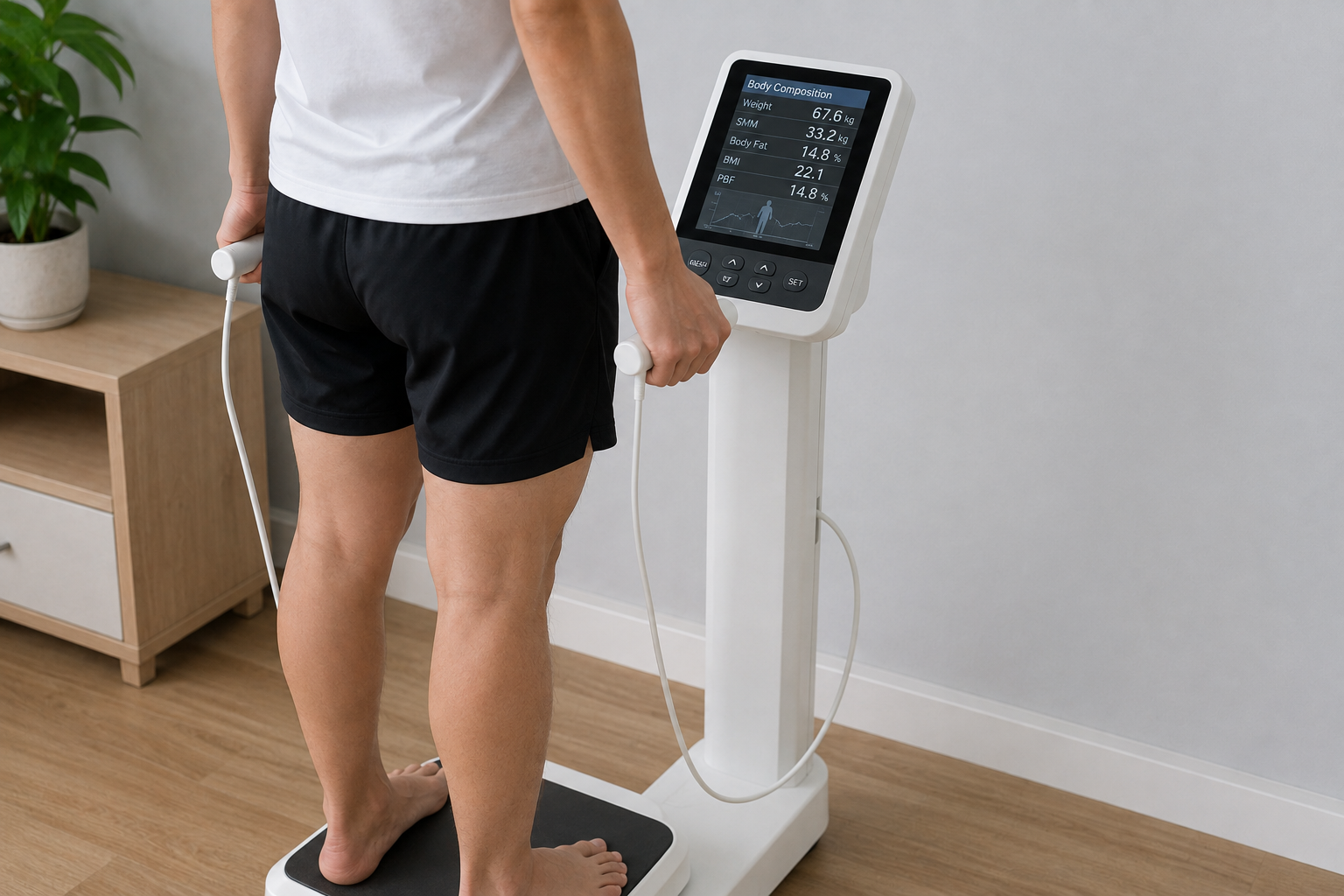
You do not need a laboratory to get a useful estimate of your body-fat percentage. Several methods can be used at home, including body-fat scales, skinfold calipers, measuring tapes, and online calculators.
However, it is important to understand that most home methods estimate body fat rather than directly measuring the amount of fat in your body. Results can change with hydration, measurement technique, equipment, and the formula used.
If your goal is to calculate body fat percentage at home, the most useful approach is usually to choose a method you can perform consistently and track the trend over time.
Can You Measure Body Fat at Home?
Yes. You can estimate body fat at home using several practical methods.
Common options include:
- Bioelectrical impedance body-fat scales
- Skinfold calipers
- Waist and other body measurements
- Height- and weight-based equations
- Online body-fat calculators
Each method has advantages and limitations.
A home method may not provide the same level of detail as professional body-composition testing, but it can still be useful for monitoring changes.
Body Fat Scales
Body-fat scales commonly use bioelectrical impedance analysis (BIA).
The scale sends a very small electrical current through the body and measures electrical impedance. The device then combines that information with details such as weight, height, age, and sex to estimate body composition.
If you use a body-fat scale at home, using the same scale under similar conditions is usually more useful than comparing numbers from different devices.
Bioelectrical Impedance Analysis
BIA is not limited to bathroom scales. Handheld devices and other consumer body-composition monitors also use electrical impedance.
BIA can be useful for tracking trends, but the result should not be interpreted as a laboratory-precise percentage.
Skinfold Calipers
Another way to calculate your body fat percentage at home is with skinfold calipers.
Calipers measure the thickness of a fold of skin and underlying subcutaneous fat at selected locations.
Several measurements are then entered into an equation that estimates total body fat.
Technique matters.
You need to measure the correct body locations and use the same procedure each time. Inexperienced users can produce inconsistent readings.
If you are using calipers yourself, practice and consistency are more important than making a single measurement appear extremely precise.
Waist and Body Measurements
A measuring tape can also be used to estimate body fat.
Some equations use combinations of:
- Waist circumference
- Neck circumference
- Hip circumference
- Height
- Weight
- Sex
Height and Weight-Based Estimates
Some equations estimate body-fat percentage from height, weight, age, sex, or BMI.
BMI is calculated using:
BMI = weight in kilograms ÷ height in meters²
A body-fat equation can then use BMI together with age and sex to estimate body-fat percentage.
This is one of the easiest approaches because you do not need special equipment.
However, BMI does not distinguish muscle from fat. A person with substantial muscle mass may therefore receive a less representative body-fat estimate.
The BMI Calculator can calculate BMI, while the Body Fat Calculator can provide a body-fat estimate using its supported method.
Using an Online Body Fat Calculator
An online calculator is one of the simplest ways to get body fat percentage without buying equipment.
Depending on the calculator, you may need to enter information such as:
- Sex
- Age
- Height
- Weight
- Waist measurement
- Neck measurement
- Hip measurement
The Body Fat Calculator can be used as a convenient starting point.
How to Take Body Measurements Correctly
Accurate measurements are important when using circumference-based calculations.
For better consistency:
- Use a flexible measuring tape.
- Measure against the skin rather than over bulky clothing.
- Keep the tape level.
- Do not pull the tape excessively tight.
- Measure at the same anatomical location each time.
- Take the measurement under similar conditions.
- Record the result immediately.
Why Home Body-Fat Measurements Vary
It is normal for home body-fat measurements to vary.
A reading can change because of:
- Hydration
- Food and drink
- Exercise
- Time of day
- Body temperature
- Measurement technique
- Device differences
- Different formulas
For example, a BIA scale can produce a different estimate when your hydration status changes.
Likewise, a circumference calculation can change if the tape is placed slightly differently.
Hydration and Body-Fat Readings
Hydration is particularly important for methods that depend on electrical properties.
BIA devices estimate body composition partly from how electrical current moves through the body. Changes in body water can therefore affect the calculation.
For more consistent tracking, avoid comparing a reading taken after unusual dehydration or heavy exercise with a reading taken under normal conditions.
Best Time to Measure Body Fat
There is no universal time that produces the "true" body-fat percentage.
For home tracking, the most useful time is one you can repeat consistently.
Many people choose to measure:
- In the morning
- After using the bathroom
- Before eating
- Before exercise
- Under similar hydration conditions
How Often to Measure Body Fat
Body-composition estimates can fluctuate because of short-term changes in hydration and other factors.
Tracking Changes Instead of One Reading
Suppose your home body-fat estimates are:
- Week 1: 28.4%
- Week 2: 28.1%
- Week 3: 28.6%
- Week 4: 27.9%
The individual readings move up and down, but the overall direction may still indicate a gradual change.
This is why consistency is more valuable than chasing a particular decimal point.
You can also track:
- Body weight
- Waist circumference
- Body-fat estimate
- Exercise performance
- Progress photographs
Home Measurement vs Professional Testing
Home methods are convenient and inexpensive, but professional testing can provide more detailed body-composition information.
Professional options may include:
- DEXA/DXA
- Air displacement plethysmography
- Hydrostatic weighing
- Professional skinfold assessment
- Professional BIA systems
How to Interpret Your Body Fat Percentage
Once you test your body fat percentage, avoid judging the result solely by whether it looks high or low on an online chart.
Consider:
- Your age
- Your sex
- Your muscle mass
- Your activity level
- Your waist circumference
- The measurement method
- Your results over time
Body-fat reference ranges differ between men and women and can also vary by age and source.
The BMI Calculator can provide additional screening information, while the Ideal Weight Calculator can provide another general reference.
A Simple Home Measurement Routine
If you want a practical routine, keep it simple.
Option 1: BIA Scale
Use the same scale once per week under similar conditions.
Record the result and look at the trend over several weeks.
Option 2: Measuring Tape
Measure your waist and any other required body sites using the same technique each time.
Enter the measurements into the same calculator.
Option 3: Skinfold Calipers
Use the same measurement locations, technique, and equation each time.
If possible, have the measurements taken by the same person.
When to Consider Professional Testing
Summary
You can calculate body fat percentage at home using a body-fat scale, BIA device, skinfold calipers, measuring tape, height and weight equations, or an online calculator.
Each method has limitations. BIA can be influenced by hydration and other conditions, skinfold measurements depend on technique, and circumference or BMI-based equations estimate body fat indirectly.
The most useful home method is usually one that you can repeat consistently.
Measure under similar conditions, record the results, and focus on longer-term trends rather than a single reading. The Body Fat Calculator can provide a convenient estimate, while the BMI Calculator and Ideal Weight Calculator can provide additional context.
References
Kyle, U. G., Bosaeus, I., De Lorenzo, A. D., Deurenberg, P., Elia, M., Gómez, J. M., Heitmann, B. L., Kent-Smith, L., Melchior, J.-C., Pirlich, M., Scharfetter, H., Schols, A. M. W. J., & Pichard, C. (2004). Bioelectrical impedance analysis—Part I: Review of principles and methods. Clinical Nutrition, 23(5), 1226–1243. https://doi.org/10.1016/j.clnu.2004.06.004
Ward, L. C. (2019). Bioelectrical impedance analysis for body composition assessment: Reflections on accuracy, clinical utility, and standardisation. European Journal of Clinical Nutrition, 73, 122–131. https://doi.org/10.1038/s41430-018-0335-3
National Institutes of Health. (1996). Bioelectrical impedance analysis in body composition measurement: NIH Technology Assessment Conference statement. American Journal of Clinical Nutrition, 64(3 Suppl.), 524S–532S. https://pubmed.ncbi.nlm.nih.gov/8780375/
Heymsfield, S. B., Lohman, T., Wang, Z., & Going, S. (Eds.). (2005). Human body composition (2nd ed.). Human Kinetics.
Gallagher, D., Heymsfield, S. B., Heo, M., Jebb, S. A., Murgatroyd, P. R., & Sakamoto, Y. (2000). Healthy percentage body fat ranges: An approach for developing guidelines based on body mass index. The American Journal of Clinical Nutrition, 72(3), 694–701. https://doi.org/10.1093/ajcn/72.3.694