
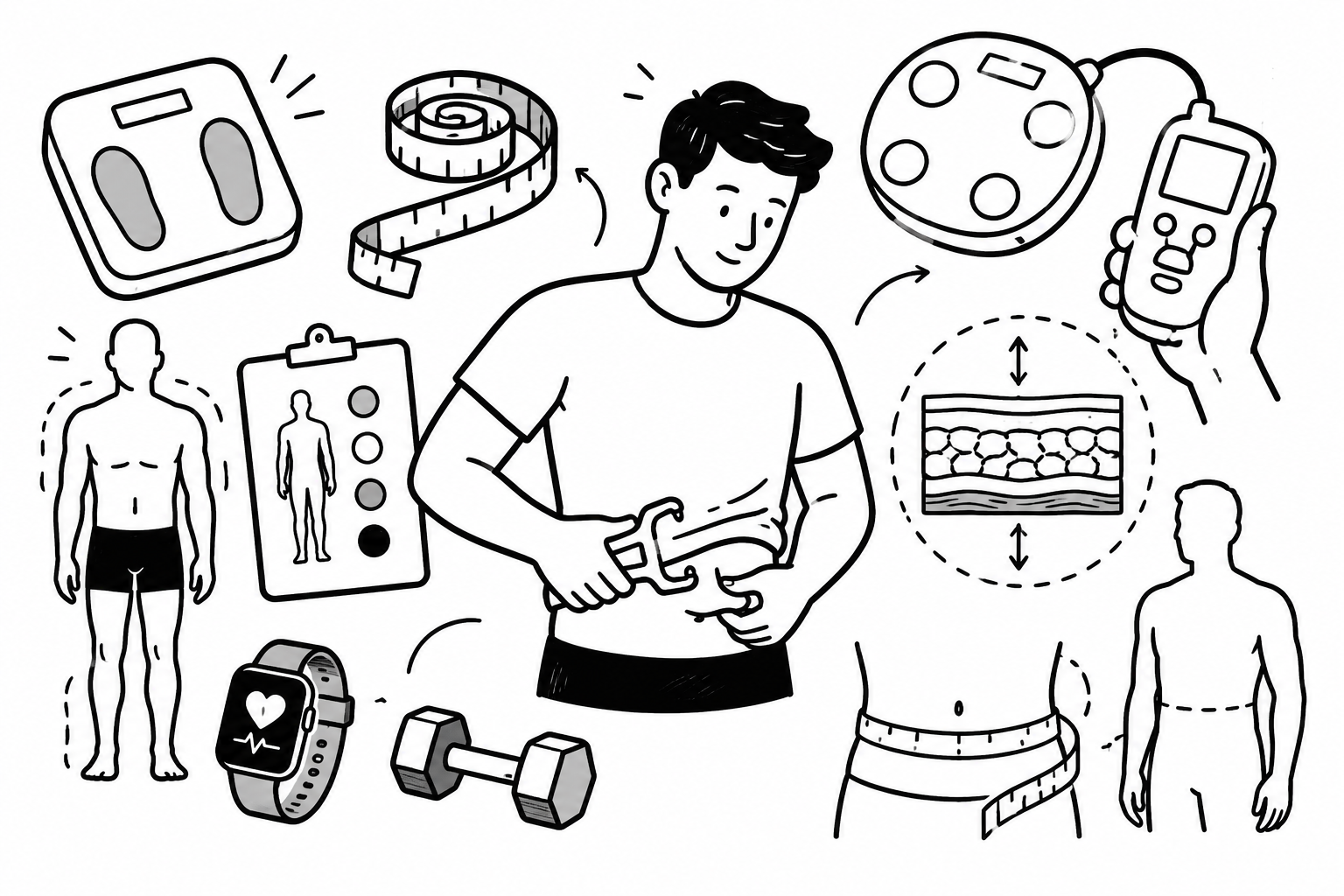
Body fat percentage estimates how much of your total body weight is fat. It can provide information about body composition that a scale weight or BMI number cannot provide by itself.
If you are searching for a body fat calculator, body fat percentage calculator, or fat percentage calculator, it is important to understand what the result actually represents. Most convenient calculators do not directly measure body fat. They use measurements and mathematical equations to produce an estimate.
Different methods can produce different results, so the goal is not to find a magical "perfect" number. Instead, use a suitable method consistently and interpret the result in context.
What Is Body Fat Percentage?
Body fat percentage is the proportion of total body weight made up of fat.
For example, if someone weighs 80 kg and has an estimated body-fat percentage of 20%:
80 × 0.20 = 16 kg of fat
The remaining approximately 64 kg consists of lean tissues and water.
How Body Fat Percentage Is Calculated
There is no single formula that works for everyone.
Body-fat estimates can be produced from measurements such as:
- Height
- Weight
- Age
- Sex
- Waist circumference
- Neck circumference
- Hip circumference
- Skinfold thickness
- Electrical impedance
Body Fat Percentage Formula
One commonly studied approach estimates body fat from BMI, age, and sex.
A published adult equation is:
Body fat % = 1.20 × BMI + 0.23 × age − 10.8 × sex − 5.4
In this equation, sex is coded as:
- 1 for men
- 0 for women
BMI itself is calculated as:
BMI = weight in kg ÷ height in meters²
The Body Fat Calculator can perform this type of calculation automatically when its required inputs are provided.
Body Fat Estimation Methods
Several methods can be used to estimate body fat. They differ in cost, convenience, equipment, and potential sources of error.
BMI-Based Body Fat Estimates
BMI-based equations use height, weight, age, and sex to estimate body fat.
They are convenient because the required information is easy to obtain.
However, BMI does not distinguish fat from muscle. A muscular person may therefore receive an estimate that does not accurately reflect their actual body composition.
BMI-based equations are most useful as general estimates rather than precise individual measurements.
The BMI Calculator can calculate BMI separately.
Skinfold Measurements
Skinfold testing uses calipers to measure the thickness of subcutaneous fat at specific body locations.
Several measurements can be entered into an equation to estimate total body fat.
This method can be inexpensive and practical, but technique matters. The location of the measurement, the amount of tissue grasped, the caliper technique, and the equation used can all affect the result.
Bioelectrical Impedance
Bioelectrical impedance analysis, or BIA, estimates body composition by measuring the body's electrical response to a low electrical current.
Lean tissue generally contains more water and conducts electricity differently from adipose tissue. The device uses the measured impedance together with prediction equations to estimate body composition.
Waist Measurements
Waist circumference can provide information about abdominal fat distribution and is also used in some body-composition equations.
Circumference-Based Estimates
Some formulas estimate body fat from combinations of body measurements.
For example, a military-style equation may use height, waist circumference, neck circumference, sex, and other information.
Body Fat Scales
Many modern bathroom scales use bioelectrical impedance to estimate body fat.
If you use a body-fat scale to monitor progress, using the same device under similar conditions is usually more useful than comparing readings from different devices.
Body Fat Index vs Body Fat Percentage
The terms body fat index calculator, fat index calculator, and body fat content calculator can be confusing because they are not always standardized terms.
Body-fat percentage has a clear basic meaning:
Body fat percentage = fat mass ÷ total body mass × 100
An "index" may refer to a specific scoring system or simply be used as an informal name for a body-fat calculation.
Before comparing an index with a percentage, check the formula used by the calculator.
Similarly, a body fat level calculator or body fat rate calculator may simply be another name for a tool that estimates body-fat percentage.
Why Body Fat Calculators Produce Estimates
Most practical body-fat calculators use indirect methods.
They do not remove or chemically analyze body tissue to determine exactly how much fat is present. Instead, they use measurable characteristics that are statistically related to body composition.
Accuracy of Body Fat Measurements
BIA is particularly sensitive to measurement conditions. Research has shown that hydration and other factors can alter BIA-derived body-composition estimates.
Skinfold testing can also vary with tester skill and measurement technique.
Why Two Methods Can Produce Different Results
It is normal for two body-fat methods to disagree.
For example, you might receive one estimate from:
- A smart scale
- A BMI-based calculator
- A skinfold test
- A circumference equation
If your goal is tracking progress, choose one method and keep the testing conditions as consistent as possible.
How to Interpret an Estimated Body Fat Percentage
Start by treating the result as an estimate.
Then consider:
- Your age
- Your sex
- Your muscle mass
- Your waist circumference
- Your activity level
- The measurement method
- Changes over time
Long-term trends are generally more useful than isolated readings.
Body Fat Percentage vs Body Weight
Body weight tells you how much your body weighs. It does not tell you how that weight is distributed between fat, muscle, bone, and water.
For example, gaining muscle can increase body weight without increasing body fat.
Likewise, a person can lose body weight while losing both fat and lean tissue.
The Ideal Weight Calculator can provide another general reference, but it should not be treated as a precise target for every individual.
When a Calculator Is Useful
A body-fat calculator is useful when you want a quick, low-cost estimate of body composition.
It can help you:
- Establish a baseline
- Track changes over time
- Compare body composition with body weight
- Understand how measurements relate to body fat
- Support a broader fitness or weight-management plan
Summary
To determine body fat percentage, you can use several approaches, including BMI-based equations, skinfold measurements, bioelectrical impedance, waist measurements, and circumference-based formulas.
A body fat percentage calculator does not usually measure fat directly. It uses measurements and a prediction equation to produce an estimate.
This explains why a fat percentage calculator, body fat index calculator, or body fat rate calculator can produce a different result from another method.
For practical tracking, consistency is often more important than chasing an exact number. Use the Body Fat Calculator alongside the BMI Calculator and Ideal Weight Calculator to build a broader picture of body composition.
References
Deurenberg, P., Weststrate, J. A., & Seidell, J. C. (1991). Body mass index as a measure of body fatness: Age- and sex-specific prediction formulas. The British Journal of Nutrition, 65(2), 105–114. https://doi.org/10.1079/BJN19910073
National Institutes of Health. (1996). Bioelectrical impedance analysis in body composition measurement: NIH Technology Assessment Conference statement. American Journal of Clinical Nutrition, 64(3 Suppl.), 524S–532S. https://pubmed.ncbi.nlm.nih.gov/8780375/
Kyle, U. G., Bosaeus, I., De Lorenzo, A. D., Deurenberg, P., Elia, M., Gómez, J. M., Heitmann, B. L., Kent-Smith, L., Melchior, J.-C., Pirlich, M., Scharfetter, H., Schols, A. M. W. J., & Pichard, C. (2004). Bioelectrical impedance analysis—Part I: Review of principles and methods. Clinical Nutrition, 23(5), 1226–1243. https://doi.org/10.1016/j.clnu.2004.06.004
Ward, L. C. (2019). Bioelectrical impedance analysis for body composition assessment: Reflections on accuracy, clinical utility, and standardisation. European Journal of Clinical Nutrition, 73, 122–131. https://doi.org/10.1038/s41430-018-0335-3
National Center for Biotechnology Information. (n.d.). Body composition measurement: Accuracy, validity, and comparability. In Body Composition and Physical Performance. https://www.ncbi.nlm.nih.gov/books/NBK235949/