
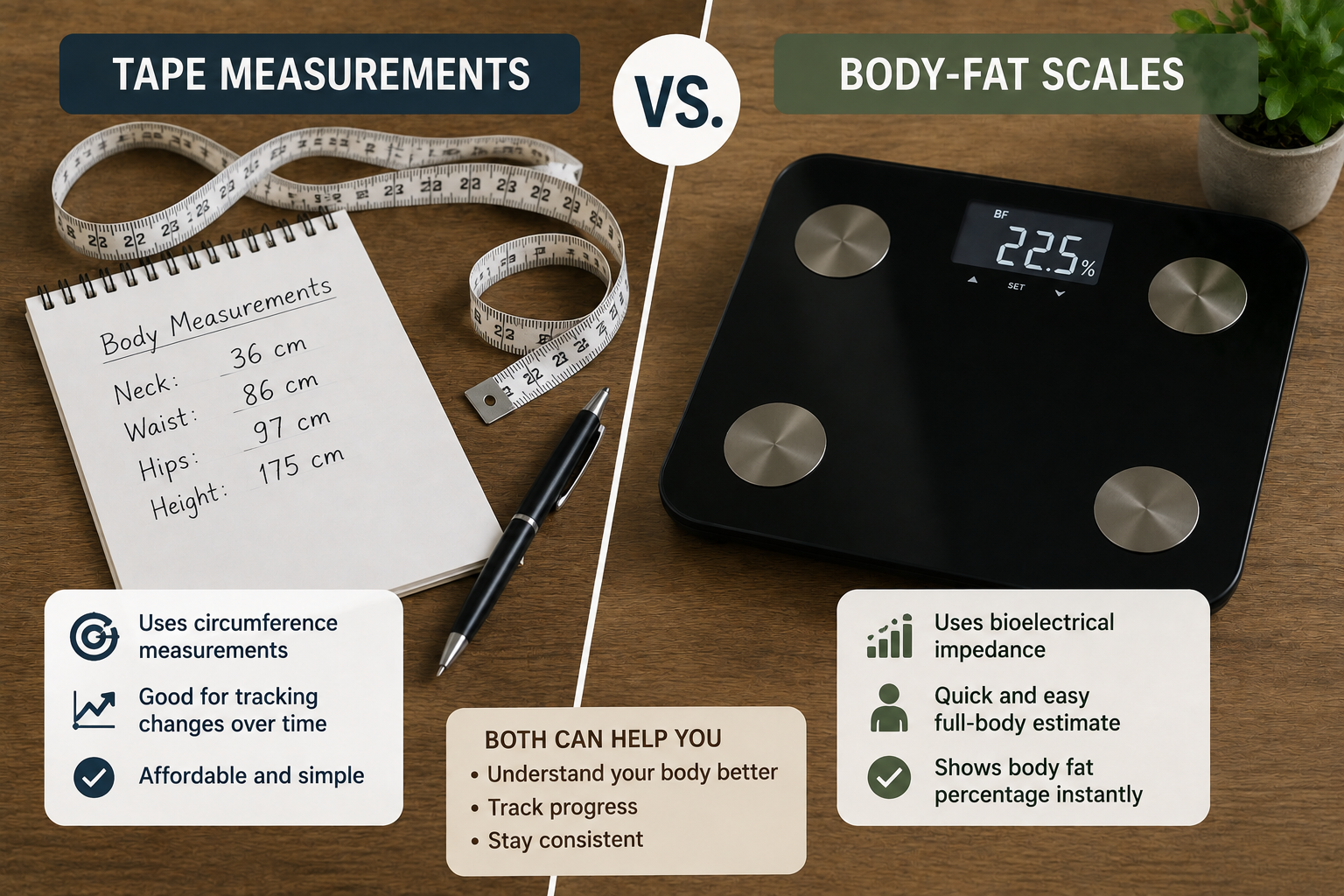
A simple measuring tape can provide useful information about body size and body composition. With the right measurements and a suitable equation, you can estimate body fat without specialized equipment.
If you want to measure body fat with tape, the most common measurements include waist circumference, neck circumference, hip circumference in some protocols, and height.
Can You Measure Body Fat With a Tape Measure?
Yes, but a tape measure provides an estimate, not a direct measurement of body fat.
Some circumference-based equations use measurements of body dimensions to estimate body-fat percentage. One widely known military-style approach uses height, neck circumference, and waist circumference for men, while women may also use hip circumference.
Tape Measurements and Body Composition
Body composition describes the different components that make up body weight, including fat mass and lean mass.
Circumference measurements can provide information about body size and fat distribution.
For example, waist circumference is useful for assessing abdominal size, but it is not identical to body-fat percentage.
What Measurements Are Needed?
The required measurements depend on the formula you use.
A circumference-based body-fat calculation may require:
- Height
- Waist circumference
- Neck circumference
- Hip circumference
- Sex
- Age
Waist Circumference
Waist circumference is one of the most important measurements in many tape-based body-fat equations.
The exact measurement location depends on the protocol.
Common approaches may use a specific anatomical landmark or a standardized location around the abdomen.
The tape should remain horizontal around the body and should not be pulled excessively tight.
Neck Circumference
Some circumference equations use neck circumference along with waist and height.
Measure around the neck at the location specified by the selected protocol.
Keep the tape in contact with the skin without compressing the tissue.
Hip Circumference
Hip circumference is used in some equations, particularly for women.
The measurement is generally taken around the widest part of the hips or buttocks according to the selected protocol.
The tape should remain level and should not be tightened enough to compress the body.
Not every body-fat equation requires hip circumference, so check the formula before measuring.
Height and Body Measurements
Height is often included in circumference-based body-fat equations.
Measure height without shoes and use the same unit system required by the calculator.
You should also record the date of each measurement.
A simple record might look like:
| Measurement | Result |
|---|---|
| Height | 170 cm |
| Waist | 85 cm |
| Neck | 38 cm |
| Hip | 100 cm |
How Tape Measurements Can Estimate Body Fat
Circumference equations work by relating body dimensions to body composition.
The basic process is:
Body measurements → prediction equation → estimated body-fat percentage
A formula may combine several measurements mathematically.
The result is not a direct measurement of fat tissue. It is an estimate based on relationships observed in a reference population.
Circumference-Based Body-Fat Formulas
One commonly used approach is associated with U.S. military body-composition assessment.
For men, the equation uses measurements such as waist circumference, neck circumference, and height.
For women, the calculation can also include hip circumference.
The exact equation should be used as published rather than reconstructed from memory because different versions can use different logarithms, units, and measurement definitions.
How to Take Measurements Consistently
Consistency is more important than making one measurement look perfect.
Try to:
- Use the same measuring tape.
- Measure at the same anatomical locations.
- Keep the tape level.
- Avoid pulling the tape too tightly.
- Measure under similar conditions.
- Record measurements immediately.
- Repeat measurements when practical.
Where to Position the Tape
The exact tape position depends on the measurement protocol.
For waist measurements, use the location specified by your chosen equation.
For neck measurements, follow the same anatomical landmark each time.
For hips, use the widest point when the selected formula calls for a hip measurement.
Common Measurement Mistakes
Several mistakes can reduce the usefulness of tape-based estimates.
Pulling the Tape Too Tight
Compressing soft tissue can make the circumference appear smaller.
Holding Your Breath
Changing your breathing or pulling your stomach inward can alter the measurement.
Measuring Over Thick Clothing
Clothing can add to the circumference and make the result less consistent.
Changing Measurement Locations
A different location can produce a different circumference.
Tilting the Tape
The tape should be positioned consistently and generally kept level around the body.
Measuring at Different Times
Food, fluid intake, exercise, and other short-term factors can influence body measurements.
Tape Measurement vs Body-Fat Scales
Body-fat scales commonly use bioelectrical impedance analysis.
Tape-based methods measure body dimensions, while BIA devices estimate body composition from electrical impedance.
| Feature | Tape measurement | BIA scale |
|---|---|---|
| Equipment | Measuring tape | BIA device |
| Cost | Very low | Low to moderate |
| Technique | Moderate | Low |
| Hydration influence | Indirect | Can be significant |
| Home use | Easy | Very easy |
| Body-fat result | Formula estimate | Formula estimate |
Tape Measurement vs Skinfold Calipers
Skinfold calipers measure the thickness of subcutaneous fat at specific locations.
Tape measurements instead measure body circumference.
Calipers can require more technical skill because the tester must identify specific skinfold sites and correctly grasp the tissue.
Tape measurements are generally simpler for beginners.
Tape Measurement vs BMI
BMI uses only height and weight:
BMI = weight ÷ height²
It does not directly measure body fat.
A muscular person can have a relatively high BMI without having a high body-fat percentage.
Tape measurements can provide additional information about body size and circumference, although they also do not directly measure total body fat.
The BMI Calculator can provide a separate BMI result.
Using Measurements to Track Weight-Loss Progress
Tape measurements can be particularly useful when tracking changes over time.
For example, you might record:
- Body weight
- Waist circumference
- Hip circumference
- Neck circumference
- Estimated body-fat percentage
A reduction in waist circumference may provide useful evidence of changing body size even when scale weight changes slowly.
Why Tape-Based Estimates Are Not Exact
Circumference-based body-fat equations are prediction models.
They were developed using relationships between body measurements and body composition in particular populations.
Your body may differ from the people represented in the original reference data.
Measurement error can also affect the result.
For this reason, a result such as 21.7% should not be interpreted as though the true body-fat percentage is known to the nearest decimal point.
How a Body-Fat Calculator Can Help
A Body Fat Calculator can make tape-based calculations easier.
Instead of manually applying logarithmic equations, you can enter the required measurements and let the calculator perform the mathematical steps.
For broader weight-management tracking, the Ideal Weight Calculator can provide another general reference.
Summary
You can measure body fat with tape by taking standardized body measurements and entering them into a suitable circumference-based equation.
Depending on the formula, you may need waist, neck, hip, and height measurements.
The tape itself does not directly measure body fat. It provides measurements that a mathematical model uses to estimate body-fat percentage.
For the most useful results, use the same tape, measurement locations, technique, and formula each time. Focus on changes over weeks or months rather than a single reading.
The Body Fat Calculator can simplify the calculation, while the BMI Calculator and Ideal Weight Calculator can provide additional context.
References
Hodgdon, J. A., & Beckett, M. B. (1984). Prediction of percent body fat for U.S. Navy men from body circumferences and height. Naval Health Research Center.
Hodgdon, J. A., & Beckett, M. B. (1984). Prediction of percent body fat for U.S. Navy women from body circumferences and height. Naval Health Research Center.
Centers for Disease Control and Prevention. (2024). Adult BMI calculator. U.S. Department of Health and Human Services. https://www.cdc.gov/bmi/adult-calculator/
Gallagher, D., Heymsfield, S. B., Heo, M., Jebb, S. A., Murgatroyd, P. R., & Sakamoto, Y. (2000). Healthy percentage body fat ranges: An approach for developing guidelines based on body mass index. The American Journal of Clinical Nutrition, 72(3), 694–701. https://doi.org/10.1093/ajcn/72.3.694
Kyle, U. G., Bosaeus, I., De Lorenzo, A. D., et al. (2004). Bioelectrical impedance analysis—Part I: Review of principles and methods. Clinical Nutrition, 23(5), 1226–1243. https://doi.org/10.1016/j.clnu.2004.06.004