
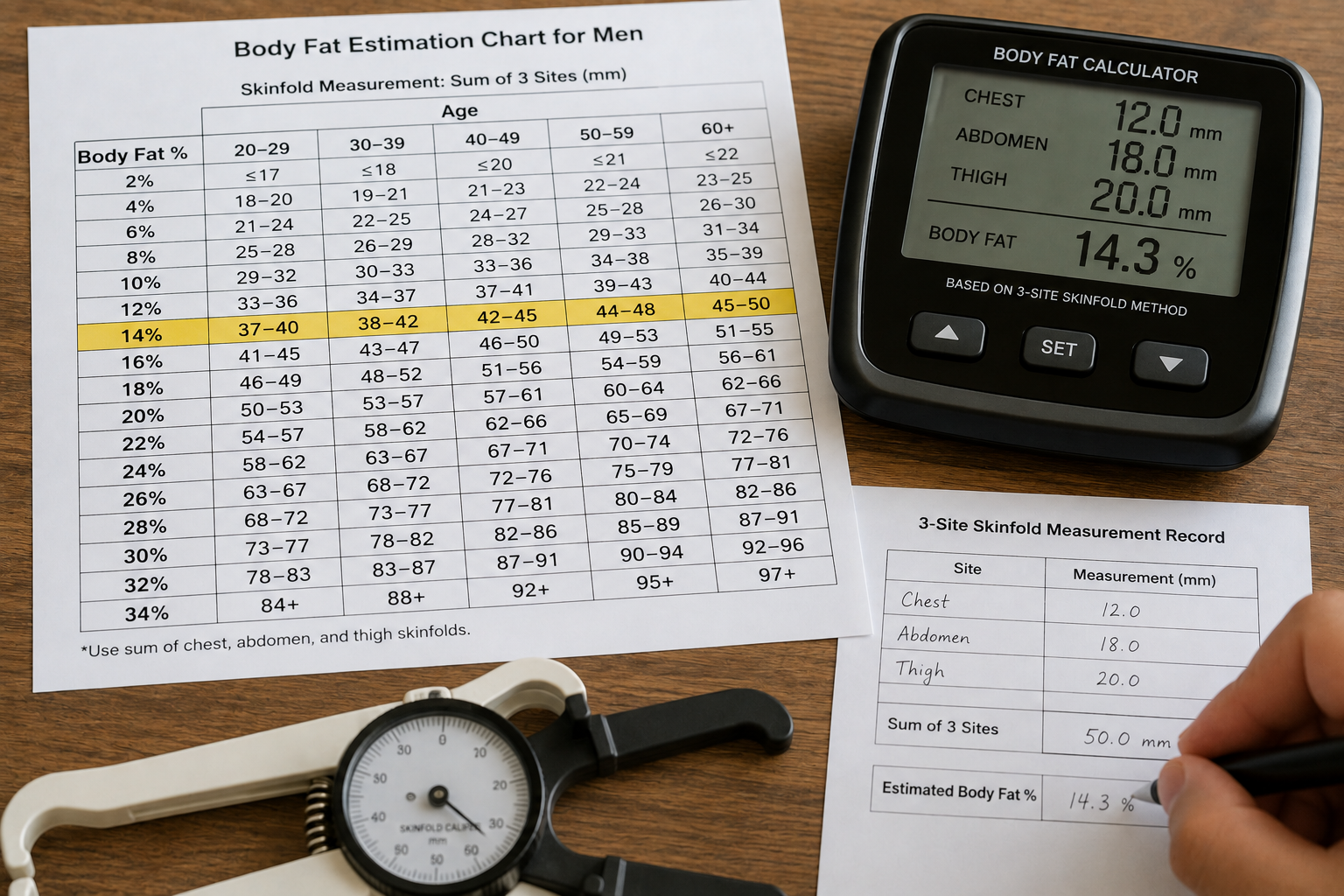
Skinfold calipers are a simple tool for estimating body fat from the thickness of fat stored beneath the skin. If you want to measure body fat using calipers, the process involves taking measurements at specific locations and entering those measurements into a validated prediction equation.
What Are Body-Fat Calipers?
Body-fat calipers are handheld instruments designed to measure skinfold thickness.
A skinfold consists of a layer of skin and the underlying subcutaneous fat. The caliper applies controlled pressure to the fold and displays a thickness measurement, usually in millimeters.
How Skinfold Measurements Estimate Body Fat
Skinfold methods are based on the relationship between subcutaneous fat and total body fat.
A prediction equation uses measurements from selected sites to estimate body density or body-fat percentage.
The basic process is:
Skinfold measurements → equation → estimated body composition
Where Body-Fat Measurements Are Taken
Common skinfold sites can include areas such as:
- Triceps
- Biceps
- Subscapular region
- Suprailiac region
- Abdomen
- Chest
- Thigh
The exact sites depend on the selected assessment protocol.
For example, a three-site equation may require measurements from three specific locations, while a seven-site protocol uses a different combination.
How to Use Body-Fat Calipers
1. Identify the Measurement Site
Locate the anatomical landmark specified by your chosen protocol.
Use the same location every time you repeat the assessment.
2. Create the Skinfold
Use your thumb and fingers to gently grasp the skin and underlying subcutaneous tissue.
The goal is to separate the skinfold from the underlying muscle.
3. Place the Caliper
Place the caliper jaws on the skinfold near the fingers holding the fold.
Do not place the jaws too close to the fingers or too far down the fold.
4. Take the Reading
Allow the caliper to apply its designed pressure and read the measurement according to the manufacturer's instructions.
Record the value in millimeters.
5. Repeat the Measurement
Take repeated measurements at the same site.
If the readings differ substantially, check the location and technique and repeat the measurement.
Preparing for a Skinfold Measurement
Preparation helps reduce unnecessary variation.
Before measuring:
- Use the same equipment each time.
- Measure under similar conditions.
- Avoid measuring immediately after strenuous exercise.
- Keep the measurement locations consistent.
- Use a consistent posture.
- Record the readings immediately.
You do not need to deliberately dehydrate yourself or manipulate your body weight before measuring.
Taking Consistent Measurements
Consistency is one of the most important parts of using calipers.
Try to keep the following consistent:
- Measurement sites
- Side of the body
- Caliper position
- Time of day
- Tester
- Measurement technique
- Number of readings
- Prediction equation
When tracking progress, consistency can be more useful than trying to obtain a highly precise single reading.
Common Skinfold Measurement Sites
Different protocols use different sites.
Triceps
The triceps site is located on the back of the upper arm.
It is commonly included in protocols designed for both men and women.
Abdomen
An abdominal site is used in several multi-site protocols.
Thigh
The thigh site is commonly measured on the front of the thigh.
Again, the exact anatomical landmark depends on the protocol.
Chest
Chest measurements are used in some protocols, particularly those developed for men.
Subscapular
The subscapular site is located below the shoulder blade.
How Caliper Measurements Are Converted Into Body-Fat Estimates
A caliper reading does not automatically tell you your body-fat percentage.
Suppose a protocol requires three skinfold measurements. You might obtain:
- Site 1: 12 mm
- Site 2: 18 mm
- Site 3: 20 mm
The measurements may then be added or entered into a specific prediction equation.
Some equations first estimate body density and then convert body density into body-fat percentage.
One commonly used relationship is the Siri equation:
Body fat % = (495 ÷ body density) − 450
Why Technique Matters
Skinfold testing is highly dependent on technique.
A small change in the measurement location or the amount of tissue grasped can change the result.
Other factors include:
- Identifying the anatomical landmark
- Separating skin and fat from muscle
- Maintaining consistent fold direction
- Positioning the caliper correctly
- Waiting the appropriate amount of time before reading
- Using the correct equation
Common Caliper Measurement Mistakes
Common mistakes include:
Measuring the Wrong Location
Even a small change in anatomical location can affect the measurement.
Grabbing Too Much or Too Little Tissue
The fold should contain skin and subcutaneous fat without including underlying muscle.
Changing Sides
If you measure the right side during one session and the left side during another, the measurements may not be directly comparable.
Using Different Equations
Switching equations can change the estimated body-fat percentage even when the raw skinfold measurements stay the same.
Taking Only One Reading
A single reading can contain technique error. Repeated measurements can help identify inconsistent results.
Accuracy of Skinfold Measurements
Skinfold calipers can be useful, but they are not a direct measurement of total body fat.
Accuracy depends on:
- Tester skill
- Caliper quality
- Measurement protocol
- Body-fat distribution
- Prediction equation
- Population characteristics
Calipers vs Body-Fat Scales
Body-fat scales usually use bioelectrical impedance, while calipers measure skinfold thickness.
| Feature | Skinfold calipers | BIA body-fat scale |
|---|---|---|
| Main measurement | Skinfold thickness | Electrical impedance |
| Cost | Usually low | Low to moderate |
| Convenience | Moderate | Very high |
| Technique required | High | Low |
| Affected by hydration | Less directly | Yes |
| Useful for trends | Yes | Yes |
Calipers vs Professional Body-Fat Testing
Professional body-composition methods can include DEXA/DXA, air displacement plethysmography, hydrostatic weighing, and professionally administered skinfold testing.
Calipers can be a practical option when the goal is regular monitoring.
If you need detailed body-composition assessment for medical, clinical, or research purposes, a qualified professional can help determine which method is appropriate.
How to Track Body-Fat Changes With Calipers
If your goal is tracking progress, create a consistent measurement routine.
For example:
- Choose one validated skinfold protocol.
- Use the same calipers.
- Measure the same sites.
- Use the same side of the body.
- Take repeated readings.
- Record the measurements.
- Use the same prediction equation.
- Compare results over weeks or months.
When a Body-Fat Calculator Can Help
A Body Fat Calculator can make the calculation easier once you have the measurements required by the selected formula.
Instead of manually performing multiple steps, you can enter the relevant measurements and receive an estimated body-fat percentage.
If you also want to understand your weight relative to height, the BMI Calculator provides a separate screening measure.
Summary
To measure body fat using calipers, you measure skinfold thickness at specific anatomical sites and use those measurements with a suitable prediction equation.
Calipers do not directly measure total body fat. They estimate body composition from subcutaneous fat measurements.
Technique matters. Use the correct anatomical locations, consistent fold technique, repeated readings, and the appropriate equation. Avoid switching protocols when tracking progress.
Compared with BIA scales, calipers require more skill but can be inexpensive and useful for repeated measurements. Professional testing can provide more specialized assessments when greater detail is required.
If you want a convenient calculation after taking your measurements, use the Body Fat Calculator and keep the measurement method consistent over time.
References
Heyward, V. H., & Wagner, D. R. (2004). Applied body composition assessment (2nd ed.). Human Kinetics.
Jackson, A. S., & Pollock, M. L. (1985). Practical assessment of body composition. The Physician and Sportsmedicine, 13(5), 76–90. https://doi.org/10.1080/00913847.1985.11708790
Lohman, T. G. (1981). Skinfolds and body density and their relation to body fatness: A review. Human Biology, 53(2), 181–225.
Kyle, U. G., Bosaeus, I., De Lorenzo, A. D., et al. (2004). Bioelectrical impedance analysis—Part I: Review of principles and methods. Clinical Nutrition, 23(5), 1226–1243. https://doi.org/10.1016/j.clnu.2004.06.004
Heymsfield, S. B., Lohman, T., Wang, Z., & Going, S. (Eds.). (2005). Human body composition (2nd ed.). Human Kinetics.