
Body recomposition means improving body composition by reducing body fat while maintaining or increasing lean muscle mass. The scale may change slowly as fat and muscle change.
Nutrition plays an important role, and calculate macros for body recomposition is a common starting point for people who want to structure their calorie and macronutrient intake.
A useful plan generally starts with calories, gives protein a clear priority, and then distributes the remaining calories between carbohydrates and dietary fat. The exact numbers should be treated as targets rather than permanent rules.
What Is Body Recomposition?
Body recomposition is the process of changing the ratio of fat mass to lean mass.
The scale does not always show dramatic changes during this process.
For example, losing 2 kg of fat while gaining 1 kg of muscle would produce a net weight loss of only 1 kg.
This is why waist measurements, strength, photographs, and body-fat estimates can sometimes provide useful information alongside body weight.
Can You Lose Fat and Gain Muscle at the Same Time?
Yes, body recomposition is possible, although the amount of change varies between individuals.
It may be more achievable for people who are new to resistance training, returning after a training break, or carrying more body fat.
What Are Macros?
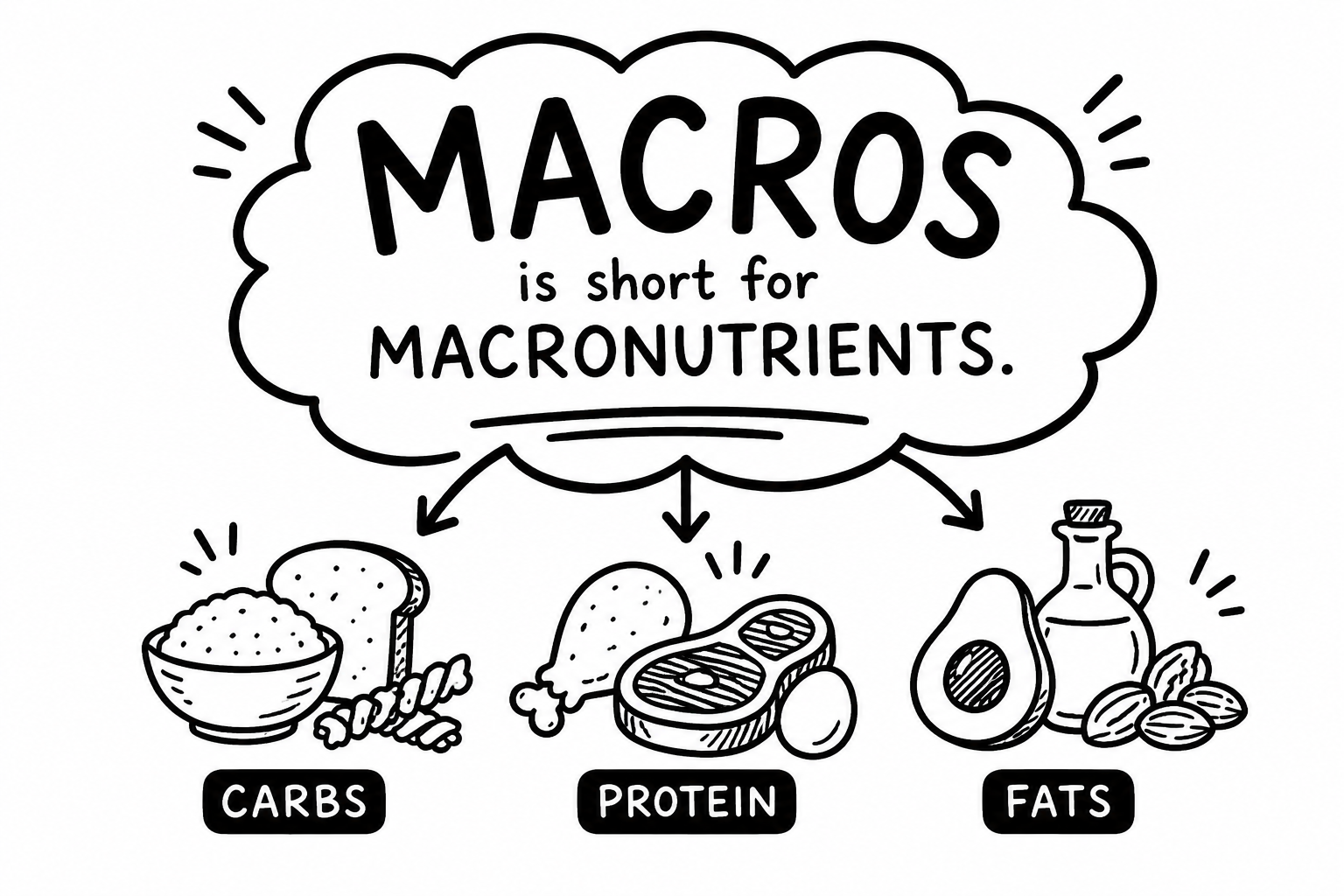
"Macros" is short for macronutrients.
The three main macronutrients are:
- Protein
- Carbohydrates
- Fat
They provide different amounts of energy:
| Macronutrient | Calories per gram |
|---|---|
| Protein | 4 kcal |
| Carbohydrate | 4 kcal |
| Fat | 9 kcal |
Your daily macro targets determine how your total calorie intake is distributed between protein, carbohydrates, and fat.
Calories and Body Recomposition
Calories still matter during body recomposition.
If calorie intake is substantially above energy needs, gaining muscle may be easier but fat gain can also occur.
If calorie intake is substantially below energy needs, fat loss may occur, but maintaining or gaining muscle can become more difficult.
A moderate approach is often more practical.
The Calorie Calculator can help estimate daily calorie needs. The BMR Calculator can provide an estimate of basal metabolic rate, which represents energy used by the body at rest.
Protein Requirements for Recomposition
Protein is particularly important during body recomposition because it supports muscle protein synthesis and helps preserve lean tissue during calorie restriction.
A commonly used evidence-based range for active people is approximately:
1.6–2.2 grams of protein per kilogram of body weight per day
For example, a 70 kg person using a target of 1.8 g/kg would calculate:
70 × 1.8 = 126 g protein per day
Carbohydrates and Training
Carbohydrates provide glucose that can be used for energy, particularly during higher-intensity exercise.
For people performing resistance training or other demanding exercise, adequate carbohydrate intake can support training performance and recovery.
After setting a protein target and an appropriate minimum fat intake, carbohydrates can receive many of the remaining calories.
Dietary Fat Requirements
Dietary fat is also essential.
Fat provides energy and supports normal physiological functions, including absorption of fat-soluble vitamins.
A common planning approach is to avoid setting dietary fat unnecessarily low. Some nutrition plans use approximately 20–35% of total calories from fat as a general planning range.
How to Calculate Macros for Body Recomposition
A simple calculation can be done in four stages.
Step 1: Set a Calorie Target
Start with an estimate of your maintenance calories.
For recomposition, you might choose a calorie intake around maintenance or use a modest calorie deficit if fat loss is the primary priority.
For example:
Estimated maintenance = 2,400 kcal
A modest target might be:
2,200–2,400 kcal
Step 2: Set a Protein Target
Suppose the person weighs 70 kg and chooses 1.8 g/kg:
70 × 1.8 = 126 g protein
Protein calories are:
126 × 4 = 504 kcal
Step 3: Set a Fat Target
Suppose the target is 30% of a 2,300 kcal diet:
2,300 × 0.30 = 690 kcal
Because fat provides 9 kcal per gram:
690 ÷ 9 ≈ 77 g fat
Step 4: Allocate Remaining Calories to Carbohydrates
Protein calories:
504 kcal
Fat calories:
690 kcal
Remaining calories:
2,300 − 504 − 690 = 1,106 kcal
Carbohydrates provide 4 kcal per gram:
1,106 ÷ 4 ≈ 277 g carbohydrates
The resulting daily target is approximately:
- Protein: 126 g
- Carbohydrates: 277 g
- Fat: 77 g
- Calories: 2,300 kcal
This is an example calculation, not a prescription for every person.
Setting a Calorie Target
The Calorie Calculator can provide an initial estimate, but real-world results should guide adjustments.
Setting a Protein Target
Protein is usually the first macro to establish.
A practical approach is to multiply body weight in kilograms by your chosen protein factor.
For example:
75 kg × 1.8 g/kg = 135 g protein
You can then convert protein into calories:
135 × 4 = 540 kcal
This leaves the remaining calorie budget for carbohydrates and fat.
Dividing Remaining Calories Between Carbs and Fat
After protein is set, choose a reasonable fat intake and use the remaining calories for carbohydrates.
This allows flexibility.
For example, someone who prefers higher carbohydrates around training may allocate more calories to carbohydrates, while someone who prefers a higher-fat eating pattern may allocate more calories to fat.
Macros for Training Days and Rest Days
Some people use different macro targets on training and rest days.
For example, they may increase carbohydrates on training days and reduce them slightly on rest days while keeping weekly calories relatively similar.
How Body Weight Affects Macro Targets
Body weight can be used to estimate protein requirements.
For example:
60 kg × 1.8 g/kg = 108 g protein
80 kg × 1.8 g/kg = 144 g protein
Tracking Body Composition Changes
Body recomposition is difficult to evaluate using body weight alone.
The Body Fat Calculator can provide an estimated body-fat percentage.
Tracking measurements under similar conditions can make longer-term changes easier to identify.
Why Scale Weight Alone Can Be Misleading
Muscle and fat can change in opposite directions.
Suppose someone loses 2 kg of fat while gaining 2 kg of muscle.
Their scale weight may remain approximately unchanged.
This is why a body-recomposition plan should consider body measurements and performance rather than relying entirely on the scale.
Adjusting Macros Over Time
Macro targets are starting points.
Common Body-Recomposition Macro Mistakes
Common mistakes include:
Setting Calories Too Low
An aggressive deficit may make training and recovery more difficult.
Ignoring Protein
Simply reducing calories without adequate protein may not provide the best environment for preserving lean mass.
Using a Macro Calculator
A Macro Calculator can simplify the mathematics by estimating calorie and macronutrient targets from your body measurements, activity, and goals.
Summary
To calculate macros for body recomposition, start with an estimated calorie target, establish an appropriate protein intake, set a reasonable dietary-fat target, and allocate the remaining calories to carbohydrates.
A practical example might use:
- Calories: 2,300 kcal
- Protein: 126 g
- Fat: 77 g
- Carbohydrates: 277 g
These numbers demonstrate the calculation process rather than prescribing a universal diet.
Body recomposition is best evaluated over time using body weight, waist measurements, estimated body fat, strength, and training performance.
The Calorie Calculator, BMR Calculator, Body Fat Calculator, and Macro Calculator can help organize the calculations.
References
Jäger, R., Kerksick, C. M., Campbell, B. I., Cribb, P. J., Wells, S. D., Skwiat, T. M., Purpura, M., Ziegenfuss, T. N., Ferrando, A. A., Arent, S. M., Smith-Ryan, A. E., Stout, J. R., Arciero, P. J., Ormsbee, M. J., Taylor, L. W., Wilborn, C. D., Kalman, D. S., Kreider, R. B., Willoughby, D. S., Hoffman, J. R., & Antonio, J. (2017). International Society of Sports Nutrition position stand: Protein and exercise. Journal of the International Society of Sports Nutrition, 14, 20. https://doi.org/10.1186/s12970-017-0177-8
Morton, R. W., Murphy, K. T., McKellar, S. R., Schoenfeld, B. J., Henselmans, M., Helms, E., Aragon, A. A., Devries, M. C., Banfield, L., Krieger, J. W., & Phillips, S. M. (2018). A systematic review, meta-analysis and meta-regression of the effect of protein supplementation on resistance training-induced gains in muscle mass and strength. British Journal of Sports Medicine, 52(6), 376–384. https://doi.org/10.1136/bjsports-2017-097608
Thomas, D. T., Erdman, K. A., & Burke, L. M. (2016). Position of the Academy of Nutrition and Dietetics, Dietitians of Canada, and the American College of Sports Medicine: Nutrition and athletic performance. Journal of the Academy of Nutrition and Dietetics, 116(3), 501–528. https://doi.org/10.1016/j.jand.2015.12.006
Helms, E. R., Aragon, A. A., & Fitschen, P. J. (2014). Evidence-based recommendations for natural bodybuilding contest preparation: Nutrition and supplementation. Journal of the International Society of Sports Nutrition, 11, 20. https://doi.org/10.1186/1550-2783-11-20
National Academies of Sciences, Engineering, and Medicine. (2005). Dietary reference intakes for energy, carbohydrate, fiber, fat, fatty acids, cholesterol, protein, and amino acids. The National Academies Press. https://doi.org/10.17226/10490