
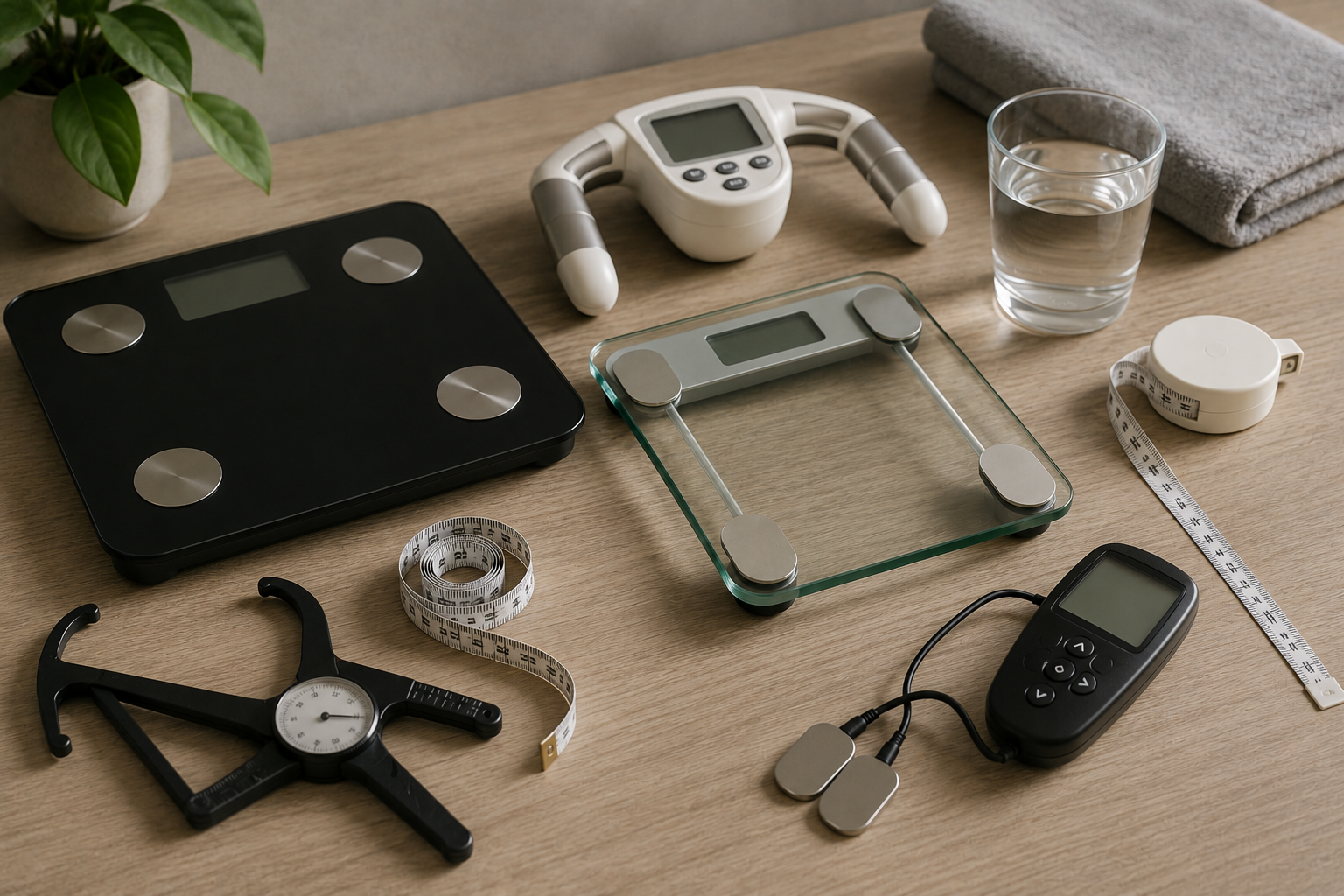
If you want to know the most accurate way to measure body fat, it is important to understand that no practical method gives a perfectly exact answer.
Body-fat percentage is usually estimated from measurements of body density, body water, electrical impedance, skinfold thickness, or other physical characteristics. Different methods use different assumptions, equipment, and equations, so results can vary.
What Is Body Fat Percentage?
Body fat percentage is the proportion of total body weight that consists of fat.
Why Measuring Body Fat Is Difficult
Fat is distributed throughout the body rather than existing in one easily measurable location.
Some fat is stored beneath the skin, while other fat is located around internal organs. The amount of water in lean tissue can also vary.
For example, a bioelectrical impedance device measures electrical properties and uses an equation to estimate body composition. A skinfold test measures subcutaneous fat at selected locations and uses an equation to estimate total body fat.
Body Fat Scales and Bioelectrical Impedance
Bioelectrical impedance analysis, or BIA, is one of the most accessible body-composition methods.
A BIA device passes a very small electrical current through the body and measures electrical impedance. The result is combined with information such as height, weight, age, and sex to estimate body composition.
BIA results can be influenced by hydration, recent exercise, food and fluid intake, body position, device design, and the prediction equation used.
Different BIA devices can therefore produce different estimates.
Research reviews emphasize that BIA can be useful, but standardization and appropriate equations are important when interpreting results.
For home monitoring, consistency is especially important. Using the same device under similar conditions can make changes over time more meaningful.
Skinfold Calipers
Skinfold testing uses calipers to measure the thickness of subcutaneous fat at specific body locations.
The measurements are then entered into a prediction equation.
Accuracy depends heavily on measurement technique.
The tester must identify the correct anatomical locations, grasp the skinfold consistently, and use the appropriate equation. Different testers may produce different measurements.
Circumference Measurements
Circumference-based methods use measurements such as waist, neck, hip, and height to estimate body fat.
Some military-style or population-specific equations use these measurements to predict body-fat percentage.
A measuring tape does not directly measure body fat.
Results depend on accurate measurement location, technique, body shape, and the equation used.
BMI-Based Body Fat Estimates
Some equations estimate body fat from BMI, age, and sex.
BMI is calculated from height and weight:
BMI = weight in kilograms ÷ height in meters²
A BMI-based body-fat equation can then use BMI and demographic information to estimate body fat.
This approach is convenient because no special equipment is required.
However, BMI does not distinguish muscle from fat. A muscular person may therefore receive a body-fat estimate that does not accurately represent their actual body composition.
The BMI Calculator can calculate BMI separately, while the Body Fat Calculator can provide a body-fat estimate using its supported method.
DEXA Scans
Dual-energy X-ray absorptiometry, commonly called DEXA or DXA, is a specialized body-composition assessment.
A DEXA scan uses low-dose X-rays to estimate bone mineral content and distinguish fat mass from lean soft tissue.
It can also provide information about regional body composition.
- More expensive
- Requires specialized equipment
- Not usually available for routine home monitoring
- Results can still have measurement uncertainty
Hydrostatic Weighing
Hydrostatic weighing estimates body composition from body density.
A person's body weight is measured on land and compared with underwater weight. The difference is used to estimate body volume and density, which can then be used in a body-composition model.
- Requires specialized equipment
- Requires underwater submersion
- Can be inconvenient
- Results depend on assumptions about body composition and lung volume
Air Displacement Methods
Air displacement plethysmography, commonly associated with the BOD POD system, estimates body volume by measuring air displacement inside a specialized chamber.
Body density is then used to estimate body composition.
- Requires specialized equipment
- More expensive than home methods
- Not widely available
Comparing Body Fat Measurement Methods
| Method | Accuracy potential | Convenience | Typical use |
|---|---|---|---|
| DEXA/DXA | High | Moderate | Clinical, research, detailed assessment |
| Hydrostatic weighing | High | Low | Specialized assessment/research |
| Air displacement | High | Moderate | Professional/research settings |
| Skinfolds | Moderate | High | Fitness and repeated tracking |
| BIA | Variable | Very high | Home and fitness tracking |
| Circumference | Variable | Very high | Home and field assessment |
| BMI-based estimate | Lower for individuals | Very high | General estimation |
Which Method Is Most Accurate?
If the question is simply "What is the most accurate way to measure body fat?", the answer depends on what you mean by accurate.
For detailed professional or research assessment, methods such as DEXA, hydrostatic weighing, air displacement, and multi-compartment body-composition models can provide sophisticated estimates.
For everyday use, a well-standardized method that you can repeat consistently may be more useful.
Accuracy vs Convenience
There is often a trade-off between measurement sophistication and convenience.
Home Measurement vs Professional Measurement
Home methods include:
- BIA scales
- Measuring tapes
- Skinfold calipers
- Online body-fat calculators
Professional methods can include:
- DEXA/DXA
- Air displacement plethysmography
- Hydrostatic weighing
- Professionally administered skinfold testing
- Professional BIA systems
Why Body Fat Results Vary
- Hydration
- Food and fluid intake
- Recent exercise
- Time of day
- Measurement technique
- Device differences
- Prediction equations
- Changes in body composition
BIA is particularly sensitive to factors affecting body water.
Skinfold measurements can vary because of tester technique.
Circumference measurements can change because of tape placement or differences in how tightly the tape is applied.
How to Improve Consistency
If you are monitoring body fat over time, consistency is one of the most useful strategies.
Try to:
- Use the same measurement method
- Use the same device
- Measure at a similar time of day
- Follow the same preparation routine
- Use consistent measurement locations
- Record results over several weeks or months
- Focus on trends rather than single readings
Avoid assuming that a small difference between two readings represents a real change in body fat.
Which Method Is Best for Tracking Changes?
Why No Body-Fat Measurement Is Perfectly Precise
Body-fat measurement involves assumptions.
Even methods regarded as reference techniques depend on models of body composition and measurement procedures.
A better interpretation is that the measurement provides an estimate within the limitations of that method.
Summary
There is no single most accurate measure of body fat for every situation.
DEXA, hydrostatic weighing, and air displacement methods can provide sophisticated professional assessments. Skinfolds and circumference measurements can be useful when performed consistently, while BIA provides a convenient option for regular home monitoring.
BMI-based equations and online calculators are convenient but are more general estimates and can be affected by differences in muscle mass and body composition.
The most accurate way to check body fat depends on your goal. For detailed assessment, a professional method may be appropriate. For tracking long-term changes, a consistent and repeatable method may be more useful than chasing a supposedly perfect number.
The Body Fat Calculator can provide a convenient estimate, while the BMI Calculator, Calorie Calculator, and Ideal Weight Calculator can provide additional context.
References
American College of Sports Medicine. (2025). ACSM-EP crosswalk. https://www.acsm.org/wp-content/uploads/2025/01/acsm-ep-crosswalk.pdf
Kyle, U. G., Bosaeus, I., De Lorenzo, A. D., Deurenberg, P., Elia, M., Gómez, J. M., Heitmann, B. L., Kent-Smith, L., Melchior, J.-C., Pirlich, M., Scharfetter, H., Schols, A. M. W. J., & Pichard, C. (2004). Bioelectrical impedance analysis—Part I: Review of principles and methods. Clinical Nutrition, 23(5), 1226–1243. https://doi.org/10.1016/j.clnu.2004.06.004
Ward, L. C. (2019). Bioelectrical impedance analysis for body composition assessment: Reflections on accuracy, clinical utility, and standardisation. European Journal of Clinical Nutrition, 73, 122–131. https://doi.org/10.1038/s41430-018-0335-3
Going, S. B., Massett, M. P., Hall, M. C., Bare, L. A., & Thériault, M. C. (2003). Assessment methods in human body composition. Sports Medicine, 33(2), 105–119. https://pmc.ncbi.nlm.nih.gov/articles/PMC2741386/
Fields, D. A., Goran, M. I., & McCrory, M. A. (2002). Body-composition assessment via air-displacement plethysmography in adults and children: A review. The American Journal of Clinical Nutrition, 75(3), 453–467. https://doi.org/10.1093/ajcn/75.3.453
Heymsfield, S. B., Lohman, T., Wang, Z., & Going, S. (Eds.). (2005). Human body composition (2nd ed.). Human Kinetics.