
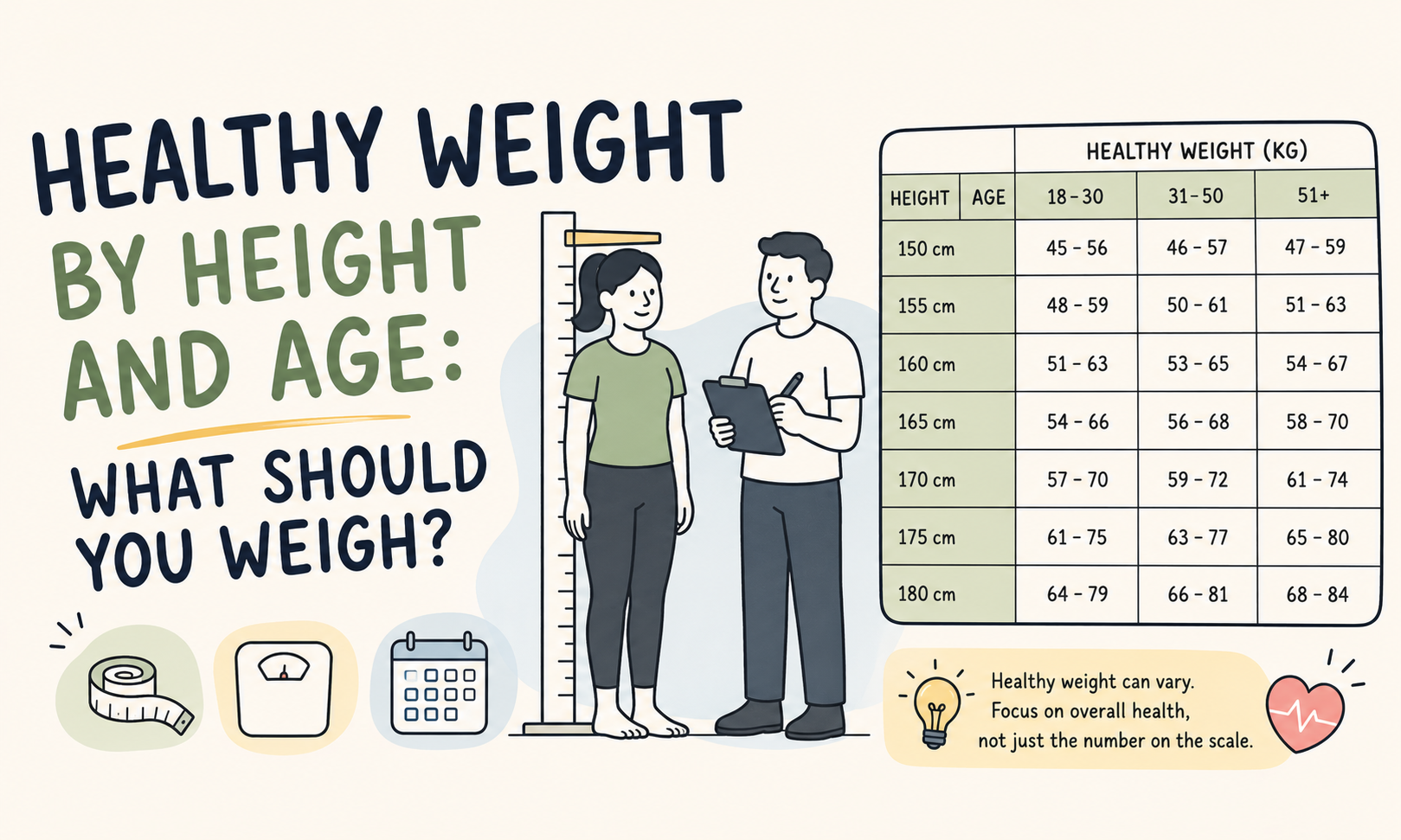
Healthy Weight by Height and Age: What Should You Weigh?
If you are looking for weight per height and age, you may expect a chart to tell you exactly how much you should weigh. In reality, healthy body weight is more complicated than a single number.
Height is an important factor when estimating weight, while age can influence body composition, muscle mass, and where body fat is stored. However, age alone does not determine an ideal weight.
For adults, BMI can provide a useful screening measure based on height and weight. Traditional ideal body weight formulas can also provide an estimate based mainly on height and, in some cases, sex.
Does Age Affect Ideal Body Weight?
Age can affect how body weight should be interpreted, but many traditional ideal body weight formulas do not directly include age.
For example, the commonly used Devine formula estimates ideal body weight from height and sex. A 30-year-old and a 60-year-old adult of the same height and sex would receive the same result from that formula.
Body composition changes throughout adulthood. Muscle mass can decrease with age, while body-fat levels and fat distribution may change. These changes can affect health even when body weight changes very little.
Therefore, age is better considered as part of the broader health picture rather than as a simple number added to an ideal-weight equation.
Healthy Weight and Height
Height has a strong influence on the interpretation of body weight.
A person who is 183 cm tall would generally be expected to weigh more than a person who is 152 cm tall because they have a larger overall body size. This is why health measures such as BMI use both weight and height.
Traditional ideal body weight formulas also use height as a major input.
However, height does not determine one exact healthy weight. People of the same height can have different:
- Muscle mass
- Bone structure
- Body-fat percentage
- Fat distribution
- Fitness levels
A chart for weight height and age is therefore best treated as a reference rather than a precise prescription.
Why Adult Weight Changes With Age
Adult body weight can change for many reasons as people get older.
One important factor is body composition. With aging, adults can lose muscle mass and strength, particularly when physical activity is low. At the same time, body fat may increase or become distributed differently.
Other factors can include:
- Changes in physical activity
- Changes in appetite or eating patterns
- Sleep changes
- Hormonal changes
- Medications
- Medical conditions
- Lifestyle changes
How BMI Relates to Height and Weight
Body mass index (BMI) is a screening measure that uses height and weight.
The formula is:
BMI = weight in kilograms ÷ height in meters²
For example, someone weighing 70 kg with a height of 1.75 m would have:
BMI = 70 ÷ (1.75 × 1.75) = 22.9
For adults, the CDC generally defines:
- Underweight: BMI below 18.5
- Healthy weight: 18.5 to less than 25
- Overweight: 25 to less than 30
- Obesity: 30 or higher
BMI can help put weight into context, but it does not directly measure body fat. A person with a large amount of muscle may have a higher BMI without having excessive body fat.
Weight Ranges for Adults
Unlike an ideal body weight formula, BMI can be used to calculate a weight range associated with a particular height.
For example, the adult BMI range of 18.5 to less than 25 corresponds approximately to these weights:
| Height | Approximate BMI 18.5–24.9 weight range |
|---|---|
| 5'0" (152 cm) | 43–57 kg |
| 5'2" (157 cm) | 46–61 kg |
| 5'4" (163 cm) | 49–66 kg |
| 5'6" (168 cm) | 52–70 kg |
| 5'8" (173 cm) | 55–75 kg |
| 5'10" (178 cm) | 59–79 kg |
| 6'0" (183 cm) | 62–83 kg |
These figures are approximate and are based on adult BMI categories, not an individualized recommendation.
The ranges are broad, which is why a healthy body weight index should not be treated as one exact target.
Why Age Alone Cannot Determine Ideal Weight
It may seem logical to create a chart that gives one ideal weight for every combination of age and height. However, such a chart would give a false impression of precision.
Age does not tell us:
- How much muscle a person has
- How much body fat they have
- Where body fat is distributed
- How physically active they are
- Whether they have a medical condition
- What medications they take
- Their individual body structure
A 45-year-old and a 55-year-old who are the same height can therefore have different healthy weights.
Similarly, two people of the same age and height can have very different body compositions.
Ideal Weight vs. Healthy Weight
Ideal body weight and healthy body weight are not interchangeable terms.
An ideal body weight formula usually produces a single estimated number. A healthy-weight assessment is broader and may consider BMI, waist circumference, body composition, lifestyle, and health conditions.
For example, a calculator might estimate an ideal body weight of 68 kg for a particular adult. That does not mean 68 kg is the only healthy weight for that person.
A person weighing somewhat more or less could still have a healthy body composition and favorable health indicators.
The goal is to understand overall health rather than reach an arbitrary "perfect" number.
How Body Composition Changes With Age
Body composition can change even when body weight stays relatively stable.
Adults may gradually lose lean muscle tissue while gaining body fat. This can make the same scale weight mean something different at different ages.
A person might weigh 70 kg at age 30 and again at age 60, yet have a different body composition because of changes in muscle and body fat.
This is one reason the scale alone cannot tell the whole story.
Strength training, regular physical activity, adequate nutrition, and other healthy lifestyle habits can help support muscle and overall health as people age.
Discuss significant changes in weight, muscle, appetite, or physical function with a healthcare professional.
Using an Ideal Weight Calculator
An ideal weight calculator can provide a quick estimate without requiring you to manually apply a formula.
It is useful when you want to:
- Estimate ideal body weight from height.
- Avoid manual unit conversions.
- Compare the estimate with a BMI range.
- See how height affects the result.
You can use the Howtigo Ideal Body Weight Calculator to calculate an estimated ideal body weight.
The calculator does not account for your complete medical history or body composition, so treat its result as a reference point rather than a diagnosis.
Summary
When considering weight per height and age, height is generally more directly involved in traditional ideal-weight calculations, while age provides additional context about body composition and health.
The key points are:
- Age can affect body composition, but many ideal-weight formulas do not directly use age.
- Height is a major factor in estimating body weight.
- BMI uses both height and weight to provide a screening measure.
- Adult BMI categories can be used to estimate a broad weight range for a given height.
- Age alone cannot determine an ideal or healthy weight.
- Muscle mass and body-fat distribution can change with age.
- Ideal body weight is an estimate, while healthy weight is a broader concept.
- An ideal weight calculator can provide a convenient starting point.
If you are trying to determine a personal weight goal, consider the calculator result alongside your body composition, lifestyle, and other health information.
Calculate Your Ideal Body Weight with the Howtigo Ideal Body Weight Calculator
References
Centers for Disease Control and Prevention. (2024). Adult BMI categories. https://www.cdc.gov/bmi/adult-calculator/bmi-categories.html
Centers for Disease Control and Prevention. (2024). About body mass index (BMI) for adults. https://www.cdc.gov/bmi/about/index.html
Devine, B. J. (1974). Gentamicin therapy. Drug Intelligence & Clinical Pharmacy, 8(11), 650–655. https://doi.org/10.1177/106002807400801005
National Institute on Aging. (2022). What do we know about healthy aging? National Institutes of Health. https://www.nia.nih.gov/health/healthy-aging
World Health Organization. (2021). Obesity and overweight. https://www.who.int/news-room/fact-sheets/detail/obesity-and-overweight