
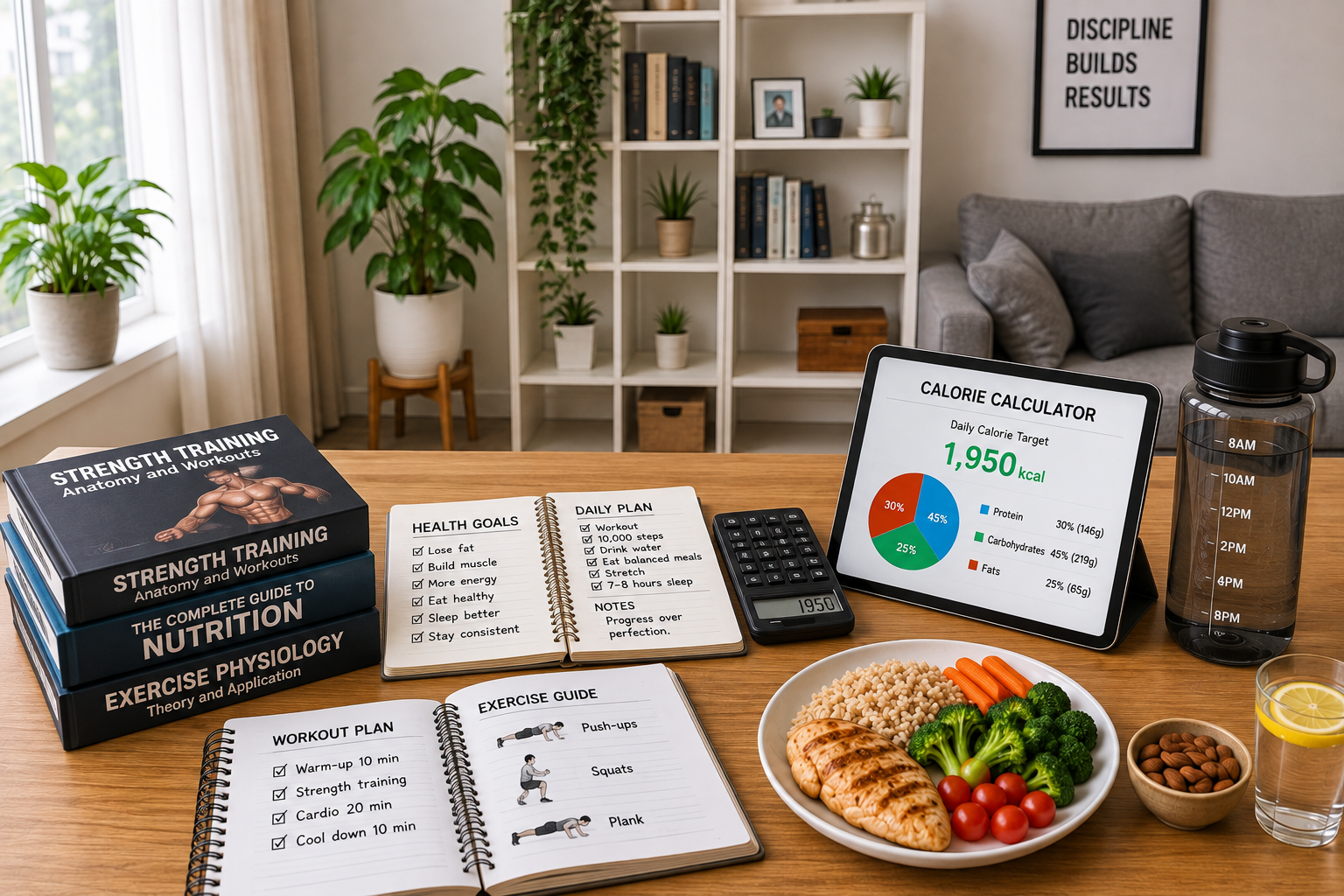
How Many Calories Should I Eat? Calculate Your Ideal Calorie Intake
A calorie calculator can estimate your daily energy needs using these inputs. BMR and TDEE provide useful concepts for understanding where the estimate comes from.
What Is Calorie Intake?
Calorie intake is the amount of energy you obtain from food and drinks.
Your body uses energy continuously for processes such as breathing, circulation, maintaining body temperature, digestion, movement, and physical activity.
If you consistently consume more energy than your body uses, body weight may increase over time. If you consistently consume less energy than your body uses, body weight may decrease. However, actual changes are influenced by many biological and behavioral factors, and short-term changes in body weight also include changes in water and other tissues.
For this reason, daily calorie needs are best understood as an estimate of energy requirements rather than an exact daily quota.
How Many Calories Do You Need Per Day?
There is no single calorie intake that is appropriate for every adult.
General calorie needs vary according to:
- Age
- Sex
- Height
- Weight
- Physical activity
- Pregnancy or breastfeeding status
- Individual health and metabolic factors
For example, the Dietary Guidelines for Americans provide estimated calorie needs across age and activity groups rather than one universal daily number.
A calculator can provide a more personalized estimate by combining several of these factors.
How Height Affects Calorie Needs
Height can influence calorie requirements because taller bodies generally have more total body mass and may require more energy to maintain.
Height is one of the inputs used in many BMR equations.
How Weight Affects Calorie Needs
Body weight is another important input.
How Age Affects Calorie Needs
Age can affect estimated calorie requirements.
As people age, average energy needs often decrease, partly because physical activity may decline and body composition can change. The Dietary Guidelines therefore provide different estimated calorie needs for different age groups and activity levels.
Age is included directly in common BMR equations such as the Mifflin-St Jeor equation.
For example:
Men:
BMR = (10 × weight in kg) + (6.25 × height in cm) − (5 × age) + 5
Women:
BMR = (10 × weight in kg) + (6.25 × height in cm) − (5 × age) − 161
These equations provide estimates of resting energy expenditure; they do not represent your total daily calorie requirement.
How Sex Affects Calorie Needs
Activity Level and Calorie Requirements
Common activity categories used by calorie calculators include:
- Sedentary
- Lightly active
- Moderately active
- Very active
- Extra active
The exact definitions vary between calculators.
Activity can include more than formal exercise. Walking, work, household tasks, sports, and other daily movement all contribute to total energy expenditure.
BMR vs. Daily Calorie Needs
BMR (basal metabolic rate) is the amount of energy your body requires to support basic physiological functions at rest.
It is not the same as the number of calories you need to eat each day.
You still use energy through movement, exercise, digestion, and other activities.
For example, someone may have a BMR estimate of 1,500 calories per day but require substantially more than 1,500 calories to maintain their usual weight because they are active throughout the day.
The Howtigo BMR Calculator can provide an estimate of your basal metabolic rate.
What Is TDEE?
TDEE (total daily energy expenditure) is an estimate of the total energy your body uses during an average day.
Many calorie calculators estimate TDEE by multiplying a BMR estimate by an activity factor.
A simplified approach is:
TDEE ≈ BMR × activity factor
The result is an estimate of the calories needed to maintain your current weight under the assumed activity level.
What Are Maintenance Calories?
Maintenance calories are the approximate number of calories you need to maintain your current body weight over time.
If your estimated TDEE is 2,200 calories per day, consuming around that amount may maintain weight for some people under similar conditions.
However, maintenance is not a fixed biological number. Energy needs can change with changes in weight, activity, body composition, appetite, and other factors.
It is therefore useful to treat a calculated maintenance value as a starting estimate and observe how your body responds over time.
How to Calculate Your Daily Calorie Needs
A typical calorie calculation follows these steps:
- Enter your age.
- Enter your sex if the calculator requires it.
- Enter your height.
- Enter your current weight.
- Select your activity level.
- Calculate your BMR.
- Apply an activity estimate to determine TDEE.
For example, suppose an adult has a BMR estimate of 1,600 calories and the selected activity factor is 1.4:
TDEE ≈ 1,600 × 1.4 = 2,240 calories/day
The estimated maintenance intake would therefore be around 2,240 calories per day.
This is an example of the calculation process, not an individualized recommendation.
You can use the Howtigo Calorie Calculator to estimate your daily calorie needs.
How to Use a Calorie Calculator
A calorie calculator is most useful when you enter realistic information.
Use:
- Your current height
- Your current weight
- Your actual age
- An activity level that reflects your normal routine
Avoid choosing a higher activity category simply because you exercise occasionally. The goal is to select the category that most closely represents your overall activity.
After calculating your estimate, use it as a starting point. If your goal is weight maintenance, weight change, or improved athletic performance, your actual needs may require adjustment based on your response over time.
What Is an "Ideal" Calorie Intake?
There is no universal ideal calorie intake.
Your appropriate intake depends on your energy expenditure and goals.
For example:
- Maintenance requires enough energy to offset average expenditure.
- Weight loss generally requires an energy deficit over time.
- Weight gain generally requires an energy surplus over time.
- Athletic training may increase energy and carbohydrate requirements.
Recommended Calorie Intake Based on Height and Weight
A search for recommended calorie intake based on height and weight is understandable, but height and weight alone are not enough to produce a useful daily calorie estimate.
Age, sex, and activity level also matter.
For example, two adults who are both 170 cm tall and weigh 70 kg could have different calorie requirements if one is sedentary and the other performs several hours of physical activity each week.
This is why a calorie calculator asks for more than height and weight.
Why Calorie Needs Differ Between People
Calorie needs differ because people differ.
Important influences include:
- Body size
- Age
- Sex
- Muscle mass
- Activity level
- Occupation
- Exercise
- Pregnancy or breastfeeding
- Health conditions
- Medications
- Individual metabolic variation
Even equations that use the same inputs produce estimates rather than exact measurements.
Calorie Intake and Ideal Body Weight
Your calorie needs are not determined by your ideal body weight.
An ideal body weight calculator answers a different question by estimating a reference weight from a formula.
If you want to explore that separate measurement, use the Howtigo Ideal Body Weight Calculator.
Summary
If you are trying to calculate your ideal calorie intake, remember:
- There is no single calorie requirement for everyone.
- Height and weight affect energy needs.
- Age can affect estimated calorie requirements.
- Sex is included in many BMR equations.
- Activity level has a major effect on daily energy expenditure.
- BMR estimates resting energy needs, not total daily needs.
- TDEE estimates total daily energy expenditure.
- Maintenance calories are an estimate of the intake that may maintain weight.
- A calorie calculator provides a starting estimate rather than an exact prescription.
- Ideal body weight and calorie requirements are different calculations.
For a personalized starting estimate, use the Howtigo Calorie Calculator. You can also calculate your BMR and explore your Ideal Body Weight separately.
References
National Academies of Sciences, Engineering, and Medicine. (2023). Dietary reference intakes for energy. National Academies Press. https://doi.org/10.17226/26818
U.S. Department of Agriculture, & U.S. Department of Health and Human Services. (2020). Dietary guidelines for Americans, 2020–2025 (9th ed.). https://www.dietaryguidelines.gov/
Mifflin, M. D., St Jeor, S. T., Hill, L. A., Scott, B. J., Daugherty, S. A., & Koh, Y. O. (1990). A new predictive equation for resting energy expenditure in healthy individuals. The American Journal of Clinical Nutrition, 51(2), 241–247. https://doi.org/10.1093/ajcn/51.2.241
Institute of Medicine. (2005). Dietary reference intakes for energy, carbohydrate, fiber, fat, fatty acids, cholesterol, protein, and amino acids. National Academies Press. https://doi.org/10.17226/10490