
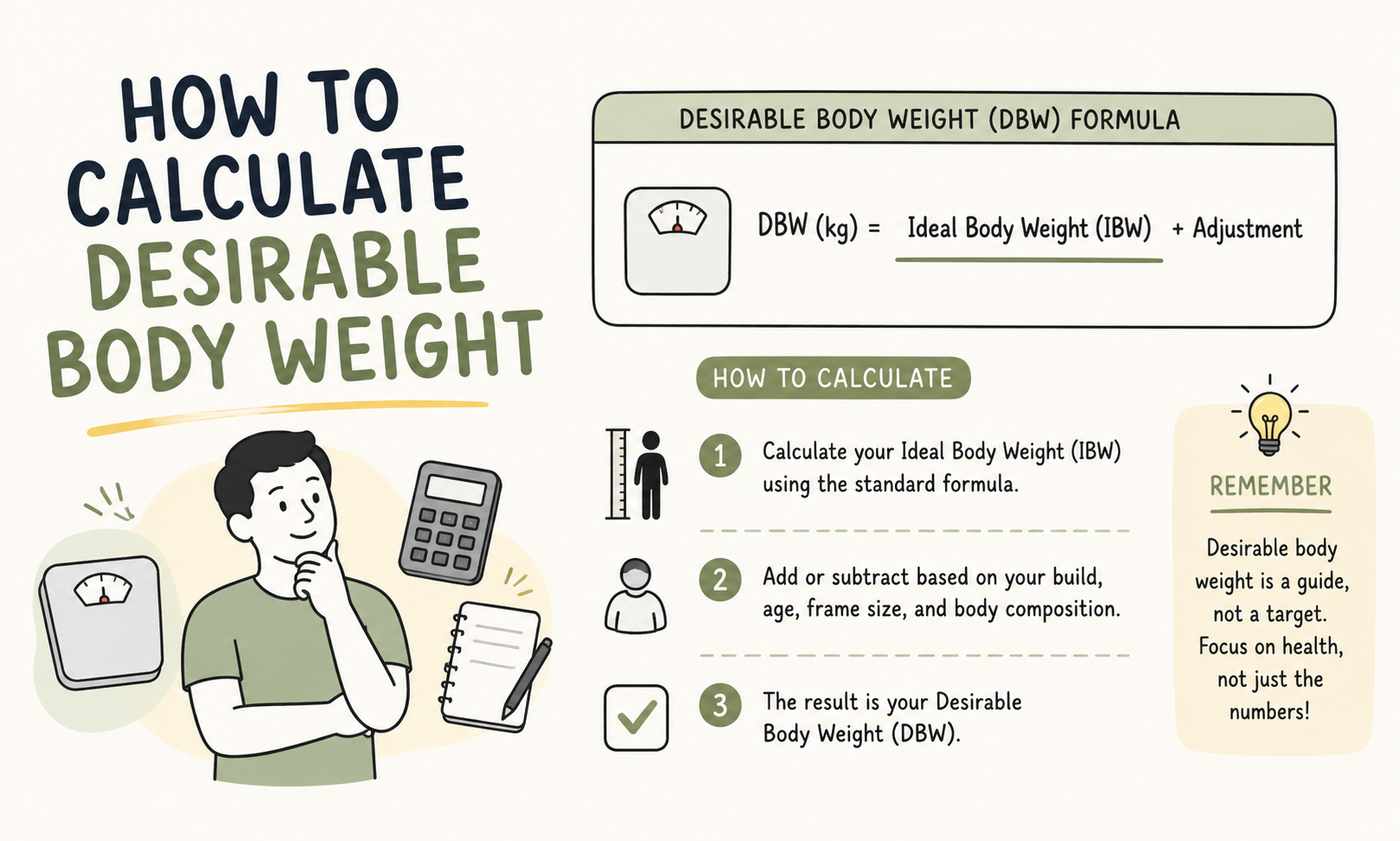
How to Calculate Desirable Body Weight
If you are looking for a desirable body weight formula, you may find several different equations online. That is because there is no single universally accepted formula for desirable or ideal body weight.
These calculations generally use height and, depending on the equation, sex. They provide a mathematical reference rather than a guaranteed healthy weight.
The term desirable body weight is sometimes used in clinical and nutrition settings as another way of describing an estimated reference weight. Several traditional ideal body weight equations have been developed, including the Devine and Robinson formulas.
What Is Desirable Body Weight?
Desirable body weight is an estimated weight calculated from characteristics such as height and sex. It is sometimes used as an alternative term for ideal body weight, although terminology varies between sources.
A desirable weight calculation is a mathematical estimate, not an exact target.
This distinction is important because people of the same height can have different amounts of muscle, body fat, bone mass, and other physical characteristics.
Research comparing traditional ideal body weight equations has found that different formulas can produce different results, and BMI-based ranges may sometimes be more useful than a single ideal-weight estimate. (Shah et al., 2006).
Desirable Body Weight vs. Ideal Body Weight
The terms desirable body weight and ideal body weight are often used interchangeably, but the exact meaning can depend on the source or clinical setting.
Both generally refer to a calculated reference weight rather than a directly measured health outcome.
For example, a traditional formula may estimate that a person of a particular height has an IBW of 70 kg. Calling that number "desirable" does not mean that 70 kg is the only healthy weight for that person.
A broader health assessment can include BMI, waist circumference, body composition, activity, and medical history.
Common Calculation Methods
Several formulas can be used to estimate desirable or ideal body weight.
Devine Formula
The Devine formula is one of the best-known equations.
For men:
IBW = 50 kg + 2.3 kg × each inch over 5 feet
For women:
IBW = 45.5 kg + 2.3 kg × each inch over 5 feet
Robinson Formula
The Robinson formula uses different starting values and increments.
For men:
IBW = 52 kg + 1.9 kg × each inch over 5 feet
For women:
IBW = 49 kg + 1.7 kg × each inch over 5 feet
At 5 feet 8 inches, the estimates are:
- Men: 67.2 kg
- Women: 62.6 kg
Step-by-Step Desirable Body Weight Calculation
Let's use the Devine formula for a practical example.
Suppose you want to calculate the desirable body weight for a woman who is 5 feet 6 inches tall.
Step 1: Find the inches above 5 feet
5 feet 6 inches means:
6 inches over 5 feet
Step 2: Select the female formula
IBW = 45.5 + 2.3 × inches over 5 feet
Step 3: Insert the height
IBW = 45.5 + (2.3 × 6)
Step 4: Calculate
IBW = 45.5 + 13.8
IBW = 59.3 kg
Using the Devine equation, the estimated desirable or ideal body weight is therefore 59.3 kg.
Example Calculation for a Man
Now consider a man who is 6 feet tall.
Six feet is 12 inches over the 5-foot starting point.
Using the Devine formula:
IBW = 50 + (2.3 × 12)
IBW = 50 + 27.6
IBW = 77.6 kg
The estimated desirable body weight is therefore approximately 77.6 kg using this formula.
Why Results Can Differ Between Formulas
If you use two desirable weight calculators and receive different results, that does not necessarily mean one calculator is incorrect.
Different equations were developed using different data, assumptions, and mathematical methods.
At 5 feet 8 inches, Devine estimates about 68.4 kg for men and 63.9 kg for women, while Robinson estimates about 67.2 kg and 62.6 kg.
Research comparing ideal body weight equations has found that their relationship to BMI varies with height and sex. This is one reason researchers have suggested that BMI ranges can sometimes provide a more useful health context than relying on one ideal-weight formula.
How Height Affects the Result
Height is the main input in most traditional desirable body weight formulas.
In the Devine equation, the calculation starts with a base weight at 5 feet and adds weight for every inch above that height.
For men:
50 kg + 2.3 kg per inch over 5 feet
For women:
45.5 kg + 2.3 kg per inch over 5 feet
The estimate therefore increases with height, but height alone cannot account for muscle mass, body frame, body fat, or other individual characteristics.
Traditional ideal body weight formulas have also been criticized for their simplified assumptions about the relationship between height and weight.
Using a Desirable Body Weight Calculator
A desirable weight calculator can make the calculation easier because you do not have to manually convert units or perform the equation yourself.
A calculator is useful when you want to:
- Enter your exact height.
- Avoid manual arithmetic.
- Compare results consistently.
- Calculate an estimate quickly.
You can use the Howtigo Ideal Body Weight Calculator to calculate an estimated ideal body weight using a formula-based approach.
When comparing calculators, check which formula each one uses. Different formulas may legitimately produce different estimates.
Is Desirable Body Weight the Same as Healthy Weight?
Not necessarily.
A desirable or ideal body weight formula normally produces one estimated value. A healthy-weight assessment is broader.
For adults, BMI is commonly used as a screening measure. A BMI from 18.5 to less than 25 is generally classified as the healthy-weight category by the CDC. However, BMI does not directly measure body fat and has important limitations.
Limitations of Desirable Weight Formulas
Traditional desirable body weight calculations have several limitations.
They do not directly account for:- Muscle mass
- Bone structure
- Body-fat percentage
- Fat distribution
- Fitness level
- Pregnancy
- Medical conditions
- Medications
- Individual body-frame differences
They also depend on the selected formula, so the same person can receive different estimates.
Use these calculations as reference tools. Discuss significant weight concerns or personal weight goals with a qualified healthcare professional.
Summary
A desirable body weight formula provides an estimated reference weight based mainly on height and, in many equations, sex.
Key points:
- Desirable body weight and ideal body weight are often used similarly, depending on the source.
- There is no single universal desirable-weight formula.
- The Devine and Robinson equations are two commonly referenced methods.
- Height has a major effect on the calculated result.
- Different formulas can produce different estimates.
- A calculated desirable weight is not necessarily the same as a healthy weight.
- BMI can provide a broader weight range and additional context.
- A desirable weight calculator can make the calculation faster and reduce arithmetic errors.
If you want to calculate an estimated desirable body weight, use a calculator that clearly identifies its formula and treat the result as a reference rather than a required target.
Calculate Your Ideal Body Weight with the Howtigo Ideal Body Weight Calculator
References
Devine, B. J. (1974). Gentamicin therapy. Drug Intelligence & Clinical Pharmacy, 8(11), 650–655. https://doi.org/10.1177/106002807400801005
Robinson, J. D., Lupkiewicz, S. M., Palenik, L., Lopez, L. M., & Ariet, M. (1983). Determination of ideal body weight for drug dosage calculations. American Journal of Hospital Pharmacy, 40(6), 1016–1019. https://pubmed.ncbi.nlm.nih.gov/6869387/
Shah, B., Sucher, K., & Hollenbeck, C. B. (2006). Comparison of ideal body weight equations and published height-weight tables with body mass index tables for healthy adults in the United States. Nutrition in Clinical Practice, 21(3), 312–319. https://pubmed.ncbi.nlm.nih.gov/16772549/
Peterson, C. M., Thomas, D. M., Blackburn, G. L., & Heymsfield, S. B. (2016). Universal equation for estimating ideal body weight and body weight at any BMI. The American Journal of Clinical Nutrition, 103(5), 1197–1203. https://pubmed.ncbi.nlm.nih.gov/27030535/