
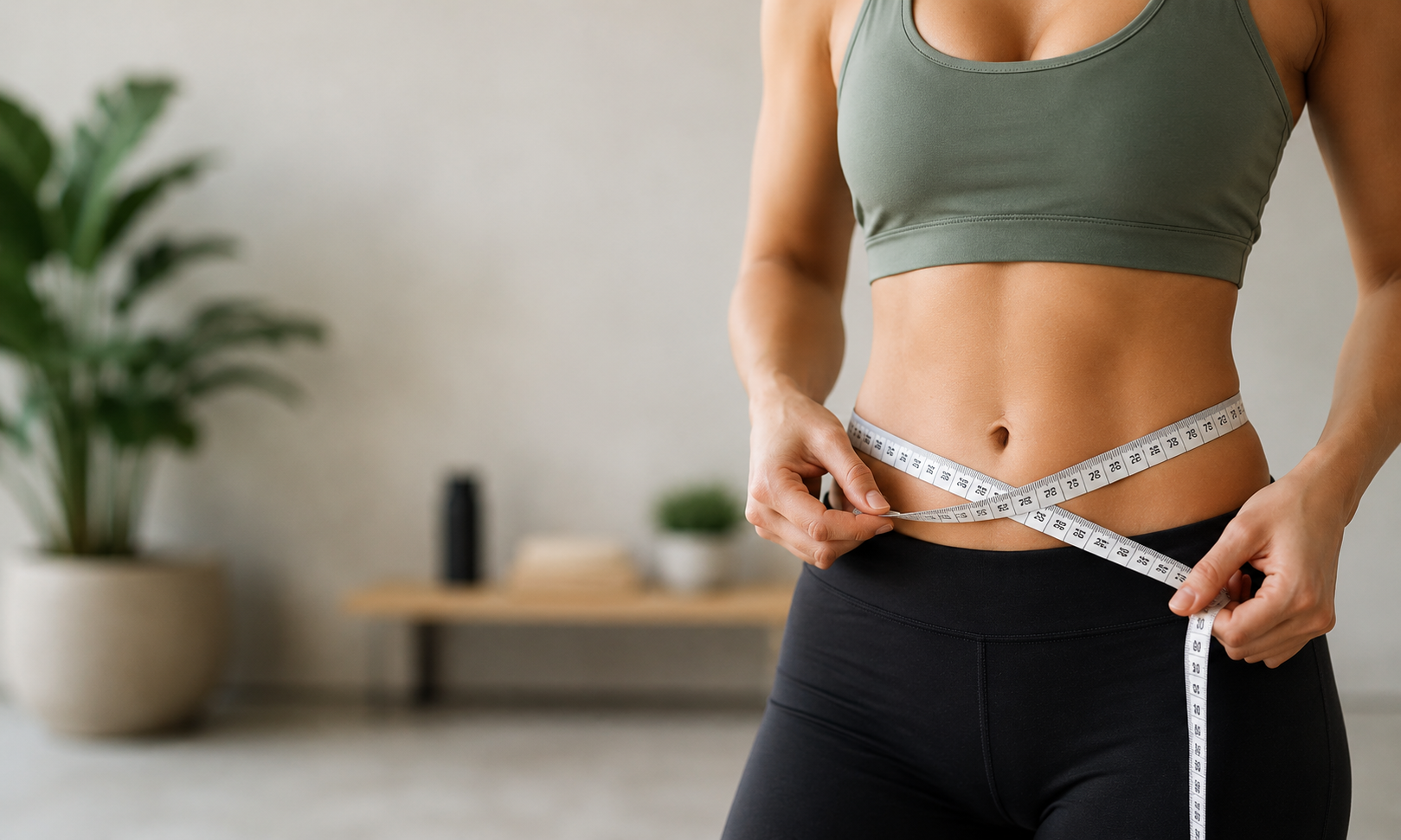
Ideal Body Fat Percentage: What Is a Healthy Range?
If you are searching for an ideal body Fat Calculator, you may be looking for one number that tells you whether your body-fat level is healthy. In reality, body fat percentage is best understood as a range rather than a single perfect value.
Body fat percentage tells you what proportion of your total body weight is fat. The remaining weight includes lean tissues such as muscle, organs, water, and bone.
Body composition can provide information that weight alone cannot, but body-fat measurements and calculators are estimates.
What Is Body Fat Percentage?
Body fat percentage is the proportion of a person's total body weight that consists of fat.
For example, if someone weighs 80 kg and has a body-fat percentage of 20%, approximately 16 kg of that weight is fat:
80 × 0.20 = 16 kg
The remaining 64 kg represents fat-free mass, which includes water, muscle, organs, bone, and other non-fat tissues.
Body fat is not inherently unhealthy. The body needs a certain amount of fat for normal functions such as energy storage, hormone production, insulation, and protection of organs.
Why Does Body Fat Percentage Matter?
Body weight does not tell you how much of your weight comes from fat versus lean tissue.
Two people can weigh exactly the same amount but have very different body compositions. Someone who has more muscle may weigh more without having a high body-fat percentage.
Body composition can therefore add useful information when assessing weight and fitness.
Healthy Body Fat Ranges
There is no single universally accepted "ideal" body-fat percentage for every adult. Recommended or commonly cited ranges vary according to the reference used, age, sex, athletic status, and measurement method.
The American Council on Exercise (ACE), for example, has cited approximately 18–24% for men and 25–31% for women as typical ranges for nonathletes. These figures should be treated as general reference ranges rather than medical cutoffs. (American Council on Exercise, 2024).
Women generally have a higher essential and total body-fat requirement than men. This is one reason male and female body-fat ranges are not identical.
Male vs. Female Body Fat Percentages
Men and women naturally have different body-composition patterns.
A commonly cited reference is:
| Group | Typical nonathlete body-fat range |
|---|---|
| Men | 18–24% |
| Women | 25–31% |
Body-fat levels also change over adulthood, so ranges may differ by age.
Body Fat vs. Body Weight
Body weight measures total mass. Body-fat percentage estimates how much of that mass is fat.
For example, imagine two adults who each weigh 80 kg:
- Person A has 15% body fat.
- Person B has 30% body fat.
Their total weights are identical, but their body compositions are very different.
This illustrates why scale weight alone cannot describe body composition.
At the same time, a lower body-fat percentage is not automatically better. Extremely low body fat can create health concerns, and maintaining a healthy level of body fat should be the goal rather than maximizing leanness.
Body Fat Percentage vs. BMI
BMI (body mass index) and body-fat percentage are different measurements.
BMI uses weight and height:
BMI = weight in kilograms ÷ height in meters²
Body-fat percentage attempts to estimate the proportion of body weight that is fat.
BMI is widely used as a screening measure because it is simple and inexpensive. However, it does not distinguish muscle from fat.
For example, a muscular person may have a relatively high BMI even when their body-fat percentage is not high.
Body-fat percentage can provide additional information, but its measurement is usually less straightforward and can be affected by the method used.
How Is Body Fat Percentage Estimated?
Several methods can estimate body-fat percentage.
Bioelectrical Impedance Analysis
Bioelectrical impedance analysis (BIA) sends a small electrical current through the body and uses electrical impedance, together with prediction equations, to estimate body composition.
BIA is convenient and widely available in scales and handheld devices. However, results can be affected by hydration, food and beverage intake, recent physical activity, body position, temperature, and the specific device and equation used. (National Institutes of Health, 1996).
BIA results are model-based estimates, and individual-level error can be substantial when conditions and prediction equations are not standardized.
Skinfold Measurements
Skinfold calipers estimate body fat from the thickness of subcutaneous fat at selected body sites. Accuracy depends on technique and the equation used.
Dual-Energy X-Ray Absorptiometry
DXA uses low-dose X-rays to estimate fat mass, lean soft tissue, and bone mineral content. It is widely used for body-composition assessment but is less accessible than home-based methods.
Why Body Fat Calculators Are Estimates
An ideal Fat Calculator does not directly measure the fat inside your body.
Instead, calculators use inputs such as age, sex, height, weight, waist measurements, or other information to estimate body-fat percentage through a prediction equation.
Even direct measurement methods have limitations. BIA, for example, can be influenced by hydration and other testing conditions, while skinfold measurements depend on technique. Research comparing BIA with DXA has found that agreement can vary according to sex and body-fat level. (Sun et al., 2005).
For tracking progress, using the same method under similar conditions can make changes over time easier to interpret.
How Body Composition Affects Ideal Weight
Ideal body weight formulas generally focus on height and sometimes sex. They do not fully account for body composition.
This matters because two people with the same height can have different amounts of muscle and body fat.
Someone who gains muscle through resistance training may become heavier while maintaining or reducing body fat, without a traditional ideal-weight formula reflecting the change.
If you want to estimate ideal body weight, the Howtigo Ideal Body Weight Calculator can provide a formula-based reference. For body composition, a Body Fat Calculator can provide an estimate.
Using a Body Fat Calculator
A body-fat calculator can be useful for getting a quick estimate and tracking general changes over time.
When using one:
- Enter your measurements carefully.
- Use the requested units.
- Check the estimation method.
- Treat the result as an estimate.
- Use the same method when tracking changes.
If a result is unexpectedly high or low, do not make major diet or exercise changes based on the number alone. Consider discussing it with a healthcare professional.
Summary
An ideal body Fat Calculator can provide a useful estimate of body composition, but there is no single perfect body-fat percentage for everyone.
Remember:
- Body fat percentage is the proportion of total body weight made up of fat.
- Men and women generally have different body-fat ranges.
- Common reference ranges should not be treated as universal medical cutoffs.
- Body weight and body-fat percentage measure different things.
- BMI does not distinguish muscle from fat.
- BIA, skinfolds, DXA, and other methods have different strengths and limitations.
- Body-fat calculators provide estimates rather than direct measurements.
- Body composition can explain why a person's healthiest weight may differ from a traditional ideal-weight estimate.
- Consistent measurement methods are useful when tracking changes over time.
The goal is not to achieve the lowest possible body-fat percentage, but to consider body composition alongside overall health and lifestyle.
Calculate Your Ideal Body Weight
References
American Council on Exercise. (2024). Body fat percentage: Charting averages in men and women. ACE Fitness. https://www.acefitness.org/about-ace/press-room/in-the-news/8602/body-fat-percentage-charting-averages-in-men-and-women-very-well-health/
National Institutes of Health. (1996). NIH consensus statement: Bioelectrical impedance analysis in body composition measurement. Nutrition, 12(11–12), 749–762. https://pubmed.ncbi.nlm.nih.gov/8974099/
National Institutes of Health. (2011–2012). Body composition procedures manual. National Health and Nutrition Examination Survey, Centers for Disease Control and Prevention.
Sun, G., French, C. R., Martin, G. R., et al. (2005). Comparison of multifrequency bioelectrical impedance analysis with dual-energy X-ray absorptiometry for assessment of percentage body fat in a large, healthy population. The American Journal of Clinical Nutrition, 81(1), 74–78. https://doi.org/10.1093/ajcn/81.1.74
Heymsfield, S. B., Wang, Z., Visser, M., Gallagher, D., & Pierson, R. N., Jr. (1996). Techniques used in the measurement of body composition: An overview with emphasis on bioelectrical impedance analysis. The American Journal of Clinical Nutrition, 64(3 Suppl), 478S–484S. https://doi.org/10.1093/ajcn/64.3.478S