
Ideal Calorie Intake for Weight Loss: How Many Calories Should You Eat?
What Is a Calorie Deficit?
A calorie deficit occurs when you consume fewer calories than your body uses over time.
For example, if your estimated maintenance requirement is 2,400 calories per day and you consistently consume 2,000 calories, the difference is approximately 400 calories per day.
Over time, this energy imbalance can contribute to weight loss.
However, the body is dynamic. As weight decreases, energy requirements can change, and actual weight loss will not necessarily follow a simple mathematical prediction every day.
How Many Calories Should You Eat to Lose Weight?
There is no universal ideal calorie count for weight loss.
A common approach is to start with estimated maintenance calories and create a moderate calorie deficit.
For example:
Estimated maintenance = 2,400 calories/day
Example deficit = 400 calories/day
Starting intake = 2,000 calories/day
This is an illustration of the calculation, not a recommendation that 2,000 calories is appropriate for everyone.
A reasonable calorie target should still provide enough energy and nutrients to support normal body functions and daily activity.
How Calorie Needs Are Estimated
Most calorie calculators use several personal measurements to estimate daily energy expenditure.
Typical inputs include:
- Age
- Sex
- Height
- Weight
- Activity level
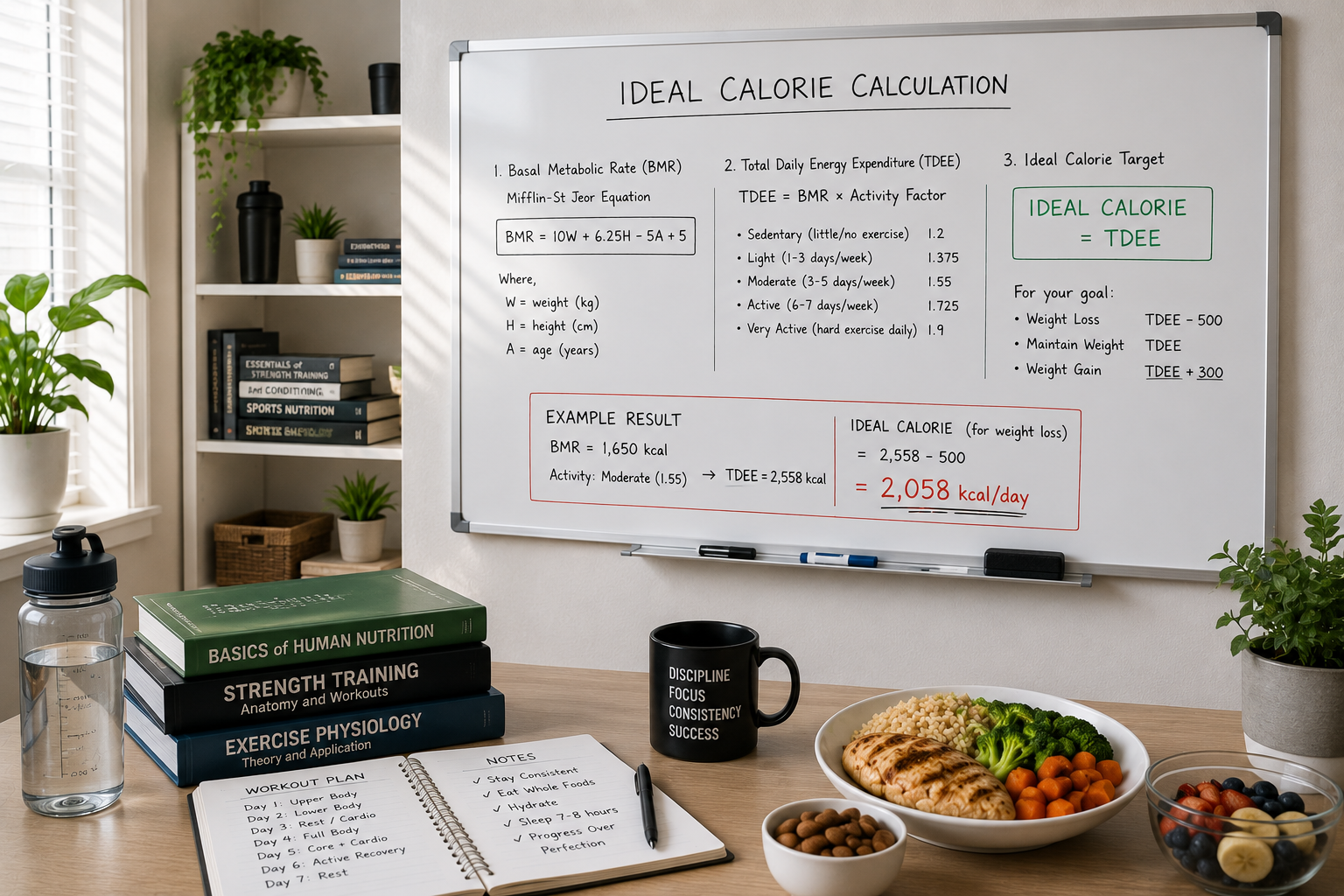
A common process is:
Step 1: Estimate BMR.
Step 2: Estimate TDEE using activity.
Step 3: Subtract a selected calorie deficit.
In simplified form:
Weight-loss calorie target ≈ TDEE − calorie deficit
BMR vs. TDEE for Weight Loss
BMR is the energy your body requires for basic physiological functions at rest.
It is not your daily calorie requirement and should not automatically be used as your weight-loss calorie target.
TDEE, or total daily energy expenditure, estimates the energy your body uses across an average day, including resting metabolism, activity, exercise, and the thermic effect of food.
A simplified calculation is:
TDEE ≈ BMR × activity factor
For example:
BMR = 1,600 calories
Activity factor = 1.4
TDEE ≈ 1,600 × 1.4 = 2,240 calories/day
If a person selected a 300-calorie deficit:
2,240 − 300 = 1,940 calories/day
Again, this is an example calculation rather than an individualized prescription.
You can calculate your estimated BMR using the Howtigo BMR Calculator.
How Activity Level Affects Calorie Needs
Creating a Reasonable Calorie Deficit
A calorie deficit does not need to be extreme.
The goal is generally to create enough of an energy gap to support gradual weight loss while still allowing an adequate and sustainable eating pattern.
A practical starting example might be a 250–500 calorie daily deficit, but the appropriate amount varies by person.
For example:
| Estimated maintenance | Example deficit | Example intake |
|---|---|---|
| 2,000 kcal | 250 kcal | 1,750 kcal |
| 2,200 kcal | 300 kcal | 1,900 kcal |
| 2,400 kcal | 400 kcal | 2,000 kcal |
| 2,600 kcal | 500 kcal | 2,100 kcal |
| 2,800 kcal | 500 kcal | 2,300 kcal |
Why Eating Too Few Calories Can Be Counterproductive
Eating substantially less than your body needs may appear to accelerate weight loss, but very restrictive diets can be difficult to maintain and may increase the risk of inadequate nutrient intake.
Large energy deficits can also make hunger, fatigue, and reduced physical activity more difficult to manage.
The National Heart, Lung, and Blood Institute notes that a combination of reduced calorie intake and increased physical activity can support weight loss, while weight-loss plans should be individualized.
Very-low-calorie diets are not appropriate for everyone and may require medical supervision.
How Height and Weight Affect Calorie Requirements
Height and weight both affect estimated calorie needs.
A taller person generally has greater body size, while a heavier person generally requires more energy for maintenance and movement, all else being equal.
For example, two adults may both be 40 years old and have the same activity level, but if one is 160 cm and 55 kg while the other is 180 cm and 90 kg, their estimated energy requirements are likely to differ.
This is why a recommended calorie intake based on height and weight should also account for age, sex, and activity.
Example Calorie Calculation
Consider an adult with the following estimated values:
- Age: 35 years
- Sex: female
- Height: 165 cm
- Weight: 75 kg
- Estimated BMR: 1,470 calories/day
- Activity factor: 1.4
Estimated TDEE:
1,470 × 1.4 = 2,058 calories/day
If a 300-calorie deficit were selected:
2,058 − 300 = 1,758 calories/day
Maintenance Calories vs. Weight-Loss Calories
Maintenance calories are the estimated calories required to maintain your current weight under a particular activity pattern.
Weight-loss calories are a lower intake selected to create an energy deficit.
For example:
- Estimated maintenance: 2,300 calories
- Weight-loss target: 2,000 calories
- Difference: 300 calories/day
The 2,300-calorie estimate and 2,000-calorie example have different purposes.
Maintenance is the baseline. The weight-loss target is created by reducing intake below that baseline.
You can estimate your maintenance needs with the Howtigo Calorie Calculator.
How to Use a Calorie Calculator for Weight Loss
To estimate your weight-loss calorie intake:
- Enter your current age.
- Enter your sex if required.
- Enter your current height.
- Enter your current weight.
- Select your usual activity level.
- Calculate your estimated BMR and TDEE.
- Choose a reasonable calorie deficit.
- Use the resulting intake as a starting estimate.
If your calculated target seems unusually low, discuss your needs with a qualified healthcare professional or registered dietitian rather than simply reducing calories further.
What Does "Ideal Calorie Intake" Mean?
The word ideal can be misleading.
There is no universally ideal calorie intake for weight loss because energy requirements differ from person to person.
The more useful question is:
What calorie intake creates a manageable deficit while providing enough energy and nutrients for my needs?
Weight Loss and Your Ideal Body Weight
Your ideal body weight and your weight-loss calorie target are different measurements.
An ideal body weight calculator estimates a reference weight using a selected formula.
A calorie calculator estimates energy needs based on your current measurements and activity.
You can use the Howtigo Ideal Body Weight Calculator to explore an ideal-weight estimate, but it should not automatically determine how many calories you should eat.
Summary
If you are trying to calculate your ideal calorie intake for weight loss, remember:
- Weight loss generally requires an energy deficit over time.
- There is no single ideal calorie count for everyone.
- BMR estimates resting energy needs.
- TDEE estimates total daily energy expenditure.
- A weight-loss calorie target can be estimated by subtracting a reasonable deficit from TDEE.
- Height, weight, age, sex, and activity all influence calorie requirements.
- A moderate deficit may be easier to sustain than an extreme restriction.
- Eating too little can make a diet difficult to maintain and may create nutritional concerns.
- Calorie calculators provide estimates rather than exact prescriptions.
- Ideal body weight and weight-loss calorie needs are separate calculations.
You can also calculate your BMR, explore TDEE, and compare your current weight with an Ideal Body Weight estimate.
References
National Heart, Lung, and Blood Institute. (1998). Clinical guidelines on the identification, evaluation, and treatment of overweight and obesity in adults. National Institutes of Health. https://www.nhlbi.nih.gov/health-pro/guidelines/current/obesity-guidelines
U.S. Department of Agriculture, & U.S. Department of Health and Human Services. (2020). Dietary guidelines for Americans, 2020–2025 (9th ed.). https://www.dietaryguidelines.gov/
National Academies of Sciences, Engineering, and Medicine. (2023). Dietary reference intakes for energy. National Academies Press. https://doi.org/10.17226/26818
Mifflin, M. D., St Jeor, S. T., Hill, L. A., Scott, B. J., Daugherty, S. A., & Koh, Y. O. (1990). A new predictive equation for resting energy expenditure in healthy individuals. The American Journal of Clinical Nutrition, 51(2), 241–247. https://doi.org/10.1093/ajcn/51.2.241