
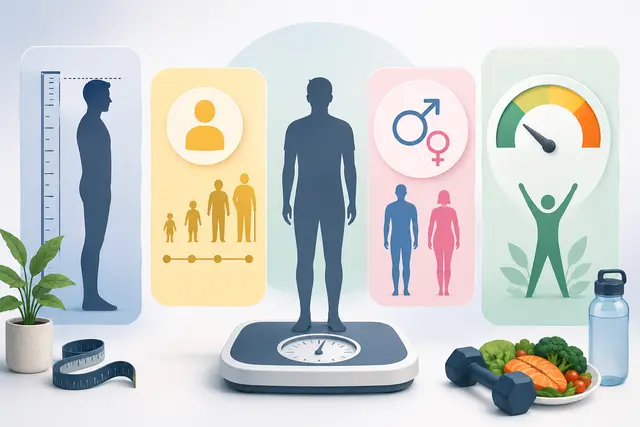
Ideal Weight by Height, Age and Gender: How to Find Your Healthy Weight
Finding a realistic weight for your height, age, and gender can seem like it should produce one simple number. In practice, healthy weight is more complicated. Height has a direct role in most ideal-weight formulas, while age and sex can affect how weight and body composition should be interpreted.
If you are searching for an ideal weight for my height and age calculator, it is important to understand what a calculator can and cannot tell you. Traditional ideal body weight formulas usually do not include age, and the same formula may produce the same estimate for two adults of the same height and sex even if their ages are very different.
For adults, BMI can provide another useful reference because it relates weight to height and provides a standard screening range. Body composition and other health measures add further context.
Does Age Affect Your Ideal Weight?
Age can affect body weight and body composition, but age is not usually a direct input in traditional ideal body weight formulas.
For example, the Devine ideal body weight equation uses height and sex rather than age:
- Men: 50 kg + 2.3 kg for each inch over 5 feet
- Women: 45.5 kg + 2.3 kg for each inch over 5 feet
A 30-year-old man and a 60-year-old man of the same height would therefore receive the same Devine ideal-weight estimate.
That does not mean age is irrelevant.
As people get older, body composition can change. Muscle mass may decline, activity patterns can change, and body-fat distribution can shift. These changes can influence how a person's weight should be interpreted even when their height remains the same.
So, if you are trying to find your ideal weight for your age and height, age is better treated as context rather than simply adding a number to an ideal-weight formula.
Does Gender Affect Ideal Weight?
Many traditional ideal body weight equations use separate formulas for men and women.
For example, the Devine formula starts with:
- 50 kg for men at 5 feet
- 45.5 kg for women at 5 feet
The formula then adds 2.3 kg for every inch above 5 feet.
How Height Affects Ideal Weight
Height is one of the strongest inputs in traditional ideal-weight formulas.
As height increases, the estimated ideal body weight generally increases as well.
For example, using the Devine formula for men:
| Height | Estimated ideal body weight |
|---|---|
| 5'2" | 54.6 kg |
| 5'4" | 59.2 kg |
| 5'6" | 63.8 kg |
| 5'8" | 68.4 kg |
| 5'10" | 73.0 kg |
| 6'0" | 77.6 kg |
Ideal Weight by Gender
Gender or sex can affect traditional ideal-weight calculations because some equations use separate male and female constants.
For example, a 5-foot-6 adult would receive these estimates under the Devine formula:
- Male: 63.8 kg
- Female: 59.3 kg
Male Weight Based on Height
If you are looking for male weight based on height, a traditional ideal-weight formula can provide one reference point.
Using the Devine equation:
Male IBW = 50 + 2.3 × inches over 5 feet
For example, a 6-foot man is 12 inches over 5 feet:
50 + (2.3 × 12) = 77.6 kg
So the estimated ideal body weight is 77.6 kg using this formula.
You can explore height-specific male estimates in the Howtigo Male Height and Weight Chart.
Female Weight by Height
The Devine formula for women is:
Female IBW = 45.5 + 2.3 × inches over 5 feet
For example, a woman who is 5 feet 4 inches tall is 4 inches above 5 feet:
45.5 + (2.3 × 4) = 54.7 kg
Her estimated ideal body weight is therefore 54.7 kg using the Devine equation.
For more height-specific information, see the Howtigo Female Height and Weight Chart.
Healthy Weight vs. Ideal Weight
Healthy weight and ideal weight are not interchangeable.
Ideal weight usually refers to the result of a selected formula.
For adults, BMI provides a standardized screening category. A BMI from 18.5 to less than 25 is classified as the standard healthy-weight category.
Because BMI provides a range, it can be useful for showing that there may be several weights associated with a healthy BMI at the same height.
For example, at 1.70 m:
18.5 × 1.70² = 53.5 kg
24.9 × 1.70² = 71.9 kg
So the approximate weight range associated with BMI 18.5–24.9 is 53.5–71.9 kg.
That range is much broader than a single ideal-weight estimate.
How BMI Can Be Used Alongside Ideal Weight
BMI and ideal body weight can complement each other.
Ideal body weight asks:
What reference weight does this formula estimate for my height and sex?
BMI asks:
How does my current weight relate to my height?
For example, suppose a 5-foot-6 woman weighs 68 kg.
Her Devine ideal body weight estimate is about 59.3 kg.
Her BMI is:
68 ÷ (1.676²) ≈ 24.2
That BMI falls within the standard adult healthy-weight category.
This example shows why being above an ideal-weight estimate does not automatically mean that a person is outside the standard healthy BMI category.
You can calculate your current BMI with the Howtigo BMI Calculator.
How to Calculate Your Ideal Weight
To calculate a traditional ideal body weight manually:
- Determine your height.
- Convert the height to feet and inches if needed.
- Identify the inches above 5 feet.
- Select the appropriate formula.
- Apply the formula.
- Treat the result as a reference estimate.
For example, a man who is 5 feet 9 inches tall is 9 inches over 5 feet:
50 + (2.3 × 9) = 70.7 kg
The estimated ideal body weight is 70.7 kg using the Devine formula.
Use the Howtigo Ideal Body Weight Calculator to calculate an estimate based on your height.
Summary
If you are looking for an ideal weight for your height and age calculator, remember that age is usually context rather than a direct input in traditional adult ideal-weight formulas.
Key points:
- Height is a major factor in traditional ideal-weight equations.
- Many formulas use separate equations for men and women.
- Age is generally not included directly in traditional adult ideal-weight formulas.
- Body composition can change with age and affect how weight should be interpreted.
- There is no universal ideal-weight chart that gives one perfect value for every age and height.
- BMI can provide a broader healthy-weight range for adults.
- Ideal weight is an estimate, not a required target.
- Male and female height charts can provide useful formula-based references.
- For a personalized starting point, use the Howtigo Ideal Body Weight Calculator and compare the result with your BMI using the Howtigo BMI Calculator.
You can also explore the Male Height and Weight Chart or Female Height and Weight Chart.
References
Centers for Disease Control and Prevention. (2024). Adult BMI categories. https://www.cdc.gov/bmi/adult-calculator/bmi-categories.html
Centers for Disease Control and Prevention. (2011). Body mass index: Considerations for practitioners. https://stacks.cdc.gov/view/cdc/25368/
Centers for Disease Control and Prevention. (2017). National Health and Nutrition Examination Survey: Anthropometry procedures manual. https://stacks.cdc.gov/view/cdc/51795/
Pai, M. P., & Paloucek, F. P. (2000). The origin of the "ideal" body weight equations. The Annals of Pharmacotherapy, 34(9), 1066–1069. https://doi.org/10.1345/aph.19381
Shah, B., Sucher, K., & Hollenbeck, C. B. (2006). Comparison of ideal body weight equations and published height-weight tables with body mass index tables for healthy adults in the United States. Nutrition in Clinical Practice, 21(3), 312–319. https://pubmed.ncbi.nlm.nih.gov/16772549/
Peterson, C. M., Thomas, D. M., Blackburn, G. L., & Heymsfield, S. B. (2016). Universal equation for estimating ideal body weight and body weight at any BMI. The American Journal of Clinical Nutrition, 103(5), 1197–1203. https://pubmed.ncbi.nlm.nih.gov/27030535/