
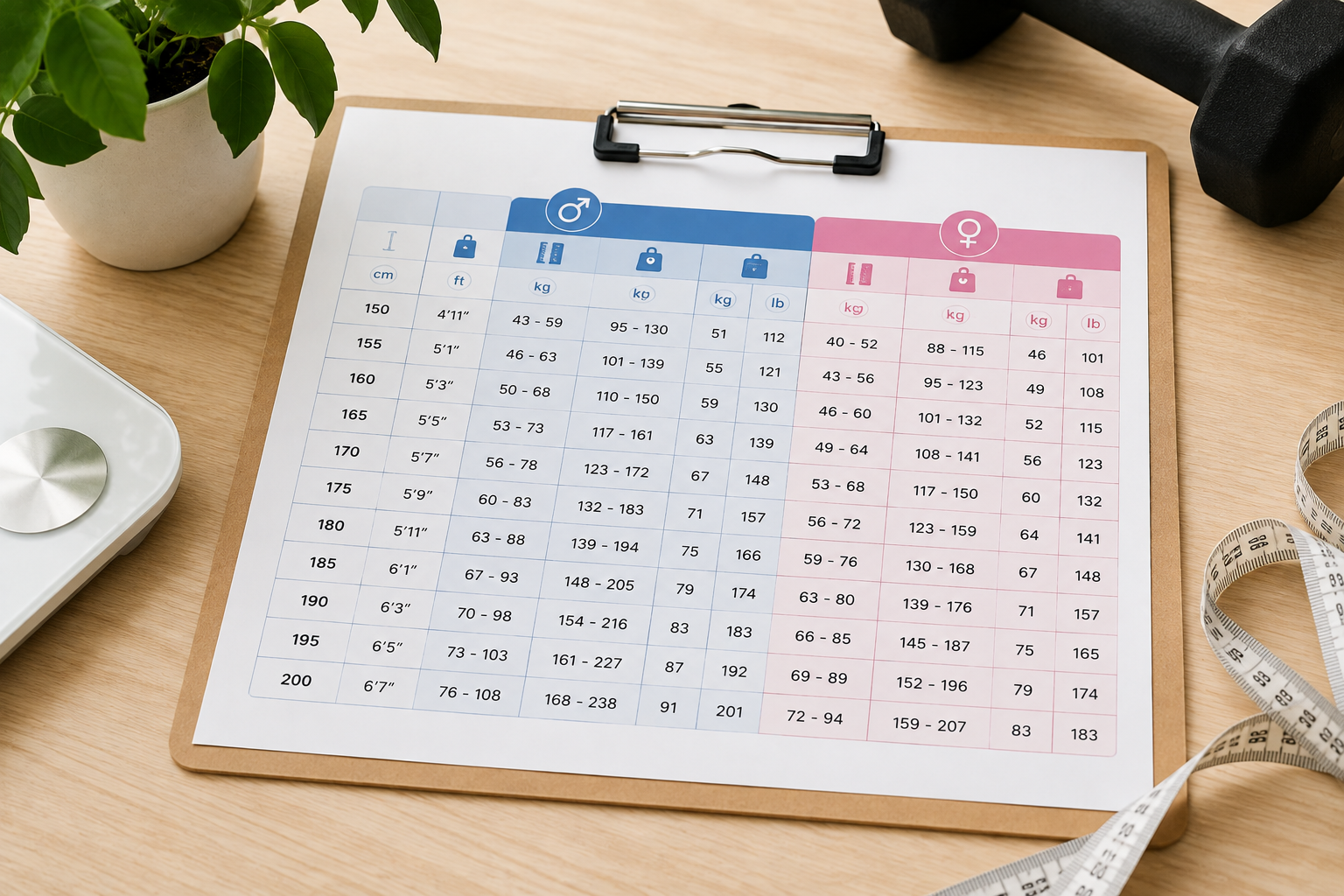
Ideal Weight Chart by Height: Find a Healthy Weight Range
An ideal weight chart can be a quick way to compare estimated body weight with height. These charts are often searched by people who want to know their ideal weight without doing a calculation themselves.
However, a chart should be treated as a general reference, not a precise answer. Your height is important, but factors such as muscle mass, body composition, age, sex, and overall health also affect how your weight should be interpreted.
How to Read an Ideal Weight Chart
An ideal weight chart normally lists height in one column and an estimated weight or weight range beside it.
For example, a chart might organize height as:
- 5 feet 0 inches
- 5 feet 2 inches
- 5 feet 4 inches
- 5 feet 6 inches
- 5 feet 8 inches
- 5 feet 10 inches
- 6 feet 0 inches
You then find the row closest to your height and read the corresponding estimate.
Check what formula or method the chart uses. Two charts can show different numbers because they may use different equations or BMI ranges.
An optimal weight chart is therefore a general reference, not a universal list of exact targets.
Ideal Weight by Height
Height is a major factor in traditional ideal body weight calculations. Taller adults generally have greater total body mass, so estimated ideal weight tends to increase as height increases.
For example, using the Devine ideal body weight formula, the estimates for adults at selected heights are approximately:
| Height | Men | Women |
|---|---|---|
| 5'0" (152 cm) | 50.0 kg | 45.5 kg |
| 5'2" (157 cm) | 54.6 kg | 50.1 kg |
| 5'4" (163 cm) | 59.2 kg | 54.7 kg |
| 5'6" (168 cm) | 63.8 kg | 59.3 kg |
| 5'8" (173 cm) | 68.4 kg | 63.9 kg |
| 5'10" (178 cm) | 73.0 kg | 68.5 kg |
| 6'0" (183 cm) | 77.6 kg | 73.1 kg |
These are estimates, not required weights. The Devine formula uses a base weight at 5 feet and adds 2.3 kg for each inch above 5 feet. It is one of several equations used to estimate ideal body weight.
If you are comparing charts, always check which formula was used.
Why Height Matters When Estimating Weight
Height matters because body size is related to total body mass. A 6-foot adult will generally have a different healthy weight range from a 5-foot adult.
Height does not determine an exact weight.
Two adults who are the same height can have very different:
- Muscle mass
- Bone structure
- Body-fat percentage
- Fat distribution
- Fitness levels
For example, a strength-trained person may weigh more than a chart estimate because of greater muscle mass.
That is why an ideal weight chart is useful for orientation, but it should not be treated as a definitive health assessment.
Ideal Weight Ranges for Adults
There is an important distinction between an ideal body weight estimate and a healthy weight range.
Traditional IBW formulas often produce one estimated number. A healthy weight range, on the other hand, allows for normal differences between individuals.
For adults, BMI is commonly used as a screening measure. The CDC defines a BMI from 18.5 to less than 25 as the healthy-weight category, providing a broader range rather than one target number.
For example, at a height of 5 feet 8 inches, the BMI healthy-weight range corresponds to approximately 125–164 pounds, or about 56.7–74.4 kg.
That difference is expected because the two methods answer slightly different questions.
BMI is also limited because it does not directly measure body fat or distinguish muscle from fat.
Male vs. Female Weight Charts
A weight chart for men by height may show different estimates from a chart for women at the same height.
Traditional ideal body weight formulas often use sex-specific equations. For example, the Devine formula starts at 50 kg for men and 45.5 kg for women at 5 feet, then adds 2.3 kg for every inch above 5 feet.
Using this formula at 5 feet 8 inches:
- Men: 68.4 kg
- Women: 63.9 kg
This explains why a weight and height chart for female adults may differ from a male chart.
These differences should not be interpreted as rules about what every man or woman should weigh. They are outputs from a particular formula.
Example Height and Weight Comparisons
Suppose three adults have different heights:
- Person A: 5'2", 55 kg
- Person B: 5'6", 65 kg
- Person C: 5'10", 75 kg
Looking only at actual weight does not tell you whether each person is within a healthy range. Height changes the interpretation.
BMI can provide additional context because it considers both height and weight. However, BMI remains a screening tool rather than a direct measurement of body fat.
Why a Chart Cannot Determine Your Exact Ideal Weight
A perfect weight chart sounds precise, but there is no single perfect weight that applies to everyone.
Charts and traditional formulas generally cannot fully account for:
- Muscle mass
- Bone density
- Body-fat distribution
- Pregnancy
- Certain medical conditions
- Medications
- Athletic training
- Individual body-frame differences
Age can also affect body composition. In addition, adult charts should not be used to assess children and teenagers in the same way because growth and development require age- and sex-specific references.
Your weight can also change naturally because of hydration and food intake.
For these reasons, an ideal human weight should not be thought of as one exact number that every person must reach.
Ideal Weight vs. BMI
Ideal body weight and BMI are different measurements.
Ideal body weight: Usually estimates one reference weight from height and sometimes sex.
BMI: Uses both weight and height to calculate a numerical index.
For adults, the CDC uses BMI categories as a screening tool:
- Underweight: below 18.5
- Healthy weight: 18.5 to less than 25
- Overweight: 25 to less than 30
- Obesity: 30 or higher
These categories provide context, but BMI has limitations. For example, a muscular person may have a higher BMI because muscle contributes to body weight.
When to Use a Calculator Instead of a Chart
An ideal weight chart is useful when you want a quick visual reference. A calculator is usually better when you want an estimate based on your exact height.
Use a chart when:
- You want to compare several heights quickly.
- You are looking for a general reference.
- You want to understand how estimated weight changes with height.
Use a calculator when:
- Your height falls between chart values.
- You use centimeters rather than feet and inches.
- You want to avoid manual calculations.
- You want to know which formula produced the result.
- You want a result based on your specific inputs.
You can use the Howtigo Ideal Body Weight Calculator to calculate an estimated ideal body weight without manually applying the formula.
Summary
An ideal weight chart is a convenient way to compare estimated weight with height, but it should not be treated as an exact health target.
Remember:
- Height is important in traditional ideal weight estimates.
- Different formulas can produce different results.
- Male and female charts may use different equations.
- BMI provides a broader screening range based on height and weight.
- Muscle mass and body composition can make chart-based estimates misleading.
- There is no single "perfect" weight for everyone at a particular height.
- A calculator can provide a more convenient result when you want to use your exact height.
Use charts as a reference and consider the result alongside other health information.
Calculate Your Ideal Body Weight with the Howtigo Ideal Body Weight Calculator
References
Centers for Disease Control and Prevention. (2024). Adult BMI categories. https://www.cdc.gov/bmi/adult-calculator/bmi-categories.html
Devine, B. J. (1974). Gentamicin therapy. Drug Intelligence & Clinical Pharmacy, 8(11), 650–655. https://doi.org/10.1177/106002807400801005
National Heart, Lung, and Blood Institute. (n.d.). Assessing your weight and health risk. National Institutes of Health. https://www.nhlbi.nih.gov/health/educational/lose_wt/risk.htm
World Health Organization. (2021). Obesity and overweight. https://www.who.int/news-room/fact-sheets/detail/obesity-and-overweight