
What Does Heart Failure Mean?
Heart failure does not mean that the heart has stopped working. It means the heart is unable to pump enough blood to meet the body's needs, or it can do so only with increased filling pressures.
The American Heart Association describes heart failure as a chronic condition that develops when the heart cannot pump enough blood and oxygen to support the body's needs.
Heart failure can occur for different reasons, including coronary artery disease, high blood pressure, heart valve disease, cardiomyopathy, and other conditions.
It is also not a single disease with one predictable course. Some people have stable symptoms for years, while others experience repeated worsening or hospitalization.
What Does Life Expectancy Mean in Heart Failure?
Life expectancy refers to the expected length of survival for a person or population.
In heart failure research, prognosis is often described using outcomes such as:
- Survival over a defined period
- Risk of hospitalization
- Risk of cardiovascular death
- Changes in symptoms and function
- Quality of life
These statistics describe groups of people. They do not determine exactly what will happen to one individual.
Why There Is No Reliable Individual Life-Expectancy Calculator
Heart failure prognosis is complex.
Two people with the same diagnosis may have very different outcomes because they can differ in ejection fraction, kidney function, symptoms, age, treatment, exercise capacity, and other conditions.
Clinical risk models can estimate outcomes in selected patient groups, but they are not the same as a personal countdown clock.
A result from an online calculator should therefore never be used to decide whether treatment is worthwhile or to predict an exact remaining lifespan.
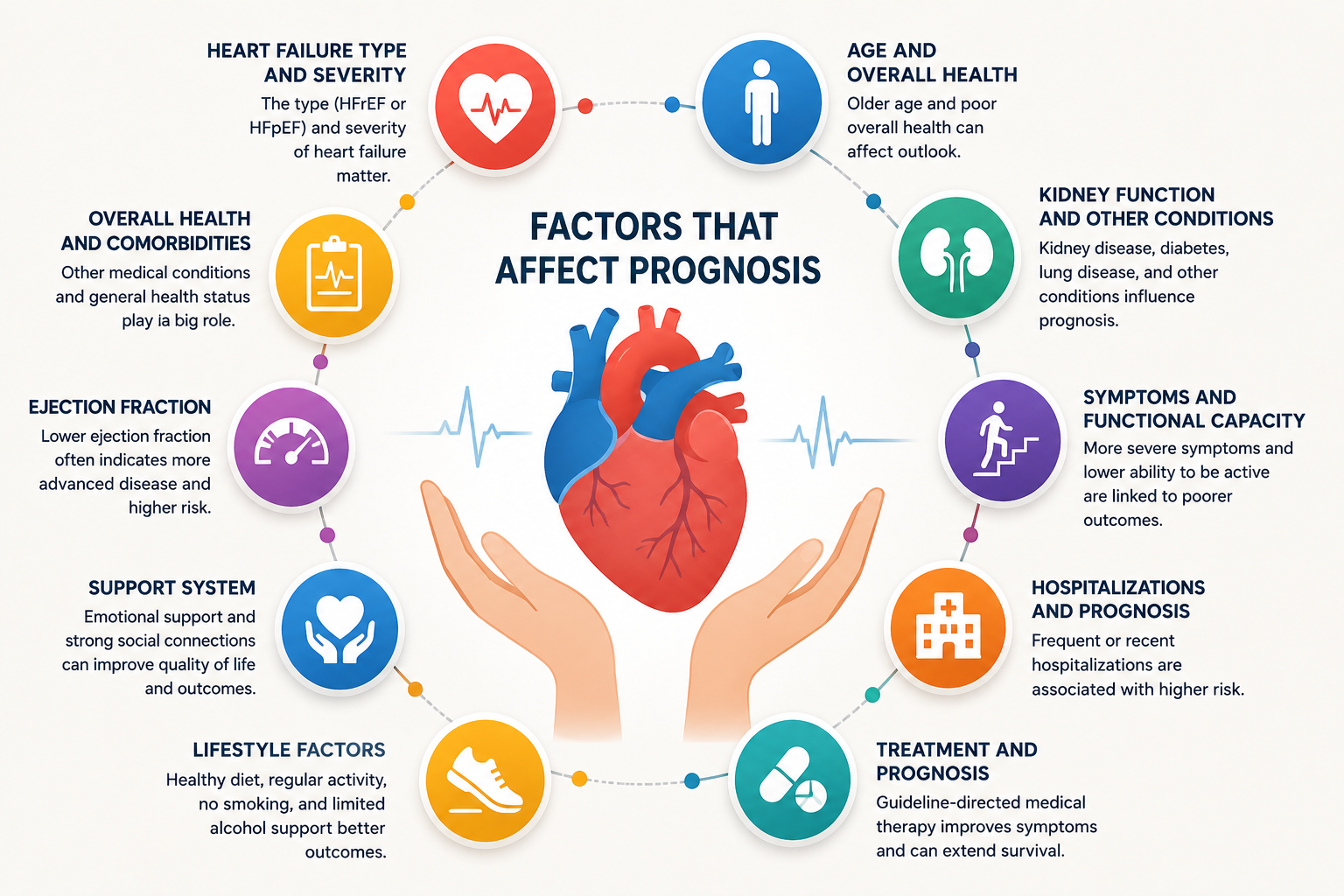
Factors That Affect Prognosis
Several factors can influence outcomes in heart failure.
Heart Failure Type and Severity
Heart failure is commonly classified according to how well the left ventricle pumps.
Two major categories include:
- Heart failure with reduced ejection fraction (HFrEF)
- Heart failure with preserved ejection fraction (HFpEF)
There are also intermediate or mildly reduced ejection-fraction categories used in contemporary clinical practice.
Severity can also be described through symptoms and functional limitations. The New York Heart Association functional classification, for example, groups patients according to how much ordinary physical activity causes symptoms.
Ejection Fraction
Ejection fraction (EF) describes the percentage of blood pumped out of the left ventricle with each contraction.
It is commonly measured with an echocardiogram.
For example, if the left ventricle contains 100 mL of blood before contraction and ejects 60 mL, the ejection fraction is 60%.
Ejection fraction is useful, but it is not the same thing as overall heart function or a complete measure of prognosis.
A person can have heart failure with a preserved ejection fraction, while another can have reduced ejection fraction. Their symptoms, causes, treatments, and prognosis may differ.
Age and Overall Health
Age is an important factor when discussing prognosis, but it should not be considered alone.
Overall health can make a substantial difference. Someone with heart failure and few other health problems may have a different outlook from an older person with several serious conditions.
Healthcare professionals may consider:
- Age
- Frailty
- Physical function
- Nutritional status
- Kidney function
- Lung disease
- Diabetes
- Vascular disease
- Previous cardiovascular events
- Other chronic conditions
Kidney Function and Other Health Conditions
The heart and kidneys interact closely. Reduced kidney function can complicate heart failure management and may be associated with poorer outcomes.
Other conditions can also influence prognosis.
For example, diabetes, chronic lung disease, anemia, liver disease, vascular disease, and certain cancers may affect overall health and treatment options.
This is one reason a simple heart failure life expectancy calculator cannot provide a dependable individual answer from a few inputs.
Symptoms and Functional Capacity
Symptoms provide important information about how heart failure affects everyday life.
Common symptoms include:
- Shortness of breath
- Fatigue
- Reduced exercise tolerance
- Swelling in the legs or ankles
- Difficulty breathing when lying down
Functional capacity refers to what a person can physically do before symptoms limit activity.
A person who remains active with minimal symptoms may have a different risk profile from someone who becomes breathless with very little activity.
Hospitalizations and Prognosis
Hospitalization for worsening heart failure is an important clinical event.
Repeated admissions may indicate that the condition is becoming harder to control and can be associated with increased risk.
A hospitalization does not determine an individual's future, but repeated worsening should prompt review of treatment, medications, fluid status, symptoms, and other contributing factors.
Treatment and Prognosis
Treatment can make an important difference in heart failure outcomes.
Depending on the type of heart failure and the person's condition, treatment may include medications, lifestyle measures, management of underlying causes, devices, procedures, or surgery.
For people with certain forms of heart failure, guideline-directed medical therapy can reduce hospitalizations and improve survival.
Treatment is individualized because kidney function, blood pressure, heart rate, potassium levels, and other factors differ between people. Never stop or change heart-failure medication based on an online calculator.
Lifestyle Factors
Lifestyle habits can support heart failure management, although recommendations should be individualized.
Depending on the person's condition, clinicians may discuss physical activity, diet, sodium or fluid management, weight monitoring, tobacco avoidance, alcohol, medications, and follow-up care. Recommendations should be individualized.
Why Statistics Cannot Predict an Individual's Outcome
Statistics are useful because they help doctors understand risk across groups of people.
However, population statistics cannot tell one person exactly what will happen.
A study might report survival after a particular period, but participants can differ in age, treatment, causes, disease severity, and other characteristics. Treatments also change over time.
Therefore, an online CHF life expectancy calculator that produces a single number should be treated cautiously.
How Prognosis Is Discussed With a Healthcare Professional
If you want to understand your personal prognosis, bring specific questions to your cardiologist or healthcare professional.
Useful questions include:
- What type of heart failure do I have?
- What is my ejection fraction?
- How severe are my symptoms?
- What factors are increasing my risk?
- How is my treatment expected to help?
- What changes should I watch for?
- What can I do to reduce hospitalizations?
- When should I contact the healthcare team?
A clinician can combine your history, examination, test results, symptoms, treatment, and response over time to provide a more meaningful assessment than a general online calculator.
Heart Rate Calculator
The Heart Rate Calculator can help with general heart-rate calculations, but it does not diagnose heart failure or estimate life expectancy.
When Worsening Symptoms Require Medical Attention
Heart failure symptoms can change over time.
Contact your healthcare team if you notice new or worsening symptoms such as increasing shortness of breath, rapid weight gain from fluid retention, worsening swelling, reduced ability to perform usual activities, or increasing fatigue.
Seek urgent medical attention for severe breathing difficulty, chest pain, fainting, confusion, or other severe or rapidly worsening symptoms.
Do not use an online prognosis calculator to determine whether urgent symptoms are safe to monitor at home.
Summary
There is no reliable heart failure life expectancy calculator that can accurately predict the exact lifespan of an individual.
Prognosis depends on many factors, including:
- Type and severity of heart failure
- Ejection fraction
- Age and overall health
- Kidney function and other conditions
- Symptoms and functional capacity
- Hospitalizations
- Treatment and response to treatment
- Lifestyle and ongoing care
Population statistics provide useful context, but they cannot replace individualized medical assessment. Discuss prognosis with the healthcare professional managing the condition.
References
American Heart Association. (2024). What is heart failure? https://www.heart.org/en/health-topics/heart-failure/what-is-heart-failure
American Heart Association. (2024). Ejection fraction heart failure measurement. https://www.heart.org/en/health-topics/heart-failure/diagnosing-heart-failure/ejection-fraction-heart-failure-measurement
American Heart Association. (2024). Classes of heart failure. https://www.heart.org/en/health-topics/heart-failure/what-is-heart-failure/classes-of-heart-failure
National Heart, Lung, and Blood Institute. (2024). Heart failure. National Institutes of Health. https://www.nhlbi.nih.gov/health/heart-failure
Heidenreich, P. A., Bozkurt, B., Aguilar, D., Allen, L. A., Byun, J. J., Colvin, M. M., Deswal, A., Drazner, M. H., Dunlay, S. M., Evers, L. R., Fang, J. C., Fedson, S. E., Fonarow, G. C., Hayek, S. S., Hernandez, A. F., Khazanie, P., Kittleson, M. M., Lee, C. S., Link, M. S., ... Yancy, C. W. (2022). 2022 AHA/ACC/HFSA guideline for the management of heart failure. Circulation, 145(18), e895–e1032. https://doi.org/10.1161/CIR.0000000000001063