
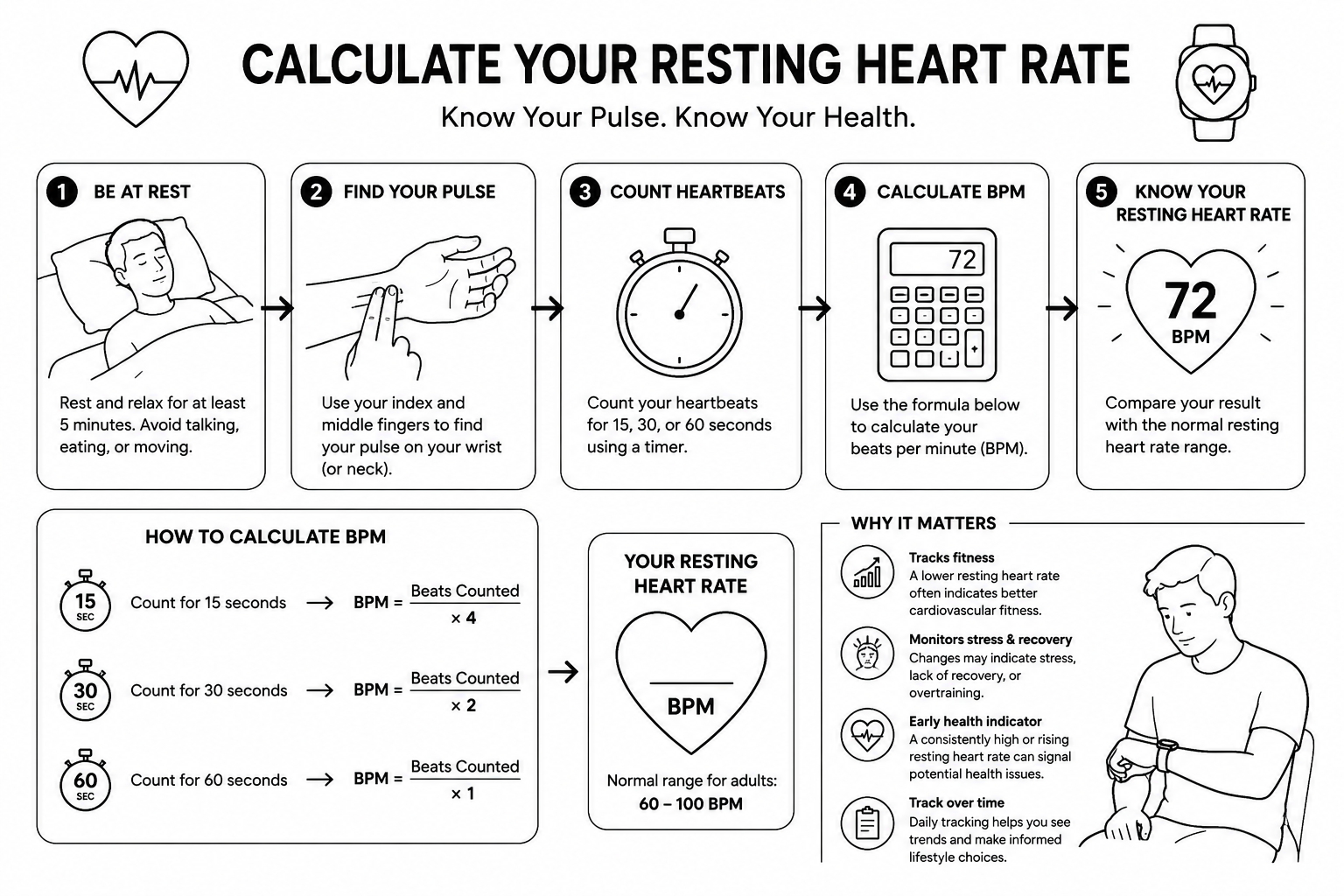
Your heart rate changes throughout the day. It is usually lower when you are relaxed and higher during exercise, stress, or illness. Your resting heart rate shows how quickly your heart beats while your body is at rest and can help you track personal patterns over time.
What Is Resting Heart Rate?
Resting heart rate is the number of times your heart beats per minute while you are relaxed and not exercising.
For many adults, a resting heart rate of 60 to 100 beats per minute (BPM) is considered a typical range. However, individual resting rates can vary, and some healthy people, particularly well-trained athletes, may have lower readings.
The American Heart Association recommends checking resting heart rate when you are calm and at rest. A morning measurement before getting out of bed can be useful because it provides a consistent condition for tracking.
Resting Heart Rate vs. Pulse Rate
Resting heart rate and resting pulse rate are closely related.
Your heart rate describes how many times your heart beats per minute. Your pulse is the rhythmic movement you can feel in an artery as blood is pumped through the body.
For most routine measurements, you can find your pulse and use it to estimate your resting heart rate.
For example, if you count 68 pulses in one minute, your resting heart rate is approximately 68 BPM.
How to Measure Resting Heart Rate
You do not need special equipment. The wrist is usually the easiest location.
- Relax for several minutes.
- Place your index and middle fingers on the thumb side of your wrist.
- Press gently until you feel the pulse.
- Count for 60 seconds.
- Record the result in BPM.
You can also use a shorter count and convert it to BPM. A full 60-second count is preferable when the rhythm feels irregular. Use your index and middle fingers rather than your thumb.
When Is the Best Time to Measure Resting Heart Rate?
Consistency is more important than finding one perfect time.
For a resting measurement, you should be relaxed and have not just exercised. Checking in the morning can be particularly useful. The American Heart Association describes checking resting heart rate in the morning after a good night's sleep and before getting out of bed as one practical approach.
If you compare measurements from different days, try to use similar conditions. For example, measuring immediately after waking on several mornings may give you a more useful trend than comparing a morning reading with one taken after coffee or exercise.
How to Calculate Resting BPM
If you count your pulse for a full minute, the calculation is simple:
Resting BPM = number of beats counted in 60 seconds
If you count for 30 seconds:
Resting BPM = beats counted × 2
If you count for 15 seconds:
Resting BPM = beats counted × 4
For example:
- 15 beats in 15 seconds = 60 BPM
- 34 beats in 30 seconds = 68 BPM
- 72 beats in 60 seconds = 72 BPM
When the pulse is irregular, counting for a full minute is preferable to using a short count multiplied by a factor.
Try the Heart Rate Calculator
The Heart Rate Calculator can help with general heart-rate and BPM calculations.
Resting Heart Rate After Waking Up
Morning measurements are useful because they are less affected by recent activity, meals, caffeine, and daily stress. After waking, remain relaxed, find your pulse, count for 60 seconds, and record the result.
How Exercise Affects Resting Heart Rate
Exercise can affect resting heart rate over time.
Regular aerobic activity can improve cardiovascular fitness, and some physically fit people have lower resting heart rates. However, resting heart rate is influenced by many factors, so a lower number does not automatically mean better health.
Do not deliberately try to lower your resting heart rate without considering your overall health and exercise needs.
Resting Heart Rate and Fitness
Resting heart rate can provide one indicator of cardiovascular fitness when viewed as a personal trend. Regular exercise may lower it in some people, but fitness also depends on exercise capacity, blood pressure, symptoms, and recovery.
Resting Heart Rate by Age
For adults, 60–100 BPM is a commonly cited resting range rather than a separate fixed value for every age. Children have different expected ranges. Age matters, but fitness, medications, illness, sleep, and stress can also substantially affect resting heart rate.
What Can Affect Resting Heart Rate?
Your resting heart rate can change temporarily because of many everyday factors.
Common influences include:
- Physical activity
- Stress or anxiety
- Poor sleep
- Dehydration
- Fever or illness
- Caffeine
- Alcohol
- Medications
- Changes in body position
- Environmental temperature
This means that one unusually high or low measurement does not necessarily represent your usual resting heart rate.
Stress and Resting Heart Rate
Stress can temporarily increase heart rate. A reading taken immediately after a stressful event may therefore be higher than usual, which is another reason to measure under calm, consistent conditions.
Caffeine and Resting Heart Rate
Caffeine can temporarily increase heart rate in some people. The American Heart Association's 2026 scientific statement notes that short-term caffeine effects can include increases in heart rate and blood pressure, although individual responses vary.
For a consistent baseline, avoid comparing readings taken under very different caffeine conditions.
Sleep and Resting Heart Rate
Sleep and circadian rhythms can influence cardiovascular measurements.
Poor or disrupted sleep can affect how you feel and may be associated with changes in heart rate. Sleep health includes duration, regularity, timing, and quality.
Illness and Resting Heart Rate
Fever and illness can raise heart rate. Dehydration can also affect cardiovascular measurements.
If your resting heart rate is temporarily higher while you are sick, focus on recovery rather than interpreting one measurement as a change in fitness.
If an unusual heart rate persists after you recover, or if it occurs with concerning symptoms, discuss it with a healthcare professional.
Why Resting Heart Rate Changes From Day to Day
Small changes are normal because heart rate responds to sleep, stress, activity, hydration, temperature, illness, caffeine, and medications. Look for a pattern rather than reacting to one isolated reading.
How to Track Resting Heart Rate Over Time
A simple record can help you understand your personal baseline.
You can record:
| Date | Time | Position | Resting HR |
|---|---|---|---|
| Monday | Morning | Lying down | 64 BPM |
| Tuesday | Morning | Lying down | 63 BPM |
| Wednesday | Morning | Lying down | 66 BPM |
Resting Heart Rate vs. Maximum Heart Rate
These measurements describe different parts of your cardiovascular response.
Resting heart rate is measured when your body is relaxed.
Maximum heart rate is the highest heart rate you can reach during maximal effort and is often estimated with an age-based formula.
A person can have a low resting heart rate without having a high maximum heart rate, and vice versa.
For more information, see How to Calculate Your Maximum Heart Rate.
Resting Heart Rate vs. Target Heart Rate
A target heart rate is an exercise range used to guide workout intensity.
Resting heart rate is measured before exercise, while target heart rate is used during exercise.
Some training methods use resting heart rate together with estimated maximum heart rate to calculate heart-rate reserve and personalized training ranges.
See Target Heart Rate Calculator: How to Find Your Training Zone for more information.
Summary
To calculate your resting heart rate, measure your pulse while you are calm and at rest.
A simple method is:
- Relax for several minutes.
- Find your pulse at the wrist.
- Count beats for 60 seconds.
- Record the BPM.
- Repeat under similar conditions when tracking your trend.
For many adults, 60–100 BPM is a commonly cited resting range, but individual healthy values can differ.
Stress, caffeine, sleep, illness, exercise, hydration, medications, and other factors can change resting heart rate. Therefore, a single measurement should be interpreted in context.
If you notice a persistent or significant change in your usual resting heart rate, particularly with symptoms such as chest pain, fainting, severe shortness of breath, or significant dizziness, seek appropriate medical evaluation.
For general calculations, use the Heart Rate Calculator. You can also explore the BMR Calculator and Calorie Calculator.
References
American Heart Association. (2024). Exercise within reach: Finding your target heart rate. https://www.heart.org/
American Heart Association. (2024). Target heart rate calculation. https://www2.heart.org/site/DocServer/STEAM_-_Finding_Your_Target_Heart_Rate.pdf
Marcus, G. M., Hu, F. B., van Dam, R. M., Cornelis, M. C., Dewland, T. A., Kang, J., Larsson, S. C., Page, R. L., & Parekh, N. (2026). Caffeine and cardiovascular disease: A scientific statement from the American Heart Association. Circulation. https://doi.org/10.1161/CIR.0000000000001454
American Heart Association. (2025). Multidimensional sleep health definitions and implications for cardiometabolic health. https://professional.heart.org/en/science-news/multidimensional-sleep-health-definitions-and-implications-for-cardiometabolic-health