
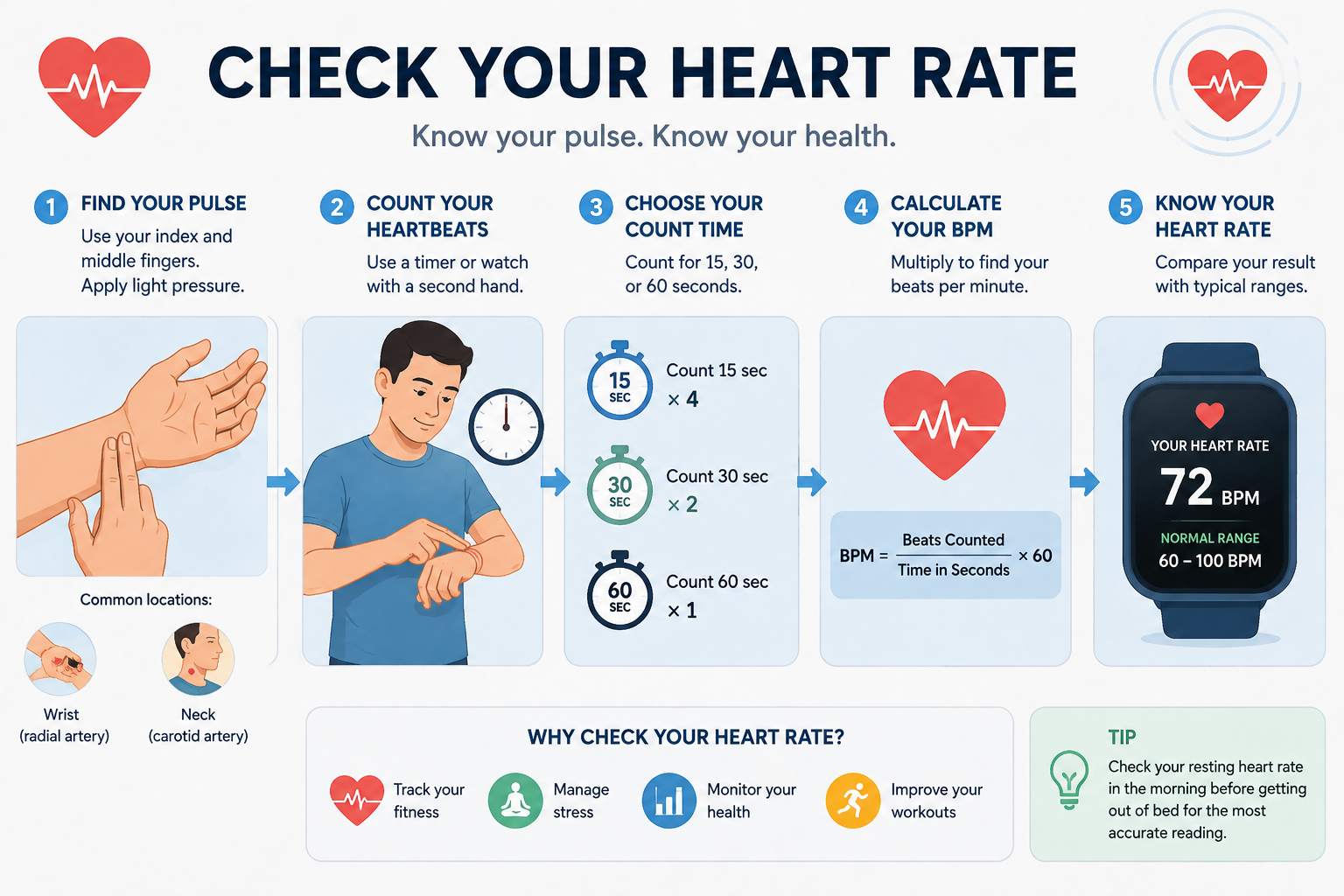
Checking your heart rate is a simple way to learn how quickly your heart is beating. You can measure it manually by feeling your pulse, or use a smartwatch, fitness tracker, or pulse oximeter.
For most people, the easiest method is to check the pulse at the wrist and count the beats for a set period. The result is usually expressed as beats per minute (BPM).
What Is Heart Rate?
Heart rate is the number of times your heart beats in one minute.
It changes naturally throughout the day. Your heart rate may be lower while you are resting and higher when you exercise, feel stressed, become excited, or experience illness.
A resting heart rate is most useful when measured while you are calm and at rest. For many adults, a resting rate between about 60 and 100 BPM is considered typical, although individual healthy rates can fall outside this range.
What Is Pulse Rate?
Your pulse is the rhythmic expansion of an artery caused by blood being pushed through it with each heartbeat. Pulse rate and heart rate are usually very similar, although they are not exactly the same measurement.
Heart Rate vs. Pulse Rate
In everyday situations, you can usually use your pulse to estimate your heart rate.
For example, if you count 72 pulses in one minute, your estimated heart rate is 72 BPM.
The distinction becomes more important in some abnormal rhythms, where not every electrical heartbeat produces an equally strong pulse.
How to Check Your Pulse Manually
The wrist is usually the easiest place to check your pulse.
Checking Your Pulse at the Wrist
The radial pulse is located on the thumb side of your wrist.
To check it:
- Sit quietly for a few minutes if you want your resting heart rate.
- Turn one hand palm-up.
- Place the index and middle fingers of your other hand on the thumb side of the wrist.
- Move your fingers gently until you feel a regular tapping sensation.
- Do not press too hard.
- Once you find the pulse, count the beats for a chosen amount of time.
Using two fingers is preferable to using your thumb because your thumb has its own noticeable pulse.
Checking Your Pulse at the Neck
You can also check the carotid pulse at the side of your neck.
Place your index and middle fingers gently beside the windpipe, in the soft area between the throat and the neck muscles. Find the pulse without pressing firmly.
Do not press both sides of the neck at the same time.
If the wrist pulse is easy to find, it is generally the simpler option for routine self-checking.
How to Count Heartbeats
Once you can feel a steady pulse, you need to count the beats and convert them to beats per minute.
There are three common approaches.
Counting for 15 Seconds
Count your pulse for 15 seconds and multiply the number of beats by 4.
For example:
18 beats × 4 = 72 BPM
This is quick but can be less reliable if your rhythm is irregular.
Counting for 30 Seconds
Count for 30 seconds and multiply the result by 2.
For example:
36 beats × 2 = 72 BPM
This gives a little more information than a 15-second count.
Counting for 60 Seconds
Count every beat for a full 60 seconds.
This is the most straightforward method because the number you count is already the BPM.
For example:
72 beats in 60 seconds = 72 BPM
How to Calculate BPM From Your Pulse
The general formula is:
BPM = number of beats counted × 60 ÷ number of seconds counted
Examples:
| Counting time | Beats counted | Estimated heart rate |
|---|---|---|
| 15 seconds | 18 | 72 BPM |
| 30 seconds | 36 | 72 BPM |
| 60 seconds | 72 | 72 BPM |
For a regular rhythm, shorter counts can provide a useful quick estimate. For an irregular rhythm, counting for a full minute is generally preferable.
Try the Heart Rate Calculator(/health/heart-rate-calculator)
The Heart Rate Calculator can help you calculate beats per minute and explore other heart-rate estimates.
How to Measure Resting Heart Rate
If you want to measure your resting heart rate, choose a time when you are relaxed and have not just exercised.
A practical approach is to:
- Sit quietly for several minutes before measuring.
- Avoid checking immediately after exercise.
- Measure at a similar time when comparing readings.
- Record the result if you are tracking changes over time.
Your resting heart rate can vary from one day to another. Stress, poor sleep, illness, caffeine, medications, dehydration, and other factors can temporarily affect it.
A single reading is therefore less informative than a pattern observed over time.
Best Time to Check Your Heart Rate
For a resting heart rate, measure while relaxed and use similar conditions when comparing readings. For exercise, measure during or after activity when you want to understand your exercise response.
Using a Smartwatch or Fitness Tracker
Smartwatches and fitness trackers can estimate heart rate automatically using sensors on the skin.
They can be convenient because they allow you to monitor heart rate during rest, daily activity, and exercise without manually counting your pulse.
However, a wearable reading is still an estimate. Movement, loose contact, sensor position, skin conditions, and device design can affect readings.
Using a Pulse Oximeter
A pulse oximeter is usually placed on a fingertip. It uses light to estimate blood oxygen saturation and typically displays a pulse rate as well.
The FDA notes that pulse oximeter readings can be affected by factors such as poor circulation, skin temperature, skin pigmentation, tobacco use, and fingernail polish.
Because of these limitations, do not rely on a pulse-oximeter number alone to determine whether you are medically well. Consider the reading alongside your symptoms and how you feel.
How Accurate Are Wearable Heart-Rate Monitors?
Wearable devices can be useful for tracking trends, but readings can be affected by movement, sensor contact, device position, activity type, and individual differences. For medical decisions, use appropriate equipment and professional guidance.
Factors That Can Temporarily Change Heart Rate
Heart rate can change with exercise, stress, emotions, caffeine, alcohol, poor sleep, dehydration, illness, medications, and changes in body position. An isolated reading should therefore be interpreted cautiously.
Why Heart Rate Changes During Exercise
During exercise, muscles require more oxygen and nutrients. The cardiovascular system responds by increasing blood flow, and heart rate normally rises.
The amount of increase depends on exercise intensity, fitness, age, environmental conditions, and individual physiology.
As you stop or reduce the intensity of exercise, your heart rate should generally begin to decrease during recovery.
For exercise-related calculations, the(/health/heart-rate-calculator) can help estimate target ranges and other heart-rate values.
When an Unusual Heart Rate May Warrant Medical Attention
An unusual heart-rate reading is not automatically a sign of a serious problem.
However, medical evaluation may be appropriate when an unusually fast, slow, or irregular heartbeat is persistent, repeatedly occurs, or is accompanied by symptoms.
Seek urgent medical attention for severe or new symptoms such as chest pain, fainting, severe difficulty breathing, or significant dizziness.
If your heart rate seems unusual but you feel well, repeat the measurement while resting and discuss persistent concerns with a healthcare professional.
Do not use an online calculator or smartwatch reading to diagnose a heart condition.
Summary
Learning how to check your heart rate is straightforward.
You can:
- Find your pulse at the wrist or neck.
- Count the beats for 15, 30, or 60 seconds.
- Convert the count to BPM.
- Use a full 60-second count when the rhythm is irregular.
- Compare readings taken under similar conditions when tracking trends.
Smartwatches, fitness trackers, and pulse oximeters provide convenient alternatives, but their readings are estimates and can have limitations.
Your heart rate naturally changes with exercise, stress, illness, sleep, hydration, medications, and other factors. If an unusual reading is persistent or occurs with concerning symptoms, seek appropriate medical advice.
For a quick calculation, use the(/health/heart-rate-calculator). You can also explore the(/health/bmr-calculator) and(/health/calorie-calculator) for related health and fitness estimates.
References
American Heart Association. (2024). Target heart rates chart. https://www.heart.org/en/healthy-living/fitness/fitness-basics/target-heart-rates
American Heart Association. (2024). All about heart rate. https://www.heart.org/en/healthy-living/fitness/fitness-basics/target-heart-rates
U.S. Food and Drug Administration. (2024). Pulse oximeter basics. https://www.fda.gov/consumers/consumer-updates/pulse-oximeter-basics
U.S. Food and Drug Administration. (2025). Pulse oximeters for medical purposes: Non-clinical and clinical performance testing, labeling, and premarket submission recommendations. https://www.fda.gov/regulatory-information/search-fda-guidance-documents/pulse-oximeters-medical-purposes-non-clinical-and-clinical-performance-testing-labeling-and
National Health Service. (2024). How to check your pulse. https://www.nhs.uk/conditions/heart-attack/symptoms/