
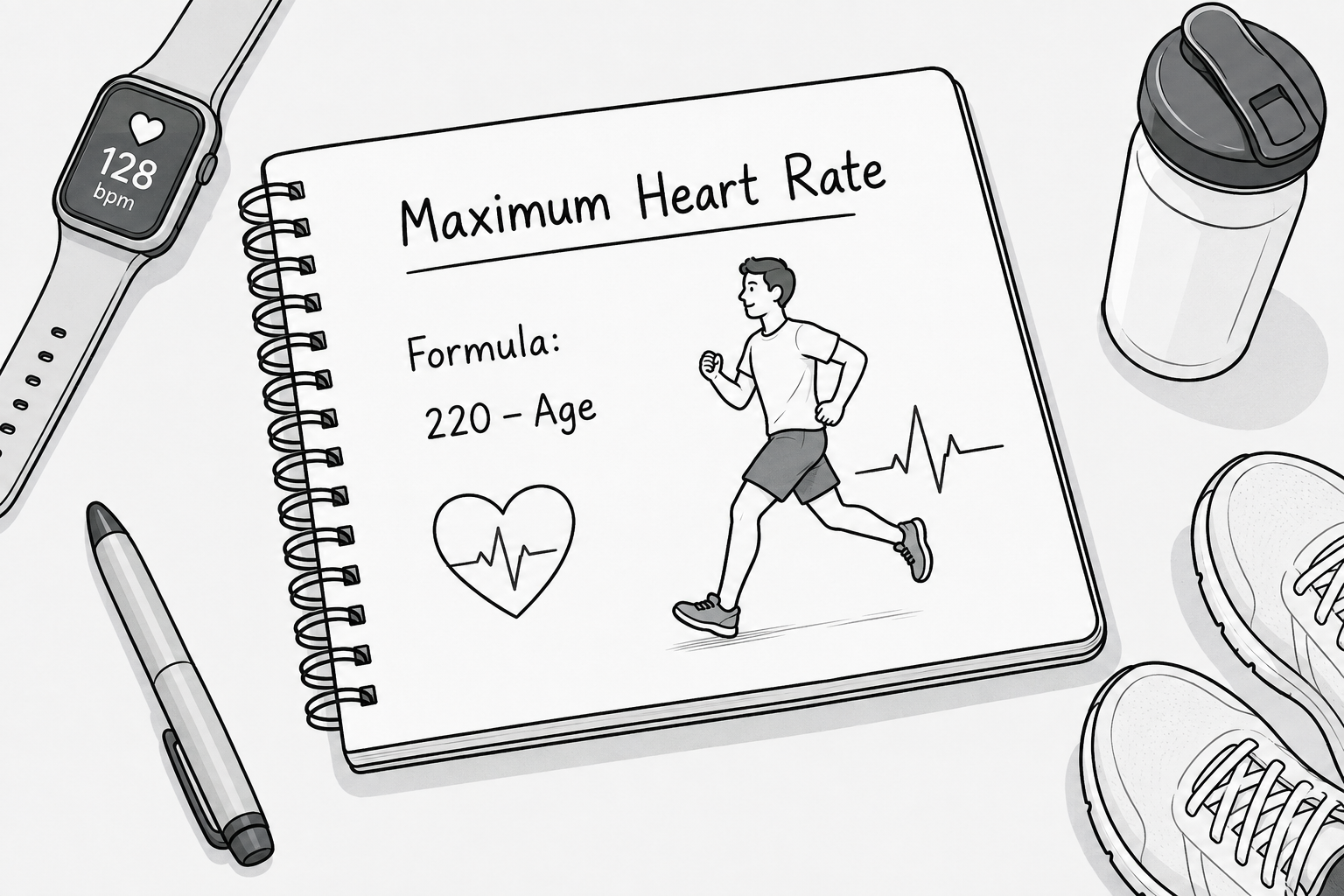
Your heart rate changes as your body responds to exercise. The harder you work, the faster your heart generally beats to deliver oxygen to working muscles. Knowing your estimated maximum heart rate can help you understand exercise intensity and create approximate training zones.
A max heart rate calculator usually estimates this number from your age. It is useful for general exercise planning, but it is not a measurement of your actual maximum heart rate.
What Is Maximum Heart Rate?
Maximum heart rate, often written as HRmax, is the highest heart rate you reach during maximal physical effort.
It is different from your resting heart rate, which is the number of times your heart beats per minute when you are relaxed. It is also different from your target heart rate, which is a range used to guide exercise intensity.
Actual HRmax varies between people. Age is strongly associated with it, but an age-based formula cannot predict an individual's exact value.
How to Estimate Maximum Heart Rate
The familiar formula is:
Maximum heart rate = 220 − age
For a 40-year-old:
220 − 40 = 180 bpm
The 220 minus age formula is widely known, but research has produced other equations.
A widely cited alternative from Tanaka, Monahan, and Seals is:
Maximum heart rate = 208 − (0.7 × age)
For a 40-year-old:
208 − (0.7 × 40) = 180 bpm
The Tanaka study analyzed data from 351 studies involving 18,712 subjects and found a strong relationship between age and maximum heart rate. [1]
Maximum Heart Rate Formulas
There is no single formula that predicts every person's maximum heart rate perfectly.
Common formulas include:
| Formula | Example for age 40 |
|---|---|
| 220 − age | 180 bpm |
| 208 − (0.7 × age) | 180 bpm |
| 207 − (0.7 × age) | 179 bpm |
Formula results can differ, and predicted HRmax can vary meaningfully from measured values. [2][3]
For general exercise planning, an age-based estimate can be useful. If an accurate measurement is medically or professionally important, a supervised exercise test can provide a direct measurement rather than relying on a formula.
Age-Based Maximum Heart Rate Estimates
Age is one of the strongest predictors used in common HRmax formulas.
For example, using 220 − age:
| Age | Estimated maximum heart rate |
|---|---|
| 20 | 200 bpm |
| 30 | 190 bpm |
| 40 | 180 bpm |
| 50 | 170 bpm |
| 60 | 160 bpm |
| 70 | 150 bpm |
These are estimates, not limits that every person will reach.
The Tanaka formula produces slightly different results for some ages. This is one reason two max HR calculators can display different numbers while both use scientifically studied equations.
Why Maximum Heart Rate Differs Between People
Two people of the same age can have different measured maximum heart rates.
Individual physiology contributes to this variation, with studies showing a wide spread around predicted values. [2][3]
Factors that can affect heart-rate response include:
- Age
- Medications
- Health conditions
- Exercise testing protocol
- Individual physiology
- Environmental conditions
- Training status
Being highly fit does not necessarily mean having a higher maximum heart rate.
Maximum Heart Rate vs. Target Heart Rate
Your maximum heart rate is a reference value. Your target heart rate is a range based on a percentage of that reference.
For example, if your estimated HRmax is 180 bpm:
- 50% = 90 bpm
- 60% = 108 bpm
- 70% = 126 bpm
- 80% = 144 bpm
- 90% = 162 bpm
ACSM describes percentage-of-HRmax as one method for monitoring exercise intensity.
Try the Heart Rate Calculator
Calculate Your Heart Rate and Training Zones
Use the Heart Rate Calculator to estimate your maximum heart rate and related training ranges from your age.
How to Calculate Training Zones From Maximum Heart Rate
A simple percentage-based approach is:
Target heart rate = estimated maximum heart rate × training intensity
For example, with an estimated HRmax of 180 bpm:
180 × 0.70 = 126 bpm
That represents 70% of estimated maximum heart rate.
ACSM also recognizes perceived exertion and other methods, so a target zone is a guide rather than a precise boundary.
Why Maximum Heart Rate Is an Estimate
An age-based maximum heart rate calculator does not measure your heart at maximal exertion. It applies a statistical equation developed from groups of people.
For example, a 50-year-old may receive an estimate of 170 bpm, while a supervised exercise test could produce a meaningfully higher or lower measured value.
Age-predicted equations have substantial individual error, so calculated HRmax should not be treated as a hard physiological ceiling.
Can Your Maximum Heart Rate Change?
Maximum heart rate generally declines with age. Your measured value can also vary with medication, health status, testing protocol, and other factors. Changes in fitness do not necessarily produce a predictable change in HRmax.
If you notice unusual heart-rate responses during exercise, especially with symptoms such as chest discomfort, fainting, unusual shortness of breath, or palpitations, stop exercising and seek appropriate medical advice.
Why Fitness Level Does Not Necessarily Determine Maximum Heart Rate
It is a common misconception that a very fit person should automatically have a higher maximum heart rate.
Maximum heart rate is strongly related to age, while habitual physical activity has not been shown to substantially change the age-based relationship in the foundational Tanaka research.
Training can improve cardiovascular fitness and performance without simply raising HRmax.
How a Maximum Heart Rate Calculator Works
A max HR calculator generally follows a simple process:
- You enter your age.
- The calculator applies a maximum-heart-rate equation.
- It returns an estimated HRmax in beats per minute.
- Training zones can then be calculated from that estimate.
Different calculators may use different equations, so results can vary.
The Heart Rate Calculator performs this calculation for you.
Summary
Your maximum heart rate is the highest heart rate you reach during maximal effort, but an age-based formula can only estimate it.
Common approaches include:
- 220 − age
- 208 − (0.7 × age)
- Other validated age-based equations
The 220-minus-age formula is simple and familiar, while the Tanaka equation is supported by a large meta-analysis and is commonly used as an alternative. [1]
Remember that your calculated HRmax is not a guaranteed personal maximum. Individual variation can be substantial, so use the number as a training guide rather than a precise physiological limit.
For a quick estimate, use the Heart Rate Calculator. You can also explore the Calorie Calculator and BMR Calculator for additional exercise and energy-use estimates.
References
American College of Sports Medicine. (2024). Tips for monitoring aerobic exercise intensity. https://www.acsm.org/docs/default-source/files-for-resource-library/exercise-intensity-infographic.pdf
Centers for Disease Control and Prevention. (2018). Physical activity guidelines for Americans, 2nd edition. U.S. Department of Health and Human Services. https://www.cdc.gov/physical-activity/media/pdfs/Physical_Activity_Guidelines_2nd_edition.pdf
Tanaka, H., Monahan, K. D., & Seals, D. R. (2001). Age-predicted maximal heart rate revisited. Journal of the American College of Cardiology, 37(1), 153–156. https://doi.org/10.1016/S0735-1097(00)01054-8
Zhu, N., et al. (2010). Maximal heart rate prediction in adults that are overweight or obese. Journal of the American College of Cardiology, 55(16), 1760–1766. https://pubmed.ncbi.nlm.nih.gov/21116203/