
Your heart rate naturally rises as exercise becomes more demanding. Understanding this response can help you pace workouts, compare exercise intensity, and choose an appropriate effort for your goals.
Heart rate zones by age are commonly estimated from age-predicted maximum heart rate. These zones can be useful, but they are not exact physiological boundaries. Your actual response can differ because of fitness, medications, health, temperature, hydration, stress, and other factors.
What Are Heart Rate Zones?
Heart rate zones are ranges used to describe exercise intensity. They are usually expressed as a percentage of your estimated maximum heart rate (HRmax).
A simple five-zone model looks like this:
| Zone | Approximate % of HRmax | General intensity |
|---|---|---|
| Zone 1 | 50–60% | Very light |
| Zone 2 | 60–70% | Light to moderate |
| Zone 3 | 70–80% | Moderate |
| Zone 4 | 80–90% | Vigorous |
| Zone 5 | 90–100% | Very high |
Different training systems use different percentages and zone definitions, so the labels should be treated as a general framework.
How Heart Rate Zones Are Calculated
Most basic calculations start with estimated maximum heart rate.
A commonly used equation is:
Maximum heart rate = 220 − age
For a 40-year-old:
220 − 40 = 180 bpm
A 70% training intensity would then be:
180 × 0.70 = 126 bpm
A more personalized method can use heart rate reserve, which incorporates resting heart rate:
Target HR = resting HR + [(maximum HR − resting HR) × intensity]
For example, with a maximum heart rate of 180 bpm and resting heart rate of 60 bpm, 70% intensity gives:
60 + [(180 − 60) × 0.70] = 144 bpm
These approaches can produce different results because they measure intensity differently.
Heart Rate Zones by Age
Using the simple 220-minus-age method, estimated zones can be illustrated as follows:
| Age | Estimated HRmax | 50% | 60% | 70% | 80% | 90% |
|---|---|---|---|---|---|---|
| 20 | 200 | 100 | 120 | 140 | 160 | 180 |
| 30 | 190 | 95 | 114 | 133 | 152 | 171 |
| 40 | 180 | 90 | 108 | 126 | 144 | 162 |
| 50 | 170 | 85 | 102 | 119 | 136 | 153 |
| 60 | 160 | 80 | 96 | 112 | 128 | 144 |
| 70 | 150 | 75 | 90 | 105 | 120 | 135 |
These numbers are estimates. A person's actual maximum heart rate may be meaningfully higher or lower than an age-based prediction.
Try the Heart Rate Calculator
Calculate Your Heart Rate Zones
Use the Heart Rate Calculator to estimate your maximum heart rate and exercise ranges.
What Is the Fat-Burning Zone?
The term fat-burning zone is commonly used to describe lower-to-moderate exercise intensities at which a relatively large proportion of the energy used during exercise comes from fat.
This does not mean that exercising only in this zone is the best way to lose body fat.
Your body uses a mixture of fat and carbohydrate for energy, and the proportion changes with exercise intensity and duration.
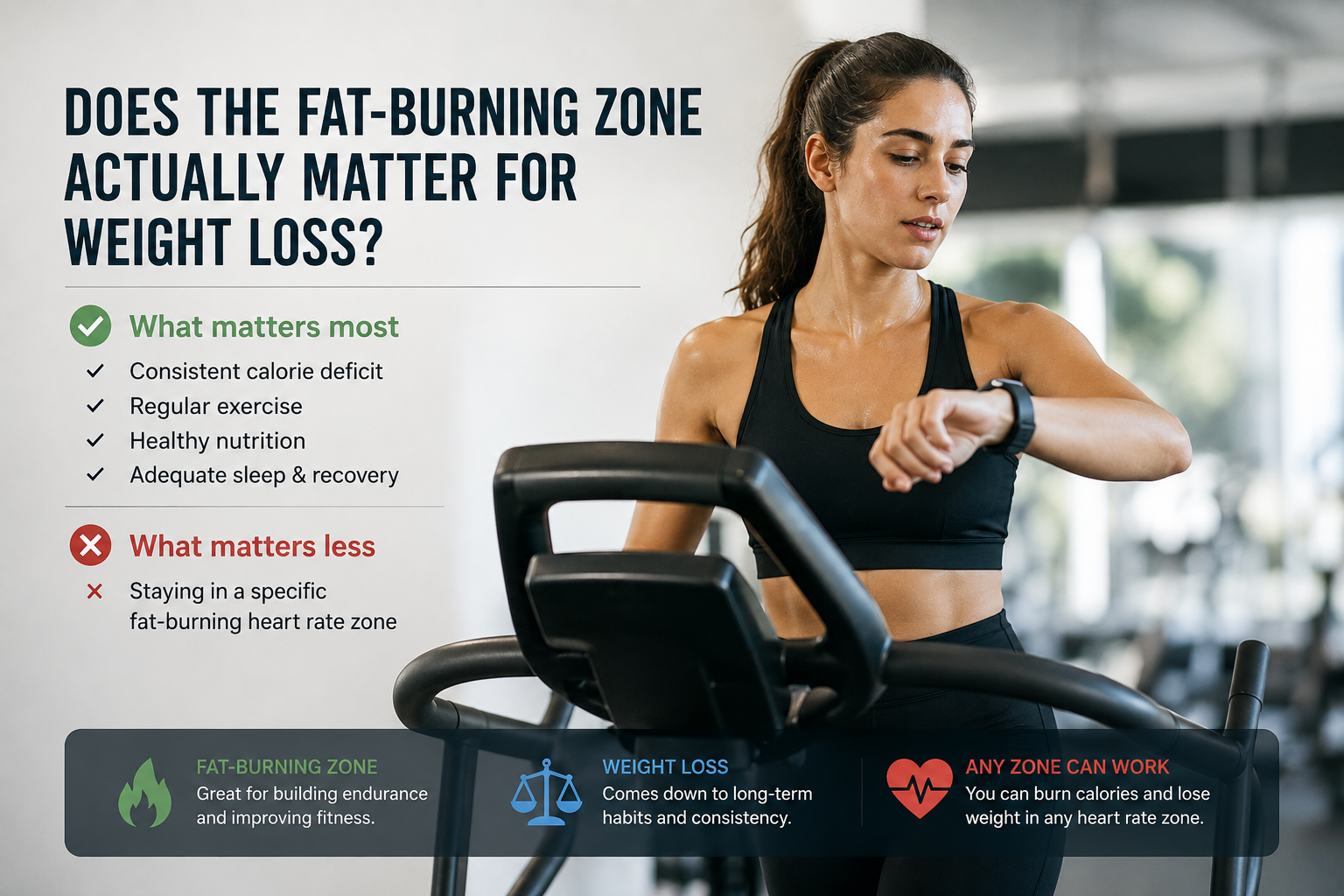
Does the Fat-Burning Zone Matter for Weight Loss?
The idea of a special fat-burning zone can be misleading.
Lower-intensity exercise may use a higher proportion of fat as fuel, while higher-intensity exercise can increase total energy expenditure and use more carbohydrate. Weight change over time depends on overall energy balance rather than simply maximizing the percentage of calories coming from fat during one workout.
If your goal is weight management, regular physical activity, nutrition, sleep, and sustainable habits all matter.
Use the Calorie Calculator for energy estimates and the Body Fat Calculator for a separate body-fat estimate.
Heart Rate and Calorie Expenditure
Heart rate can rise as exercise intensity increases, but heart rate is not a direct measurement of calories burned.
Calorie expenditure depends on factors such as:
- Body size
- Exercise type
- Exercise duration
- Exercise intensity
- Fitness level
- Individual physiology
Fitness watches and exercise machines often estimate calories using heart rate and other information. These values should be treated as estimates rather than exact measurements.
Resting Heart Rate vs. Exercise Heart Rate
Resting heart rate is measured when you are relaxed and provides information about your cardiovascular state at rest.
Exercise heart rate reflects how your cardiovascular system responds to physical activity.
They serve different purposes.
A person may have a relatively low resting heart rate but still have an age-predicted maximum heart rate similar to another person of the same age.
Some training methods use resting heart rate together with HRmax to calculate heart-rate reserve and target ranges.
How Maximum Heart Rate Determines Training Zones
Maximum heart rate provides the upper reference point for percentage-based zones.
For example, if estimated HRmax is 180 bpm:
- 60% = 108 bpm
- 70% = 126 bpm
- 80% = 144 bpm
- 90% = 162 bpm
This creates approximate boundaries for different exercise intensities.
However, age-based maximum heart rate formulas have individual error. Research has shown that predicted HRmax can differ substantially from measured values in individual adults.
For a deeper explanation, read How to Calculate Your Maximum Heart Rate.
How Target Heart Rate Relates to Heart Rate Zones
Target heart rate and heart rate zones are closely related.
A target heart rate is usually a specific number or range you aim for during an activity. A heart rate zone describes a broader intensity category.
For example, a workout may have a target of 120–140 bpm, which could correspond to a particular zone depending on your estimated HRmax.
See Target Heart Rate Calculator: How to Find Your Training Zone for more information.
Using a Heart Rate Monitor
A heart-rate monitor can help you observe changes during exercise.
Common options include:
- Fitness watches
- Chest-strap monitors
- Other wearable sensors
To use one effectively:
- Estimate your zones.
- Start gradually.
- Observe your heart rate.
- Compare it with how the exercise feels.
- Adjust effort when appropriate.
Do not assume that the monitor's number is perfectly accurate or that you must remain inside one exact zone throughout a workout.
Why Heart Rate Zones Are Estimates
Your actual exercise heart rate may differ from a calculated zone because age-based formulas estimate HRmax from population data rather than measuring your individual maximum.
Heart rate can also be influenced by temperature, hydration, illness, stress, sleep, caffeine, medications, exercise duration, and environmental conditions.
During prolonged aerobic exercise, heart rate can also gradually change even when external workload remains similar.
How Fitness Level Affects Exercise Heart Rate
Fitness can influence how your body responds to a given workload.
A trained person may perform the same exercise at a lower heart rate than someone less conditioned, while training can improve endurance and workload capacity.
However, greater fitness does not automatically mean a higher maximum heart rate.
This distinction is important: exercise heart rate at a given workload and maximum heart rate are different measurements.
Summary
Heart rate zones by age provide a simple framework for understanding exercise intensity.
A common five-zone model ranges from approximately 50% of estimated maximum heart rate in Zone 1 to 90–100% in Zone 5. The actual boundaries vary between training systems.
The so-called fat-burning zone should also be viewed carefully: the percentage of energy coming from fat during exercise is not the same as long-term fat loss.
For a practical starting point, use the Heart Rate Calculator to estimate your heart-rate zones. You can also use the Calorie Calculator, BMR Calculator, and Body Fat Calculator for additional health and fitness estimates.
References
American College of Sports Medicine. (2024). Tips for monitoring aerobic exercise intensity. https://www.acsm.org/docs/default-source/files-for-resource-library/exercise-intensity-infographic.pdf
American College of Sports Medicine. (2022). “Mind the drift” of HR for accurate exercise intensity implementation in prolonged aerobic exercise. https://acsm.org/hr-drift-prolonged-aerobic-exercise/
Centers for Disease Control and Prevention. (2022). Physical activity guidelines for Americans, 2nd edition. U.S. Department of Health and Human Services. https://www.cdc.gov/physical-activity/media/pdfs/Physical_Activity_Guidelines_2nd_edition.pdf
Tanaka, H., Monahan, K. D., & Seals, D. R. (2001). Age-predicted maximal heart rate revisited. Journal of the American College of Cardiology, 37(1), 153–156. https://doi.org/10.1016/S0735-1097(00)01054-8