
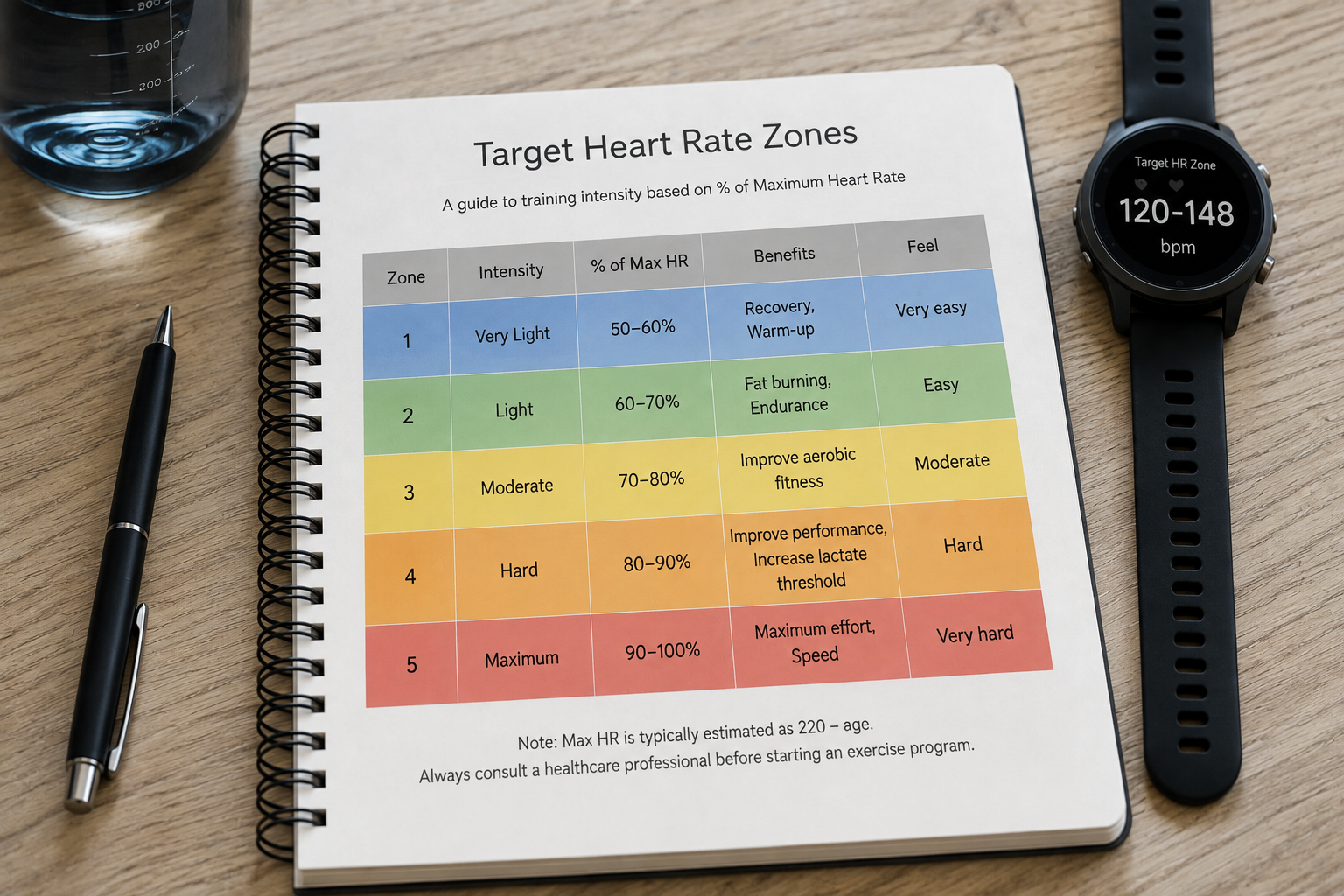
Your heart rate gives you useful information about how hard your body is working during exercise. A target heart rate calculator can help turn an estimated maximum heart rate into a practical range for aerobic workouts.
Instead of asking only how fast your heart is beating, a target range helps you understand whether an activity is relatively easy, moderate, or vigorous for you. These calculations are estimates, so they work best as one tool alongside perceived effort and other signs of exercise intensity.
What Is Target Heart Rate?
Target heart rate is a range of heart rates used to guide exercise intensity.
For example, if your estimated maximum heart rate is 180 beats per minute (bpm), exercising at 60% to 70% of that estimate would give a target range of 108 to 126 bpm.
A target range is a practical guide for pacing aerobic exercise, not a medical requirement.
What Is a Target Heart Rate Range?
A target heart rate range is usually expressed as a percentage of estimated maximum heart rate.
A simple formula is:
Target heart rate = maximum heart rate × exercise intensity
If your estimated maximum heart rate is 180 bpm:
- 50% = 90 bpm
- 60% = 108 bpm
- 70% = 126 bpm
- 80% = 144 bpm
- 90% = 162 bpm
The exact ranges used by calculators and exercise programs can differ because they may use different formulas or definitions of intensity.
Target Heart Rate vs. Maximum Heart Rate
Maximum heart rate and target heart rate are related but not the same.
Maximum heart rate (HRmax) is an estimate of the highest heart rate you could reach during maximal effort.
Target heart rate is a range below that maximum used to guide exercise.
For example, a person with an estimated HRmax of 180 bpm might have a target exercise range of 108–144 bpm depending on the workout goal.
For more information about calculating HRmax, see How to Calculate Your Maximum Heart Rate.
How to Calculate Target Heart Rate
The simplest approach uses estimated maximum heart rate.
First calculate maximum heart rate:
Maximum heart rate = 220 − age
Then multiply that estimate by the desired exercise intensity.
For a 40-year-old:
220 − 40 = 180 bpm
At 70% intensity:
180 × 0.70 = 126 bpm
At 80%:
180 × 0.80 = 144 bpm
So the estimated 70%–80% target range would be 126–144 bpm.
The American College of Sports Medicine describes percentage of maximum heart rate as one method of monitoring aerobic exercise intensity, alongside measures such as perceived exertion and the talk test.
How Age Affects Target Heart Rate
Age is included in many target heart rate calculations because estimated maximum heart rate generally declines with age.
For example, using the 220-minus-age equation:
| Age | Estimated HRmax | 60% | 70% | 80% |
|---|---|---|---|---|
| 20 | 200 bpm | 120 | 140 | 160 |
| 30 | 190 bpm | 114 | 133 | 152 |
| 40 | 180 bpm | 108 | 126 | 144 |
| 50 | 170 bpm | 102 | 119 | 136 |
| 60 | 160 bpm | 96 | 112 | 128 |
These numbers are estimates rather than personal physiological limits.
Different maximum-heart-rate formulas can produce different results. This means two target HR calculators may give slightly different ranges for the same person.
Resting Heart Rate and Target Heart Rate
Resting heart rate is the number of times your heart beats per minute while you are relaxed. It provides different information from maximum heart rate.
Some target-heart-rate methods use heart rate reserve (HRR), which incorporates both resting and maximum heart rate.
The Karvonen-style approach is:
Target HR = resting HR + [(maximum HR − resting HR) × intensity]
For example, suppose:
- Maximum HR = 180 bpm
- Resting HR = 60 bpm
- Desired intensity = 70%
First calculate heart rate reserve:
180 − 60 = 120
Then:
60 + (120 × 0.70) = 144 bpm
This approach accounts for resting heart rate and can produce a different target than simply taking a percentage of maximum heart rate.
Try the Heart Rate Calculator
Calculate Your Target Heart Rate
Use the Heart Rate Calculator to estimate maximum heart rate and target exercise ranges.
Moderate-Intensity Exercise
Moderate-intensity exercise generally feels challenging but sustainable.
The CDC describes moderate relative intensity as about 5 or 6 on a 0-to-10 effort scale. Another practical method is the talk test: during moderate activity, you can generally talk but not sing.
Examples can include:
- Brisk walking
- Easy cycling
- Recreational swimming
- Dancing
- Other activities that noticeably increase breathing and heart rate
People may reach moderate intensity at different heart rates because relative intensity depends on individual fitness and capacity.
Vigorous-Intensity Exercise
Vigorous exercise requires substantially more effort.
The CDC describes vigorous relative intensity as beginning around 7 or 8 on a 0-to-10 effort scale. During vigorous activity, you generally cannot say more than a few words without pausing for breath.
Examples can include:
- Running
- Fast cycling
- Vigorous swimming
- High-intensity aerobic exercise
- Strenuous sports
Heart-rate percentages can estimate intensity, but perceived effort remains useful when heart rate is affected by medication or other factors.
How to Tell If Exercise Intensity Is Appropriate
Heart rate is only one way to judge intensity.
The talk test is particularly useful. If you can talk comfortably but cannot sing, the activity is generally moderate. If you can only speak a few words before needing a breath, the activity is generally vigorous.
Perceived exertion is another option. On a 0-to-10 scale:
- 0 = resting
- 3–4 = moderate effort
- 5–7 = vigorous effort
- 10 = maximal effort
ACSM recommends considering perceived exertion alongside heart rate when monitoring aerobic exercise intensity.
Why Target Heart Rate Is an Estimate
A target heart rate calculator depends on an estimated maximum heart rate unless you have a directly measured HRmax.
Age-based maximum-heart-rate equations have individual error. ACSM notes that prediction equations can differ from direct measurement, with reported standard errors of estimate of roughly ±3 to 12 bpm depending on the equation and population.
This means your actual response may be above or below the calculated target.
For most general fitness planning, this does not make the calculation useless. It simply means the number should be treated as a guide.
Target Heart Rate for Beginners
If you are new to exercise, you do not need to immediately train at the upper end of a target range.
Starting at a comfortable intensity and increasing gradually can make exercise more manageable.
A beginner might focus first on:
- Maintaining a pace that feels sustainable
- Learning how their heart rate responds
- Using the talk test
- Building exercise consistency
- Gradually increasing duration or intensity
The CDC recommends regular physical activity and notes benefits from both moderate- and vigorous-intensity aerobic activity.
If you have a chronic health condition, symptoms during exercise, or concerns about whether vigorous exercise is appropriate, seek individualized medical advice.
How a Target Heart Rate Calculator Works
A target pulse rate calculator generally follows these steps:
- Uses your age to estimate maximum heart rate.
- Applies selected exercise-intensity percentages.
- Produces a target heart rate or range.
- May use resting heart rate if a heart-rate-reserve method is available.
This makes it easier to determine target heart rate without performing the calculations manually.
If two calculators give slightly different results, check which maximum-heart-rate formula and target-zone method each one uses.
Summary
A target heart rate calculator provides an estimate of the heart-rate range that may correspond to a chosen exercise intensity.
You can calculate a simple target by:
Target HR = estimated maximum HR × intensity
Another method uses resting heart rate and heart-rate reserve.
Remember that target heart rate is a guide, not an exact physiological boundary. Your perceived effort, breathing, fitness, medications, health status, and exercise conditions can all influence how exercise feels.
For a quick estimate, use the Heart Rate Calculator. You can also explore the Calorie Calculator and BMR Calculator for additional exercise and energy-use information.
References
American College of Sports Medicine. (2024). Tips for monitoring aerobic exercise intensity. https://www.acsm.org/docs/default-source/files-for-resource-library/exercise-intensity-infographic.pdf
American College of Sports Medicine. (2022). “Mind the drift” of HR for accurate exercise intensity implementation in prolonged aerobic exercise. https://acsm.org/hr-drift-prolonged-aerobic-exercise/
Centers for Disease Control and Prevention. (2022). Physical activity guidelines for Americans, 2nd edition. U.S. Department of Health and Human Services. https://www.cdc.gov/physical-activity/media/pdfs/Physical_Activity_Guidelines_2nd_edition.pdf
American College of Sports Medicine. (2023). We can and should do better when estimating cardiorespiratory fitness. https://acsm.org/estimating-cardiorespiratory-fitness/
Centers for Disease Control and Prevention. (2024). Tips for maintaining a healthy weight. https://www.cdc.gov/healthy-weight-growth/about/tips-for-balancing-food-activity.html