
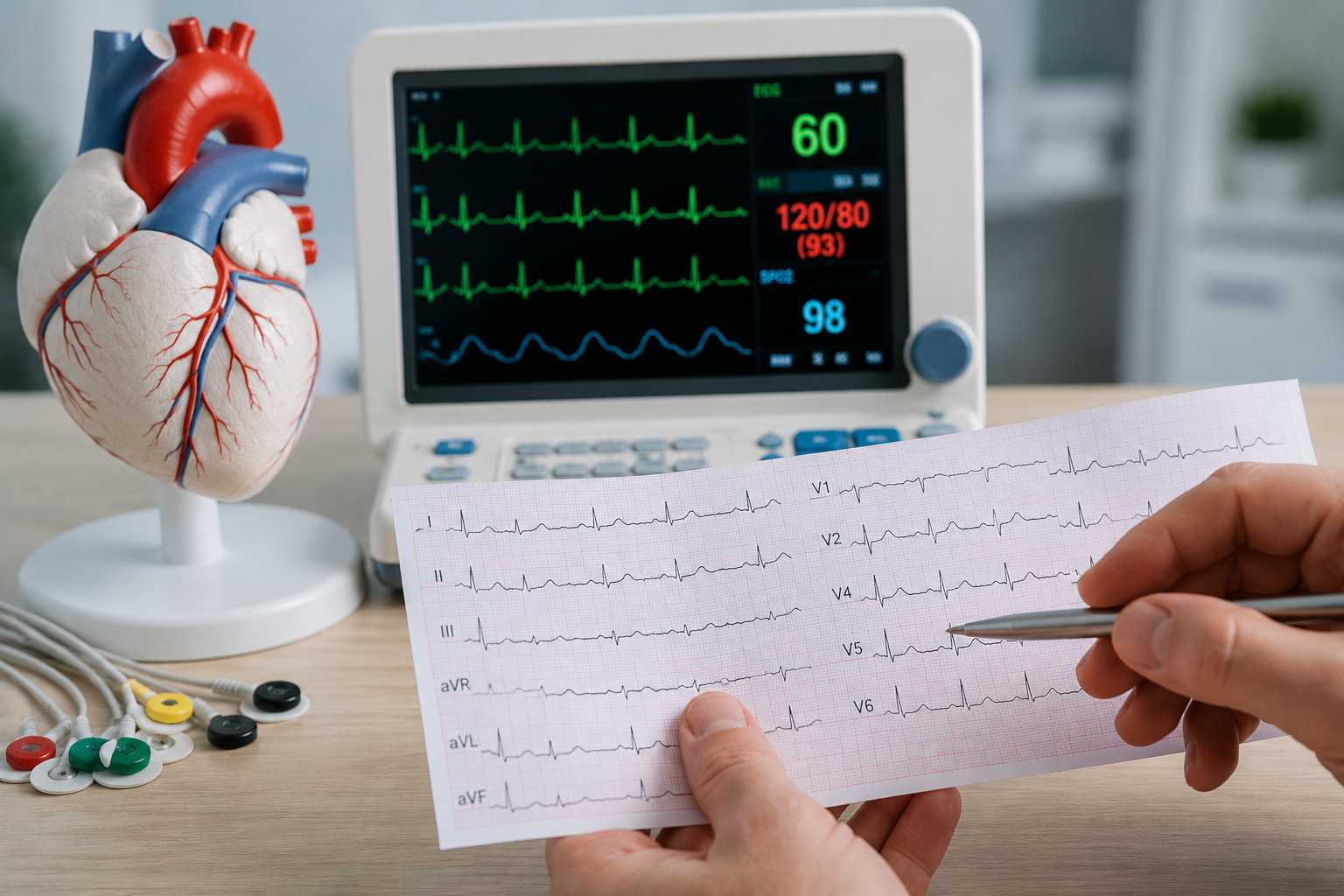
An ECG or EKG can show how quickly the heart is beating by recording its electrical activity over time. If you know how the ECG paper is scaled, you can estimate the heart rate by measuring the distance between successive heartbeats.
Learning how to calculate ECG heart rate is useful for understanding ECG basics and recognizing how clinicians estimate rate from a rhythm strip. However, calculating a number is different from interpreting the entire ECG. Rhythm, conduction, waveform changes, and symptoms also matter.
What Is an ECG or EKG?
An electrocardiogram, commonly called an ECG or EKG, is a test that records the heart's electrical activity. Electrodes attached to the skin detect electrical signals, and the ECG displays those signals as waveforms over time.
The NHLBI explains that an ECG can show how fast the heart is beating and whether the rhythm is steady or irregular. It is commonly used when evaluating abnormal heart rhythms and other heart conditions.
The terms ECG and EKG refer to the same type of test. ECG comes from "electrocardiogram," while EKG reflects the German spelling Elektrokardiogramm.
What Does an ECG Record?
An ECG records electrical activity rather than the pulse directly.
A typical heartbeat produces recognizable waves, including the P wave, QRS complex, and T wave. For heart-rate calculation, the R waves within successive QRS complexes are especially useful because the interval between them represents the time between ventricular depolarizations.
The distance between two consecutive R waves is called the R-R interval.
If the R-R intervals are regular, measuring one interval can provide a quick estimate of heart rate.
What Does Heart Rate Look Like on an ECG?
Heart rate is reflected by how frequently the QRS complexes appear across the ECG recording.
- QRS complexes close together generally indicate a faster rate.
- QRS complexes farther apart generally indicate a slower rate.
- Uneven spacing suggests an irregular rhythm.
The ECG machine may calculate and display a ventricular rate automatically, but understanding the manual method can help you check the basic calculation.
How Heart Rate Is Estimated From ECG Intervals
At the standard ECG paper speed of 25 mm per second:
- 1 small square = 0.04 seconds
- 1 large square = 0.20 seconds
- 5 large squares = 1 second
- 300 large squares = 1 minute
- 1,500 small squares = 1 minute
These relationships make the common 300 rule and 1500 rule possible.
If the ECG uses a different paper speed, these calculations must be adjusted.
The 300 Rule
The 300 rule is a quick method for a regular rhythm.
Count the number of large squares between two consecutive R waves, then calculate:
Heart rate = 300 ÷ number of large squares between R waves
For example, if there are 4 large squares between R waves:
300 ÷ 4 = 75 bpm
If there are 3 large squares:
300 ÷ 3 = 100 bpm
If there are 2 large squares:
300 ÷ 2 = 150 bpm
The 300 rule is fast and convenient, but it works best when the rhythm is regular.
The 1500 Rule
The 1500 rule uses small squares instead of large squares.
At 25 mm/s, calculate:
Heart rate = 1500 ÷ number of small squares between R waves
For example, if there are 20 small squares between two R waves:
1500 ÷ 20 = 75 bpm
If there are 15 small squares:
1500 ÷ 15 = 100 bpm
The 1500 method can provide a more precise estimate than the large-square method because it uses the smaller ECG grid.
Counting QRS Complexes
Another approach is to count QRS complexes over a known period.
If you have a 10-second rhythm strip, count the number of QRS complexes and multiply by 6:
Heart rate = QRS complexes in 10 seconds × 6
For example, if you count 12 QRS complexes:
12 × 6 = 72 bpm
This method can be useful when the rhythm is irregular because it averages the number of beats over a longer interval.
Calculating Heart Rate From an ECG With a Regular Rhythm
For a regular rhythm, the R-R interval remains approximately consistent.
A practical approach is:
- Identify two consecutive R waves.
- Check that the rhythm is reasonably regular.
- Count the large squares between the R waves.
- Divide 300 by the number of large squares.
For greater precision, count small squares and divide 1,500 by that number.
For example, suppose there are 18 small squares between R waves:
1500 ÷ 18 ≈ 83 bpm
The result is an estimate of the ventricular rate.
Estimating Heart Rate With an Irregular Rhythm
When the rhythm is irregular, relying on one R-R interval can be misleading.
Instead, count the QRS complexes over a fixed period, such as 10 seconds, and multiply by 6.
For example:
11 QRS complexes × 6 = 66 bpm
This gives an average rate over the measured period.
An irregular rhythm can require more than a simple rate calculation. The pattern and cause of the irregularity also need clinical interpretation.
Why ECG Heart-Rate Calculations Are Estimates
Manual ECG calculations depend on accurate measurement of the recording.
Small measurement differences can change the result, particularly when the R-R interval is short. Modern ECG machines can calculate ventricular rate automatically, but the displayed value should still be considered in the context of the actual ECG tracing and clinical situation.
ECG Heart Rate vs. Pulse Rate
ECG heart rate and pulse rate are related, but they are not always identical.
An ECG measures electrical activity. A pulse represents the mechanical effect of heartbeats that produces a pressure wave in the arteries.
In many regular rhythms, the ECG rate and pulse rate are very similar. However, some abnormal rhythms can produce electrical beats that do not generate an effective peripheral pulse.
This is one reason a heart-rate calculation from an ECG should not automatically be treated as the same thing as a manually measured pulse.
Common ECG Calculation Mistakes
Several simple errors can lead to an incorrect result when you calculate HR in ECG recordings.
Common mistakes include:
- Using the 300 rule with an irregular rhythm
- Forgetting to check the paper speed
- Counting the wrong ECG squares
- Measuring from the wrong points on the waveform
- Assuming every QRS complex represents a normal heartbeat
- Treating an automated ECG number as a complete interpretation
- Rounding too early during a precise calculation
Always confirm the ECG scale before applying a formula.
Why ECG Interpretation Should Be Performed by Trained Professionals
Calculating heart rate is only one small part of ECG interpretation.
A trained professional may also assess rhythm, P waves, PR interval, QRS duration, ST-segment changes, QT interval, electrical axis, and other waveform abnormalities.
ECG results should be interpreted in the context of symptoms, medical history, and the complete recording.
An EKG heart rate calculator can perform arithmetic, but it cannot independently determine whether an ECG is normal.
Try the Heart Rate Calculator
Use the Heart Rate Calculator for general heart-rate calculations and exercise-related estimates. It is not a substitute for professional ECG interpretation.
When an ECG Result Requires Medical Evaluation
An ECG may be performed because of symptoms such as palpitations, dizziness, fainting, chest discomfort, shortness of breath, or an unusually fast or slow heartbeat.
If an ECG has been performed and you have been told that the result is abnormal, discuss it with the healthcare professional who ordered or interpreted the test.
Seek urgent medical attention for severe or new symptoms such as significant chest pain, severe difficulty breathing, fainting, or other potentially serious symptoms.
Do not rely on a manual ECG rate calculation to decide whether an abnormal tracing is safe.
Summary
To calculate heart rate from an ECG, first confirm the ECG paper speed.
At the standard 25 mm/s speed:
- 300 rule: 300 ÷ large squares between R waves
- 1500 rule: 1500 ÷ small squares between R waves
- 10-second method: QRS complexes × 6
The 300 and 1500 rules work best for regular rhythms. For irregular rhythms, counting QRS complexes over a defined time period provides an average rate.
These methods can help you understand the arithmetic behind ECG rate calculation, but heart rate is only one part of ECG interpretation. A complete ECG should be assessed by an appropriately trained professional.
For general heart-rate calculations, use the Heart Rate Calculator.
References
National Heart, Lung, and Blood Institute. (2024). Heart tests: Electrocardiogram. National Institutes of Health. https://www.nhlbi.nih.gov/health/heart-tests
National Heart, Lung, and Blood Institute. (2022). Arrhythmias: Diagnosis. National Institutes of Health. https://www.nhlbi.nih.gov/health/arrhythmias/diagnosis
LITFL. (2024). ECG rate interpretation. Life in the Fast Lane Medical Blog. https://litfl.com/ecg-rate-interpretation/
National Heart, Lung, and Blood Institute. (2025). How the heart beats. National Institutes of Health. https://www.nhlbi.nih.gov/health/heart/heart-beats