
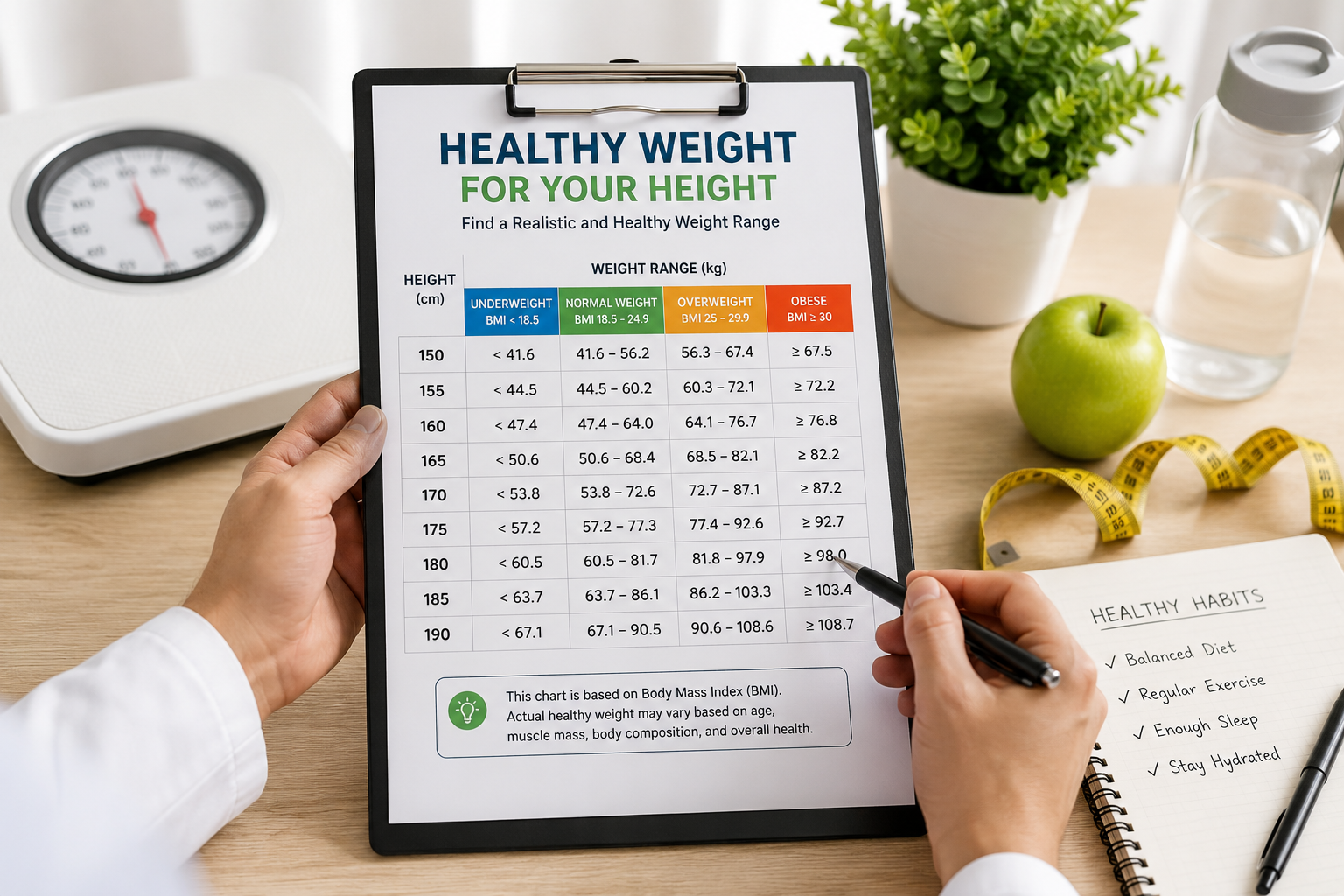
Healthy Weight for Your Height: How to Find a Realistic Weight
If you are searching for a healthy body weight for my height, you may expect a calculator or chart to give you one exact number. In reality, healthy weight is better understood as a range and depends on more than height alone.
Height is important because body weight needs to be interpreted in relation to stature. For adults, BMI (body mass index) is one common screening tool used to relate weight to height. A BMI from 18.5 to less than 25 is classified as the standard healthy-weight category.
What Is a Healthy Weight?
A healthy weight is not simply the number printed on a bathroom scale. It is a body weight that, considered in the context of height, body composition, and other health factors, is not associated with unnecessary health risk.
For adults, BMI provides a practical starting point because it relates weight to height. The standard categories are:
| BMI | Adult category |
|---|---|
| Below 18.5 | Underweight |
| 18.5–24.9 | Healthy weight |
| 25.0–29.9 | Overweight |
| 30.0 or higher | Obesity |
How Height Affects Healthy Weight
Height has a major effect on the weight associated with a particular BMI.
BMI is calculated as:
BMI = weight in kilograms ÷ height in meters²
If you rearrange the equation, you can estimate weight from a target BMI:
Weight = BMI × height²
Because height is squared, a taller person can weigh more than a shorter person while having the same BMI.
For example, consider two adults with a BMI of 22:
- At 1.60 m, weight is about 56.3 kg.
- At 1.80 m, weight is about 71.3 kg.
The BMI is the same, but the weights are different because the heights are different.
This is why a realistic weight chart should always identify the height being considered.
Healthy Weight vs. Ideal Weight
Healthy weight and ideal weight are related but are not the same measurement.
A BMI-based healthy-weight range describes several weights associated with the standard adult BMI category.
An ideal body weight estimate usually comes from a particular formula. Traditional formulas may use height and sex to produce one reference value.
For example, the Devine formula is commonly expressed as:
Men: 50 kg + 2.3 kg for each inch over 5 feet
Women: 45.5 kg + 2.3 kg for each inch over 5 feet
These equations produce estimates rather than universally accepted personal targets. Different ideal-weight formulas can also produce different results.
If you want a formula-based estimate, use the Howtigo Ideal Body Weight Calculator.
Can You Have a Perfect Weight?
There is no single perfect weight for your height that applies to every person.
Two people can have the same height but different:
- Muscle mass
- Body-fat percentage
- Bone structure
- Body frame
- Activity levels
- Health conditions
This is why "perfect weight" is better viewed as a convenient search term than as a precise medical concept.
How Age Affects Healthy Weight
Age can influence body weight and body composition, but there is no simple rule that says every person of a certain age should weigh a particular amount.
As adults age, muscle mass, physical activity, fat distribution, and other aspects of body composition can change.
Traditional adult ideal-weight equations generally do not include age directly. A formula may therefore give the same reference weight to two adults of the same height and sex even if their ages differ.
Age is better treated as context when interpreting weight rather than as a reason to assign a separate "perfect" number.
For children and adolescents, adult BMI categories should not be used. BMI is interpreted using age- and sex-specific growth references instead.
How Gender Affects Healthy Weight
Sex can influence body composition, and some traditional ideal-weight formulas use separate calculations for men and women.
For example, the Devine equation has different starting values for men and women. This means two adults of the same height can receive different formula-based ideal-weight estimates.
However, a sex-specific formula does not mean every man or every woman of the same height should weigh the same amount.
Individual differences in muscle mass, body-fat distribution, skeletal build, and activity remain important.
What Makes a Weight Realistic?
A realistic weight is more useful than an arbitrary target because it should fit your body and circumstances.
A realistic weight goal should consider:
- Your current height and weight
- Your current body composition
- Your activity level
- Your usual eating pattern
- Your age and sex
- Your health history
- Whether the goal can be maintained over time
Healthy Weight Ranges vs. a Single Target Weight
A range is often more useful than one target number.
For example, at 1.70 m, the approximate weight corresponding to BMI 18.5 is:
18.5 × 1.70² = 53.5 kg
At BMI 24.9:
24.9 × 1.70² = 71.9 kg
That gives an approximate BMI-based healthy-weight range of 53.5–71.9 kg for an adult who is 1.70 m tall.
The range is broad because BMI covers a range rather than one value.
Why Weight Charts Are Only Estimates
Weight charts are useful for quick reference, but they simplify human biology.
BMI has a similar limitation. CDC sources describe BMI as a useful screening measure but note that it does not distinguish fat from lean tissue.
Therefore, use a chart to understand a general range, not to decide whether your body is healthy based on one number.
How to Find a Healthy Weight for Your Height
If you want to find your healthy weight, you can start with your height and BMI.
For adults, the approximate BMI-based range can be calculated as:
Lower weight = 18.5 × height²
Upper weight = 24.9 × height²
For example, if you are 1.65 m tall:
Lower: 18.5 × 1.65² ≈ 50.4 kg
Upper: 24.9 × 1.65² ≈ 67.8 kg
This provides a mathematical reference range based on standard adult BMI categories.
You can also calculate your current BMI with the Howtigo BMI Calculator.
What About a Target Weight for Men?
A search for target weight for male often assumes that men of a particular height should have one standard weight.
For example, a 5'9" man is approximately 1.75 m tall. His weight corresponding to BMI 18.5 is about 56.7 kg, while BMI 24.9 corresponds to about 76.3 kg.
How to Use an Ideal Weight Calculator
An ideal-weight calculator can be useful when you want a quick formula-based estimate.
The Howtigo Ideal Body Weight Calculator can provide a formula-based reference.
You can then use the Howtigo BMI Calculator to see how your current weight relates to your height.
Summary
If you are looking for a healthy body weight for your height, avoid thinking of the answer as one perfect number.
Remember:
- Height strongly affects the weight associated with a given BMI.
- Adult BMI 18.5 to less than 25 is the standard healthy-weight category.
- BMI can help estimate a height-based weight range.
- Ideal body weight formulas provide separate reference estimates.
- Age and sex can affect body composition and interpretation.
- Two people of the same height can have different healthy weights.
- Muscle mass can make a person weigh more without necessarily having excessive body fat.
- Weight charts are useful references but are not personalized diagnoses.
- A realistic weight should be practical and sustainable for the individual.
For a quick estimate, use the Howtigo Ideal Body Weight Calculator together with the Howtigo BMI Calculator.
You can also view the Howtigo Ideal Weight Chart for a height-based reference.
References
Centers for Disease Control and Prevention. (2011). Body mass index: Considerations for practitioners. https://stacks.cdc.gov/view/cdc/25368
Centers for Disease Control and Prevention. (2017). National Health and Nutrition Examination Survey (NHANES): Anthropometry procedures manual. https://stacks.cdc.gov/view/cdc/51795
Centers for Disease Control and Prevention. (2021). National Health and Nutrition Examination Survey: 2021 anthropometry procedures manual. https://stacks.cdc.gov/view/cdc/127207
Flegal, K. M., Kit, B. K., & Graubard, B. I. (2014). Body mass index categories in observational studies of weight and risk of death. American Journal of Epidemiology, 180(3), 288–296. https://doi.org/10.1093/aje/kwu120
Pai, M. P., & Paloucek, F. P. (2000). The origin of the "ideal" body weight equations. The Annals of Pharmacotherapy, 34(9), 1066–1069. https://doi.org/10.1345/aph.19381