
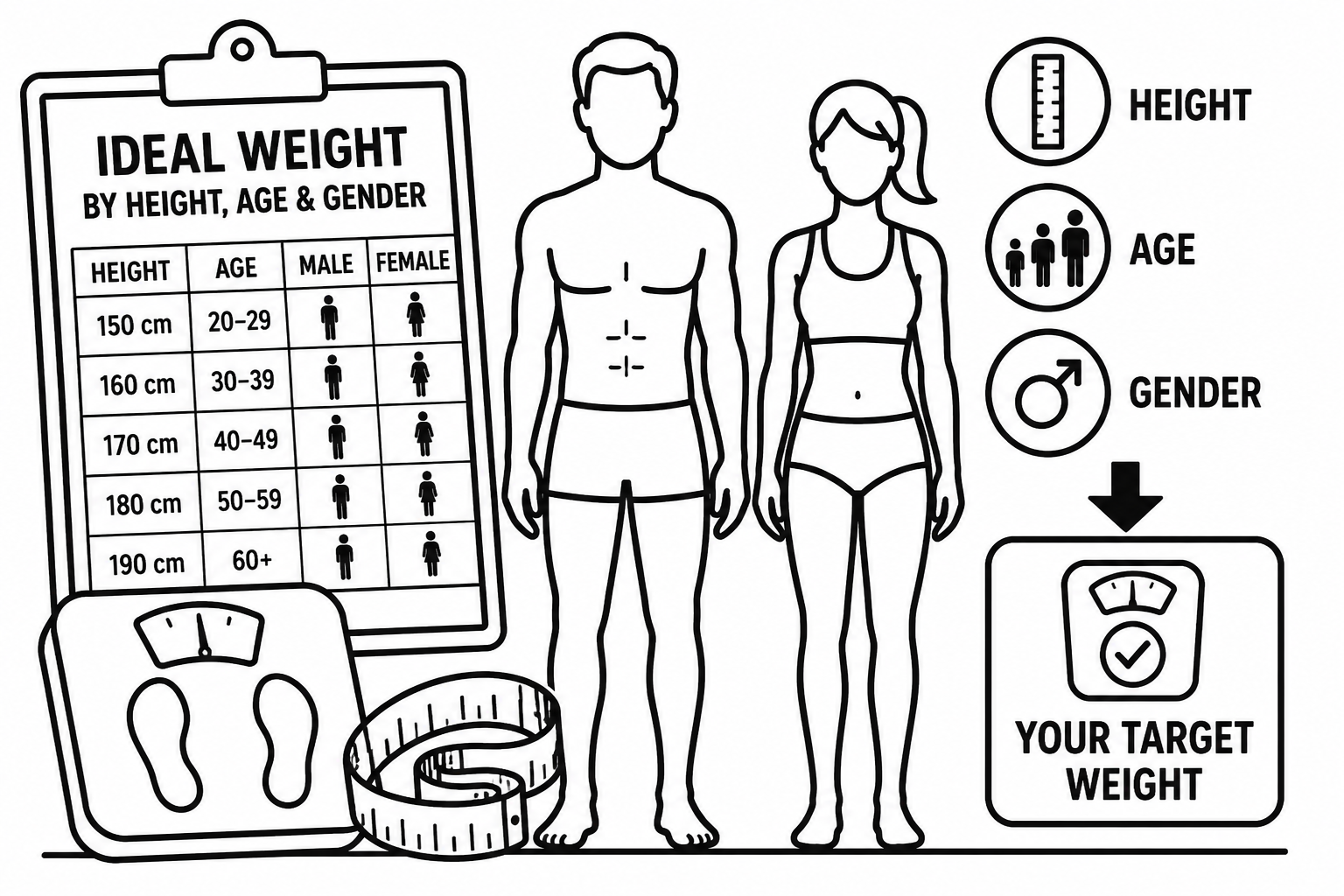
Ideal Weight by Height, Age and Gender: How to Calculate Your Target Weight
Height is the main measurement used in many traditional ideal body weight equations. Some formulas also use sex, while age is often used to interpret body composition and health rather than directly calculate adult ideal body weight.
BMI provides another way to evaluate weight in relation to height. For adults, a BMI from 18.5 to less than 25 is classified as the standard healthy-weight category.
This guide explains how to calculate a practical target-weight reference, how height, age, and gender affect the result, and why an ideal weight should be treated as an estimate rather than a required number.
How Height Affects Ideal Weight
Height is one of the most important inputs in traditional ideal body weight formulas.
A common example is the Devine formula:
Men:
IBW = 50 kg + 2.3 kg for each inch over 5 feet
Women:
IBW = 45.5 kg + 2.3 kg for each inch over 5 feet
For example, a man who is 5 feet 10 inches tall is 10 inches over 5 feet:
50 + (2.3 × 10) = 73 kg
The estimated ideal body weight is therefore 73 kg using the Devine equation.
A woman of the same height would have:
45.5 + (2.3 × 10) = 68.5 kg
How Age Affects Weight
Age is important when interpreting weight, but traditional adult ideal body weight formulas generally do not include age directly.
For example, two men who are both 5 feet 10 inches tall would receive the same Devine ideal-weight estimate even if one were 30 and the other 60.
Body composition can change with age. Muscle mass, physical activity, fat distribution, and other factors may change over adulthood. Therefore, the same scale weight can have different implications for people at different stages of life.
For adults, age is better considered as part of the broader health context rather than as a number to insert into a traditional ideal-weight equation.
For children and adolescents, adult ideal-weight formulas should not be used as a substitute for age- and sex-specific growth assessment.
How Gender Affects Weight
Many traditional ideal-weight equations use separate values for men and women.
Using the Devine equation, a 5-foot-6 adult would have these estimates:
- Man: 63.8 kg
- Woman: 59.3 kg
The difference comes from the equation's sex-specific starting value.
However, these estimates do not mean every man or woman at 5 feet 6 inches should weigh exactly these amounts. Individuals can differ substantially in muscle mass, body frame, body-fat percentage, and other characteristics.
Ideal Weight for Men
If you are looking for a target weight for male adults, a traditional ideal-weight formula can provide a starting reference.
For men:
IBW = 50 + (2.3 × inches over 5 feet)
Examples:
| Male height | Devine ideal-weight estimate |
|---|---|
| 5'4" | 59.2 kg |
| 5'6" | 63.8 kg |
| 5'8" | 68.4 kg |
| 5'10" | 73.0 kg |
| 6'0" | 77.6 kg |
How to Calculate Target Weight
For a BMI-based target, you can work backward from a selected BMI:
Weight = BMI × height²
For example, suppose an adult is 1.70 m tall and wants to know the weight corresponding to a BMI of 22:
22 × 1.70² = 63.6 kg
So 63.6 kg is the weight corresponding mathematically to a BMI of 22 at 1.70 m.
Ideal Weight vs. Target Weight
Ideal weight and target weight are not necessarily the same.
Ideal weight usually refers to a formula-based reference.
Target weight usually refers to a weight someone chooses or is advised to work toward based on a particular goal.
For example:
- A formula may estimate an ideal body weight of 68 kg.
- A person's current weight may be 82 kg.
- A healthcare professional or the individual may establish a gradual target that is different from 68 kg.
Healthy Weight vs. Ideal Weight
A healthy weight is broader than a formula-based ideal weight.
For adults, BMI can provide a standard screening framework. A BMI of 18.5 to less than 25 is classified as healthy weight.
You can estimate the weight associated with that BMI range by using:
Lower weight = 18.5 × height²
Upper weight = 24.9 × height²
For someone who is 1.70 m:
18.5 × 1.70² = 53.5 kg
24.9 × 1.70² = 71.9 kg
So the approximate BMI-based healthy-weight range is 53.5–71.9 kg.
Combining BMI and Ideal Weight
Using both measurements can provide more context than using either one alone.
Ideal body weight gives a formula-based reference.
BMI shows how your current weight relates to your height.
For example, suppose a 5-foot-10 man weighs 80 kg.
His Devine ideal-weight estimate is approximately 73 kg.
His height is about 1.778 m, so his BMI is:
80 ÷ 1.778² ≈ 25.3
That BMI is just above the standard healthy-weight category.
Use the Howtigo BMI Calculator to calculate your current BMI.
Why There Is No Single Perfect Weight
Searching for "a perfect weight for my height and age" suggests that one number should apply to everyone.
Human bodies are more variable than that.
People of the same height and age can have different:
- Muscle mass
- Body-fat percentages
- Bone structure
- Body frames
- Activity levels
- Medical histories
A muscular person may weigh more than a traditional ideal-weight estimate while having relatively low body fat.
Similarly, being close to an ideal-weight formula does not automatically mean someone has optimal health.
Example: Calculating a Target Weight
Consider a woman who is 5 feet 6 inches tall.
Using the Devine formula:
45.5 + (2.3 × 6) = 59.3 kg
Her estimated ideal body weight is 59.3 kg.
Now consider a BMI-based reference.
Her height is approximately 1.676 m.
At BMI 18.5:
18.5 × 1.676² ≈ 52.0 kg
At BMI 24.9:
24.9 × 1.676² ≈ 70.0 kg
So the standard adult healthy-BMI range is approximately 52.0–70.0 kg.
How to Use an Ideal Weight Calculator
An ideal weight calculator is useful when you want to avoid manually calculating the formula.
To use one:
- Enter your height accurately.
- Select the appropriate sex if required.
- Confirm the units.
- Calculate the ideal-weight estimate.
- Review which formula was used.
- Compare the result with your BMI and other relevant health information.
The Howtigo Ideal Body Weight Calculator can provide a formula-based estimate.
Summary
If you want to calculate your ideal weight and BMI, use the two measurements for their different purposes.
Key points:
- Height is a major input in traditional ideal-weight formulas.
- Many traditional formulas use separate equations for men and women.
- Age generally provides context rather than directly changing adult ideal-weight formulas.
- A BMI-based target can be calculated using weight = BMI × height².
- Ideal weight and target weight are not necessarily the same.
- Healthy weight is broader than one formula-based ideal weight.
- Combining BMI with an ideal-weight estimate provides more context.
- There is no single perfect weight for every person of a particular height and age.
- Muscle mass and body composition can affect how a weight should be interpreted.
- An ideal-weight calculator provides a reference estimate, not a prescription.
For a quick calculation, use the Howtigo Ideal Body Weight Calculator and compare the result with your BMI.
For the broader discussion of healthy weight by height, see Howtigo Healthy Weight for Your Height: How to Find a Realistic Weight.
References
Centers for Disease Control and Prevention. (2024). Adult BMI categories. https://www.cdc.gov/bmi/adult-calculator/bmi-categories.html
Centers for Disease Control and Prevention. (2011). Body mass index: Considerations for practitioners. https://stacks.cdc.gov/view/cdc/25368/
Centers for Disease Control and Prevention. (2017). National Health and Nutrition Examination Survey: Anthropometry procedures manual. https://stacks.cdc.gov/view/cdc/51795/
Pai, M. P., & Paloucek, F. P. (2000). The origin of the "ideal" body weight equations. The Annals of Pharmacotherapy, 34(9), 1066–1069. https://doi.org/10.1345/aph.19381
Shah, B., Sucher, K., & Hollenbeck, C. B. (2006). Comparison of ideal body weight equations and published height-weight tables with body mass index tables for healthy adults in the United States. Nutrition in Clinical Practice, 21(3), 312–319. https://pubmed.ncbi.nlm.nih.gov/16772549/