
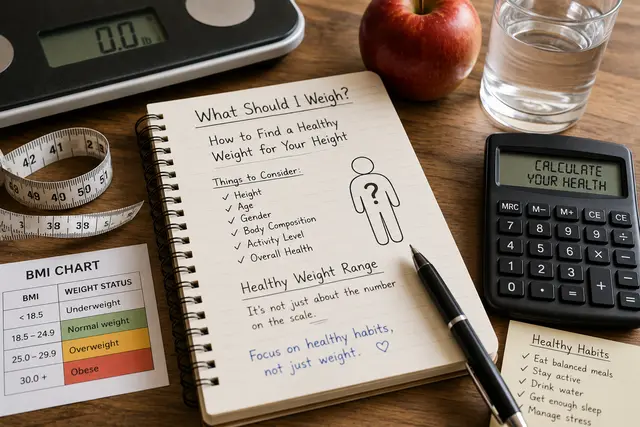
What Should I Weigh? How to Find a Healthy Weight for Your Height
If you have searched "what should I weigh?", you may be looking for a simple number based on your height. But healthy weight is better understood as a range than as one perfect number.
For adults, BMI (body mass index) can be used to estimate a standard healthy-weight range for a given height. An ideal body weight formula can provide a separate reference estimate. Neither method determines the one weight you must reach.
What Should You Weigh for Your Height?
There is no single weight that is automatically correct for everyone at a particular height.
Instead, a useful starting point is to calculate the adult BMI range considered healthy and see what weight range corresponds to your height.
For adults, a BMI from 18.5 to less than 25 is classified as the standard healthy-weight category.
Because BMI uses both height and weight, the corresponding weight range changes with height.
Healthy Weight vs. Ideal Weight
Healthy weight and ideal body weight are related but different ideas.
A healthy-weight range describes a range of body weights associated with a standard BMI category.
An ideal body weight calculation produces a formula-based reference value. Traditional formulas such as the Devine equation use height and, depending on the equation, sex.
For example, using the Devine formula:
Men: 50 kg + 2.3 kg for each inch over 5 feet
Women: 45.5 kg + 2.3 kg for each inch over 5 feet
The formula gives one estimated value, while BMI can provide a range.
How Height Affects Healthy Weight
Height has a strong effect on the weight associated with a particular BMI.
BMI is calculated as:
BMI = weight in kilograms ÷ height in meters²
Because height is squared in the equation, a taller person can weigh more while having the same BMI as a shorter person.
For example, consider an adult who is 1.60 m tall. The approximate weight corresponding to a BMI of 18.5 is:
18.5 × 1.60² = 47.4 kg
The weight corresponding to a BMI of 24.9 is:
24.9 × 1.60² = 63.7 kg
So, using the standard adult BMI range, an adult who is 1.60 m tall has an approximate healthy-BMI weight range of 47.4–63.7 kg.
This is a screening range, not a personal prescription.
How BMI Can Estimate a Healthy Weight Range
BMI can be used in reverse to estimate the weight range associated with a particular height.
The formula is:
Weight = BMI × height²
For the standard adult healthy-weight category, use BMI values from 18.5 through 24.9.
Example: 1.70 m Height
Suppose an adult is 1.70 m tall.
Lower end:
18.5 × 1.70² = 53.5 kg
Upper end:
24.9 × 1.70² = 71.9 kg
The approximate weight range associated with a BMI of 18.5–24.9 is therefore 53.5–71.9 kg.
A BMI calculator can perform this calculation automatically.
Use the Howtigo BMI Calculator to calculate your BMI from your height and current weight.
How to Find Your Ideal Body Weight
If you want to find your ideal body weight, you can use a traditional ideal body weight formula.
The Devine formula is one commonly referenced equation. For a person more than 5 feet tall, it adds a specified amount for each inch above 5 feet.
If you want to calculate a formula-based ideal weight, use the Howtigo Ideal Body Weight Calculator.
Why There Is No Single Perfect Weight
The idea of one "perfect weight" is appealing because it makes a complicated question seem simple. Human bodies are more variable than a single number can represent.
Two people who are the same height can have different:
- Muscle mass
- Body-fat percentages
- Bone structure
- Body frames
- Fat distribution
- Activity levels
- Medical histories
Both could be healthy at different body weights.
Why Healthy Weight Varies Between People
Height is only one part of the picture.
Their actual health cannot be determined from weight alone.
BMI itself is a screening measure and does not directly measure body fat.
How Age and Sex Can Affect Weight
Age does not appear directly in most traditional ideal body weight formulas, but it can affect how body weight and body composition change over time.
For children and teenagers, adult BMI categories should not be used. BMI for children is interpreted using age- and sex-specific growth references.
How Body Composition Affects Healthy Weight
Body composition is one of the most important reasons two people can have different healthy weights.
Muscle is denser than fat, and people who participate in resistance training or other sports may carry more lean mass.
For example, a muscular person may weigh more than an ideal-weight formula suggests while having a relatively low body-fat percentage.
Conversely, someone can have a BMI within the standard healthy-weight range but still have a relatively high proportion of body fat.
If you want another perspective on body composition, the Howtigo Body Fat Calculator can provide an estimate of body-fat percentage.
When to Use a Healthy-Weight Calculator
A healthy-weight calculator can be useful when you want a quick reference based on your height and current weight.
Example: Comparing Healthy Weight and Ideal Weight
Consider a woman who is 1.70 m tall.
Using BMI:
Healthy-BMI weight range ≈ 53.5–71.9 kg
These numbers do not conflict. They answer different questions.
The BMI calculation gives a range associated with the standard adult healthy-weight category, while the Devine equation provides one traditional reference estimate.
Summary
If you are asking "what should I weigh?", there is no single answer that applies to everyone.
The key points are:
- Height strongly affects the weight associated with a particular BMI.
- For adults, BMI 18.5 to less than 25 is the standard healthy-weight category.
- You can estimate a BMI-based weight range using weight = BMI × height².
- Ideal body weight formulas provide a separate reference estimate.
- Age and sex can affect body composition and how weight should be interpreted.
- Muscle mass and body composition can make two healthy people of the same height weigh differently.
- There is no universal perfect weight for a particular height.
- BMI is a screening tool and should be considered with other health information.
For a quick assessment, use the Howtigo BMI Calculator and Ideal Body Weight Calculator to compare the two approaches.
You can also view the Howtigo Ideal Weight Chart for a height-based reference.
Calculate Your Ideal Body Weight
References
Centers for Disease Control and Prevention. (2024). Adult BMI categories. https://www.cdc.gov/bmi/adult-calculator/bmi-categories.html
Centers for Disease Control and Prevention. (2011). Body mass index: Considerations for practitioners. https://stacks.cdc.gov/view/cdc/25368/
Centers for Disease Control and Prevention. (2017). National Health and Nutrition Examination Survey: Anthropometry procedures manual. https://stacks.cdc.gov/view/cdc/51795/
National Heart, Lung, and Blood Institute. (1998). Clinical guidelines on the identification, evaluation, and treatment of overweight and obesity in adults. National Institutes of Health. https://www.nhlbi.nih.gov/health-pro/guidelines/current/obesity-guidelines
Pai, M. P., & Paloucek, F. P. (2000). The origin of the "ideal" body weight equations. The Annals of Pharmacotherapy, 34(9), 1066–1069. https://doi.org/10.1345/aph.19381
Shah, B., Sucher, K., & Hollenbeck, C. B. (2006). Comparison of ideal body weight equations and published height-weight tables with body mass index tables for healthy adults in the United States. Nutrition in Clinical Practice, 21(3), 312–319. https://pubmed.ncbi.nlm.nih.gov/16772549/