
A BMI number is often presented as a quick way to understand whether your weight falls within a commonly used range for your height. But what do the numbers actually mean?
BMI categories provide a standardized way to classify weight in adults. They include underweight, healthy weight, overweight, and obesity. BMI is useful as a screening measure, but it does not tell the whole story about body composition or individual health.
What Is BMI?
Body mass index, or BMI, is a value calculated from your weight and height. For adults, it is calculated by dividing weight in kilograms by height in metres squared:
BMI = weight (kg) ÷ height² (m²)
For example, an adult weighing 70 kg and measuring 1.75 m tall has a BMI of about 22.9.
BMI is widely used because it is simple, inexpensive, and can be applied consistently across large populations. The World Health Organization describes BMI as a simple weight-to-height index used to classify underweight, overweight, and obesity in adults. [1]
What Are the BMI Categories?
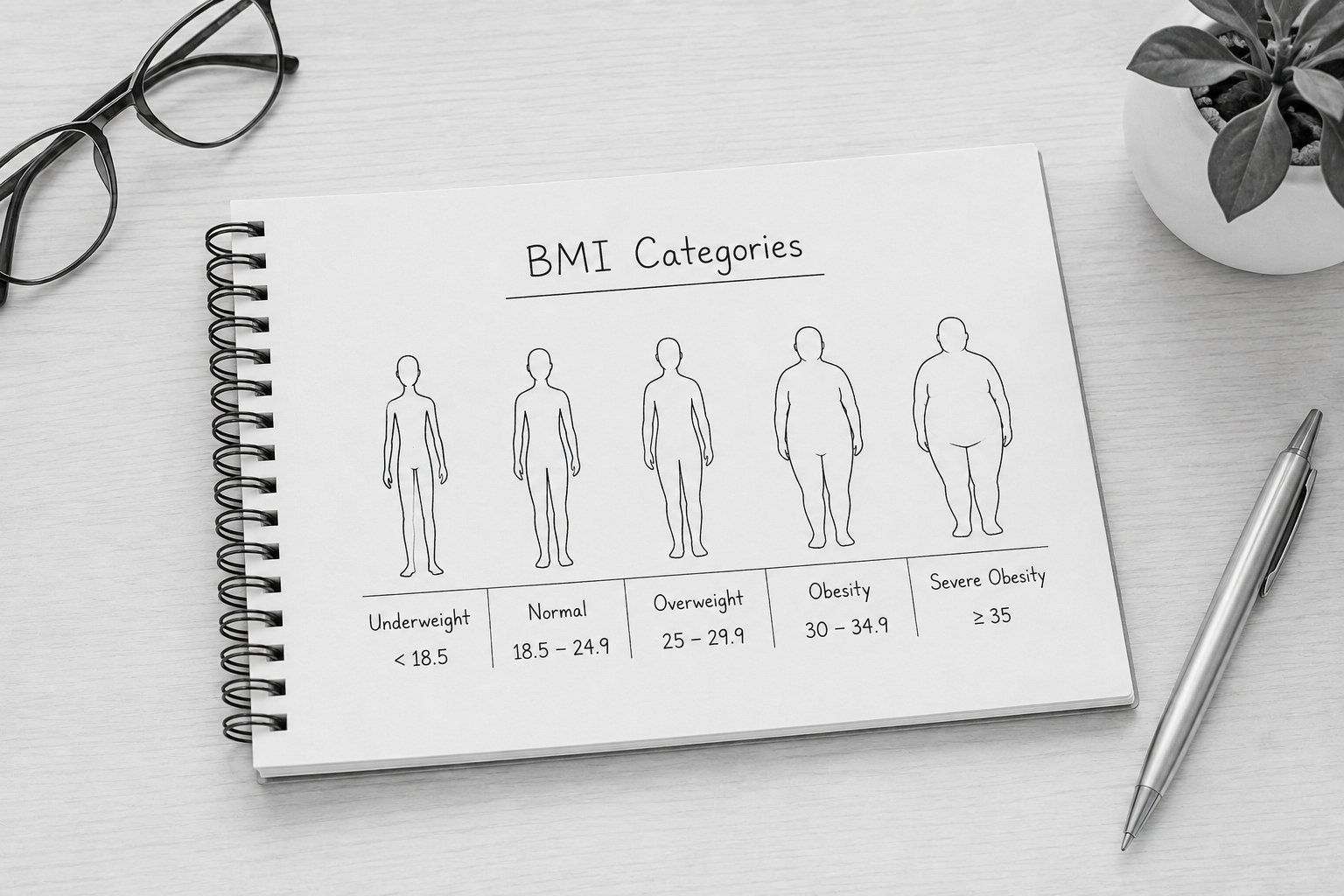
For most adults aged 20 and older, the commonly used BMI classification is:
| BMI | Category |
|---|---|
| Below 18.5 | Underweight |
| 18.5–24.9 | Healthy weight |
| 25.0–29.9 | Overweight |
| 30.0 or higher | Obesity |
These categories are used by organizations such as the National Heart, Lung, and Blood Institute and the World Health Organization. [1][2]
Some systems further divide obesity into classes:
- Class 1: BMI 30.0–34.9
- Class 2: BMI 35.0–39.9
- Class 3: BMI 40.0 or higher
A BMI category is a screening classification, not a diagnosis by itself.
Underweight BMI
An adult BMI below 18.5 falls into the underweight category.
A low BMI can sometimes be associated with inadequate nutrition or other health concerns, although BMI alone cannot identify the reason for a person's weight.
If your BMI is below the usual range, other information may be needed to understand your health, such as your diet, medical history, muscle mass, and recent changes in weight.
Healthy or Normal BMI
A BMI from 18.5 to 24.9 is generally classified as healthy weight for adults.
You may also see this range described as "normal BMI" or "normal weight." Health depends on many factors beyond height and weight, including physical activity, diet, blood pressure, blood glucose, cholesterol, sleep, medical history, and body composition.
Overweight BMI
A BMI from 25.0 to 29.9 is classified as overweight for adults.
Healthcare professionals may consider other measurements alongside BMI when evaluating weight-related health risk.
Obesity BMI Categories
A BMI of 30 or higher falls within the obesity category for adults.
The category is commonly divided into three classes:
| BMI | Obesity classification |
|---|---|
| 30.0–34.9 | Class 1 |
| 35.0–39.9 | Class 2 |
| 40.0+ | Class 3 |
Higher BMI levels are associated with increased risk for several health conditions at the population level. The WHO notes associations between overweight and obesity and conditions including cardiovascular disease, diabetes, and some cancers. [1]
However, an individual's health risk cannot be determined from BMI alone.
How BMI Categories Are Determined
BMI categories are based on ranges that have been established for adult populations.
The basic calculation uses only two measurements: weight and height. Once BMI is calculated, the result is compared with the established classification ranges.
For adults, age and sex do not change the standard BMI cutoffs used in the common adult classification system.
This is different from children and teenagers, whose BMI is interpreted using age- and sex-specific growth charts or percentiles rather than the adult categories. [2]
What Does a BMI Number Mean?
Your BMI number tells you which classification range your height and weight fall into.
For example:
- BMI 17.8: Underweight
- BMI 21.5: Healthy weight
- BMI 27.0: Overweight
- BMI 32.0: Obesity
Why BMI Is Used as a Screening Measure
BMI remains widely used because it is easy to calculate and does not require specialized equipment.
It can help healthcare professionals and researchers identify people who may benefit from a more detailed assessment. NHLBI describes BMI as a screening tool and notes that other measures, such as waist circumference, may also be used when evaluating health and weight-related risk. [2]
BMI and Health Risk
BMI categories can provide information about health risk at a population level.
As BMI rises above certain ranges, the likelihood of several weight-related conditions generally increases. However, risk varies from person to person.
Other factors can influence health risk, including:
- Waist circumference
- Blood pressure
- Blood glucose
- Cholesterol
- Physical activity
- Smoking
- Diet
- Family history
- Existing medical conditions
This is why a healthcare professional may use BMI alongside other measurements.
Is BMI the Same as Body Fat?
No. BMI is not the same as body-fat percentage.
BMI uses weight and height, but it does not directly measure how much of your weight comes from fat, muscle, bone, or other tissues.
For example, someone who does resistance training may have a relatively high amount of muscle and therefore a higher BMI without having the same body-fat level as another person with the same BMI.
If you want additional information about body composition, a Body Fat Calculator can provide an estimate using the measurements required by that tool.
Even body-fat estimates have limitations and should not be treated as exact measurements.
Limitations of BMI Classification
BMI is useful, but it has important limitations.
It does not directly measure:
- Body-fat percentage
- Where body fat is stored
- Muscle mass
- Bone density
- Overall fitness
- Metabolic health
BMI can therefore be less informative for some individuals, including people with unusually high muscle mass.
The WHO and NHLBI both emphasize that BMI should be interpreted appropriately and, when necessary, alongside other measures. [1][2]
BMI for Different Populations
Adult BMI categories should not automatically be applied to everyone.
For children and adolescents, BMI is interpreted according to age and sex because body composition changes during growth. The CDC and other health organizations use BMI-for-age percentiles for children and teenagers rather than adult BMI categories. [2]
BMI interpretation can also differ in some ethnic and clinical populations because health risks associated with a particular BMI may vary between groups.
For this reason, a BMI calculator should clearly indicate whether it is intended for adults or children.
How to Calculate Your BMI
You can calculate BMI manually or use an online tool.
The formula is:
BMI = weight in kilograms ÷ height in metres²
For example, if you weigh 80 kg and are 1.80 m tall:
80 ÷ (1.80 × 1.80) = 24.7
That result falls within the commonly used healthy-weight BMI range for adults.
For a faster calculation, use the BMI Calculator below.
Try the BMI Calculator
Enter your height and weight to get your BMI and see which adult category your result falls into.
How a BMI Calculator Can Help
A BMI calculator makes the calculation faster and reduces the chance of arithmetic errors.
It can be useful for:
- Checking your current BMI
- Understanding BMI categories
- Comparing BMI results over time
- Starting a conversation about weight-related health
- Learning how height and weight affect BMI
For broader health tracking, you can also explore the Ideal Weight Calculator, Calorie Calculator, and BMR Calculator.
Remember that these tools provide estimates or screening information. They do not replace an individualized medical assessment.
Summary
BMI categories provide a simple classification system for adult weight status:
- Below 18.5: underweight
- 18.5–24.9: healthy weight
- 25.0–29.9: overweight
- 30.0 or higher: obesity
BMI is useful because it is simple and standardized, but it is not a direct measure of body fat or a complete measure of health.
Your BMI number is best understood as one piece of information. Factors such as waist circumference, body composition, blood pressure, blood glucose, fitness, diet, and medical history can provide additional context.
Use the BMI Calculator to calculate your BMI, then consider the result alongside the bigger picture of your health.
References
National Heart, Lung, and Blood Institute. (2024). Overweight and obesity: Symptoms and diagnosis. National Institutes of Health. https://www.nhlbi.nih.gov/health/overweight-and-obesity/symptoms
National Heart, Lung, and Blood Institute. (2026). Calculate your BMI. National Institutes of Health. https://www.nhlbi.nih.gov/calculate-your-bmi
World Health Organization. (2025). Obesity and overweight. https://www.who.int/news-room/fact-sheets/detail/obesity-and-overweight
World Health Organization. (2025). Nutrition: Maintaining a healthy lifestyle. WHO Regional Office for Europe. https://www.who.int/europe/news-room/fact-sheets/item/nutrition---maintaining-a-healthy-lifestyle